News
VRA hospital campaigns against cervical cancer

- /home/u249204778/domains/spectator.com.gh/public_html/wp-content/plugins/mvp-social-buttons/mvp-social-buttons.php on line 27
https://spectator.com.gh/wp-content/uploads/2023/01/Dr-Valmont-addressing-participants-at-the-durbar.jpg&description=VRA hospital campaigns against cervical cancer', 'pinterestShare', 'width=750,height=350'); return false;" title="Pin This Post">
- Share
- Tweet /home/u249204778/domains/spectator.com.gh/public_html/wp-content/plugins/mvp-social-buttons/mvp-social-buttons.php on line 72
https://spectator.com.gh/wp-content/uploads/2023/01/Dr-Valmont-addressing-participants-at-the-durbar.jpg&description=VRA hospital campaigns against cervical cancer', 'pinterestShare', 'width=750,height=350'); return false;" title="Pin This Post">
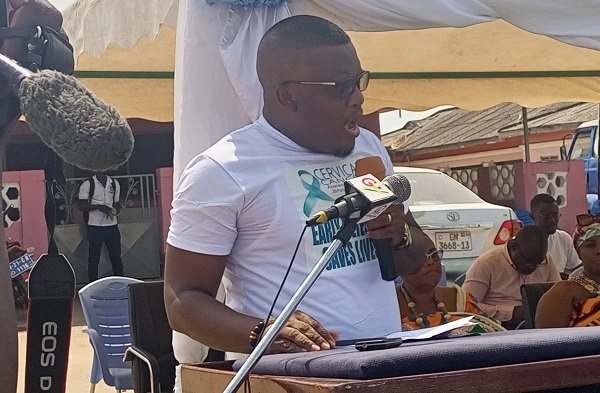
• Dr Valmont(Inset) addressing participants at the durbar
The Volta River Authority (VRA) Hospital in the Aboadze enclave of the Western Region has set itself to eradicate cervical cancer by 2100, in tandem with World Health Organisation (WHO) targets.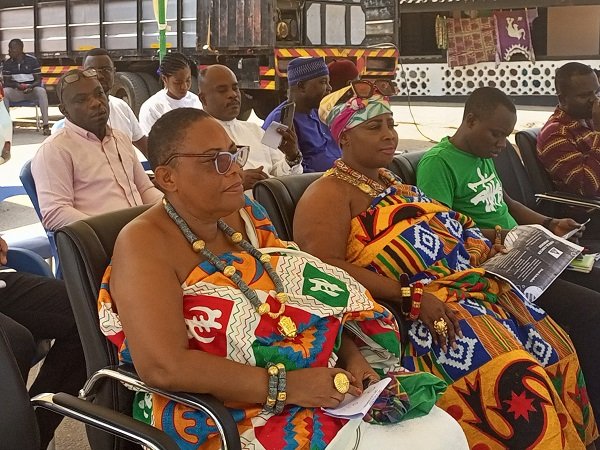
As part of this, the hospital has intensified public education includ ing durbars, medical conference among staff, screening and vaccination of women against the disease that killed about 47,500 in 2020, globally.
On Tuesday, staff of the hospital assisted by management, organised a float from Aboadze through Abuesi, Shama and Inchaban to Aboadze, for durbar to climax the cervical cancer awareness Month which falls on January each year. This year’s theme is “Get informed, get screened, get vaccinated”.
The Medical Superintendent of VRA Hospital, Aboadze, Dr Taurus Valmont, noted that, although, much had been said about cancer of the cervix, it remained a major cause of cancer death in the world.
Dr Valmont said the fight against cervical cancer had been a major objective of VRA medical directorate as it had intensified screening, vaccination and treatment of precancerous conditions at its health establishments.
“The cost of screening is reduced by 50 percent. Screening is done at the VRA Hospital every Wednesday, although, vaccination can be done on every working day. I would like to reiterate the commitment or the VRA to improve health delivery to the communities in the districts.
“I have to say that cervical cancer is still a major killer in our communities. Let’s all come together, get informed and ensure that our women are screened and vaccinated to help eradicate cancer of the cervix,”he said.
District Director of Health, Ms Naa Deide Okai, explained that cervical cancer affected the entrance of the vagina and the uterus, stressing “it could be eradicated.”
She said the cancer affected women and that almost 99 percent of cases were due to human tumour virus commonly transmitted through sex.
Cervical cancer, Ms Okai told the gathering, was the sixth most commonly cancers in women and that 89,500 got infected in 2020.
She advised women aged 30- 45 on the need to be screened and also repeat screening periodically, saying that the girl child between ages nine and 14, could also get vaccinated.
For 2023, she said, the WHO conference held in Cairo, Egypt, on January 13 , had set a 70 percent screening coverage for women between age 35 and 45 and 90 percent treatment for cervical cancer and management for women with cancer by 2030.
On preventive measures, she streesed “safe sex practices including abstinences,being faithful to one’s partner and the use of condom if one cannot abstain.
The Queen mother of Aboadze, Nana Korbabo III, praised the VRA campaign to reduce cervical cancer and encouraged women to participate in sensitisation programmes.
From Clement Adzei Boye, Aboadze

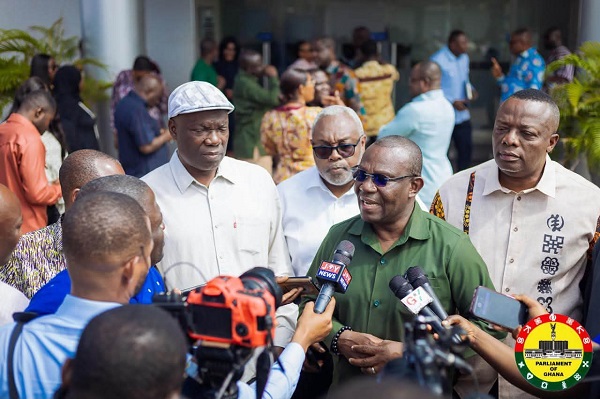
The Parliamentary Select Committee on Energy has appealed to the Ministry of Finance to release GH¢5.6 million to the Petroleum Commission to enable it to establish and operate a world-class data centre.
According to the Committee, access to the funds will strengthen the Commission’s capacity to manage critical upstream petroleum data and improve its operations.
Speaking during the appeal, Chairman of the Committee, Emmanuel Kwasi Bedzrah, said the move was crucial to efforts to revitalise Ghana’s upstream petroleum industry and increase oil production.
He noted that although investment and hydrocarbon production had declined in recent years, Parliament’s approval of an extension of the petroleum agreement to 2030 had attracted additional funding and contributed to an increase in production from about 80,000 to 120,000 barrels per day.
Meanwhile, concerns have been raised over repeated budget allocations for oil exploration in the Voltaian Basin.
Mr. Bedzrah stressed that funds approved for exploration must produce tangible results, adding that the Committee would require clear evidence of progress before supporting future budget allocations for the programme.
The appeal was made during a working visit to the Petroleum Commission as part of the Committee’s oversight activities to assess its operations and management procedures.
During the engagement, the Chief Executive Officer of the Petroleum Commission, Emeafa Hardcastle, took the Committee through the Commission’s working procedures and mandate, which includes regulating, managing and coordinating upstream petroleum activities.
She disclosed that since assuming office in 2025, government had pursued measures to reverse the decline in crude oil production, sustain output and reposition Ghana as an attractive destination for investment in Africa’s increasingly competitive petroleum sector.
In addition, she said government had secured fresh commitments of about US$35 billion to help revitalise the sector.
As part of the oversight exercise, the Committee is expected to conclude its monitoring visit with engagements at the National Petroleum Authority (NPA) and the Ghana Oil Company Limited (GOIL).
By Edem Mensah-Tsotorme
News
“No civilisation deserves to be annihilated” – Mahama calls for dialogue on global conflicts at UNGA 81

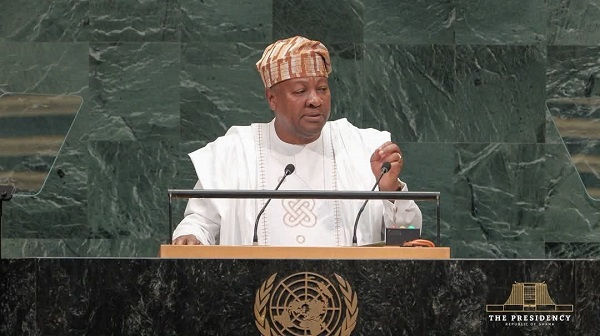
President John Dramani Mahama has called for solidarity and dialogue in resolving global conflicts, insisting that no civilisation deserves to be wiped out.
“No human civilisation deserves to be annihilated, certainly not a member state of the United Nations,” President Mahama stated in his address at the 81st United Nations General Assembly in New York.
He called for solidarity with nations facing terrorism, especially the Alliance of Sahel States (AES), and for a uniform approach to conflicts in Europe, the Middle East and Africa.
On the Middle East, the President called for a return to negotiations, saying “The current Middle East crisis is having a deleterious effect on the world economy.”
“I believe that dialogue can resolve even the most intractable of problems,” he added.
By Edem Mensah-Tsotorme