News
Nearly 5,000 MSMEs apply for COVID-19 business support fund


- /home/u249204778/domains/spectator.com.gh/public_html/wp-content/plugins/mvp-social-buttons/mvp-social-buttons.php on line 27
https://spectator.com.gh/wp-content/uploads/2020/05/NBSSI-Kosi-Yankey-Ayeh-NBSSI-boss.jpg&description=Nearly 5,000 MSMEs apply for COVID-19 business support fund', 'pinterestShare', 'width=750,height=350'); return false;" title="Pin This Post">
- Share
- Tweet /home/u249204778/domains/spectator.com.gh/public_html/wp-content/plugins/mvp-social-buttons/mvp-social-buttons.php on line 72
https://spectator.com.gh/wp-content/uploads/2020/05/NBSSI-Kosi-Yankey-Ayeh-NBSSI-boss.jpg&description=Nearly 5,000 MSMEs apply for COVID-19 business support fund', 'pinterestShare', 'width=750,height=350'); return false;" title="Pin This Post">
The National Board for Small Scale Industries (NBSSI) has received close to 5,000 applications days after government launched the GH¢1 billion COVID-19 Alleviation Programme (CAP) business support scheme to cushion businesses negatively impacted by the coronavirus (COVID-19) pandemic.
Jointly funded by government and some commercial banks in the country, the scheme which is being managed by the National Board for Small Scale Industries (NBSSI) is expected to help micro, small and medium enterprises (MSMEs) back onto their feet.
The scheme, which has been grouped into two, namely Adom and Anidaso, will make available funds to smaller enterprises and larger companies respectively.
Speaking at a press briefing in Accra yesterday on government’s interventions against the disease, Executive Director of NBSSI, Esi Kosi Antwiwaa Yankey, said the applicants have been registered and were awaiting the next stage.
She noted that the interest rate was three per cent with a one-year payment moratorium and two to three years payment period.
As at yesterday, she said the Board has received more than 1000 calls from interested businesses on how to access the funds.
She indicated that all the announced platforms for access to the fund including online portal, USSD codes and dedicated office have been activated and could be used by all including persons with disabilities (PWDs).
To be able to provide opportunities for all to receive the financial support, Madam Yankey said the NBSSI has established a grievance centre to address issues and challenges faced by applicants.
“If you are experiencing any difficulty with regards to the application process, please contact the grievance centre and all your issues will be looked at. It is for all MSMEs and so we encourage all to participate to benefit financially,” she added.
To ensure efficient use of the funds, she said, the Board would monitor and train beneficiaries on book keeping skills to digitise their businesses and increase revenue potentials.
She stated that beneficiaries which fail to pay back the funds they receive would be blacklisted from accessing future support from government.
President Nana Addo Dankwa Akufo-Addo on Tuesday launched a GH¢1 billion COVID-19 Alleviation Business Support Programme to support MSMEs affected by the COVID-19 pandemic.
The amount is expected to support businesses in areas such as agriculture and agribusiness, manufacturing, tourism and hospitality, education, food and beverages, technology, transportation, commerce, healthcare and pharmaceuticals, and textile and garments.
According to President Akufo-Addo, the business support programme, which is expected to reach 180,000 beneficiaries across the country, will help minimise job losses in the wake of the outbreak of the COVID-19 pandemic.
BY CLAUDE NYARKO ADAMS


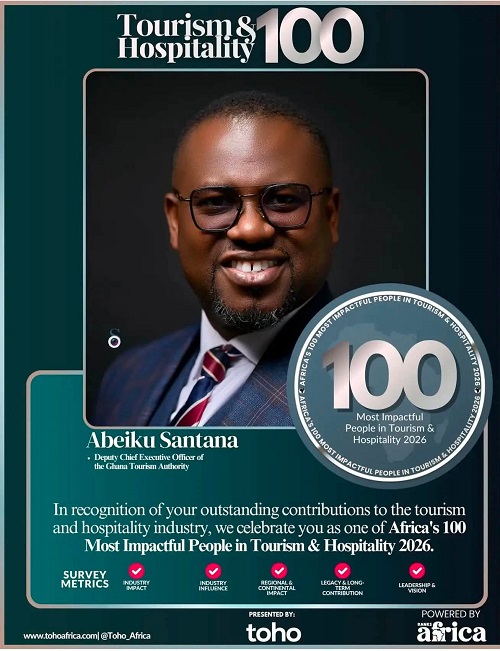
Renowned tourism advocate, and Deputy Chief ExecutiveOfficer (CEO) of Ghana TourismAuthority (GTA), Abeiku Santana, has expressed gratitude to Tourism and Hospital (TOHO) Africa after being recognised among outstanding personalities for his contributions to tourism and hospitality on the continent.
In a statement following the announcement, Santana said he was “deeply honoured and sincerely grateful” for the recognition, but stressed that the award was not about him alone.
“This honour is not a personal achievement but a testament to the collective efforts of everyone I have had the privilege to work with over the years,” he stated.
The Deputy CEO of GTA dedicated the recognition to the Government of Ghana, the Ministry of Tourism, Culture and Creative Arts, the Ghana Tourism Authority, his colleagues, industry stakeholders, the media, his family, and “every Ghanaian who believes in the power of tourism to transform lives and drive national development.”
Mr.Aggrey reaffirmed his commitment to championing sustainable tourism and promoting Ghana’s rich culture and heritage.
He added that he will continue working with partners across Africa to position the continent as “the world’s preferred destination for tourism, investment, and cultural exchange.”
He also congratulated all other personalities recognised in the *
TOHO100 list.
“Thank you, TOHO Africa, for this honour. Congratulations to all the outstanding personalities recognised,” he said.
The TOHO 100 recognises 100 leading figures in tourism leadership and hospitality across Africa who are driving growth, innovation, and destination marketing on the continent.
By Edem Mensah-Tsotorme

Vice President of IMANI Africa, Kofi Bentil, has criticised the Accra Metropolitan Assembly’s directive requiring residents and traders to close their shops and participate in the August National Sanitation Day clean-up exercise.
His comments followed the Assembly’s announcement that all trading activities should cease from 6:00 a.m. to 12:00 noon on Saturday, August 1, 2026, while residents take part in cleaning activities across the metropolis.
In a statement posted on social media, Mr Bentil described the approach as “absurd” and argued that sanitation officials were shifting their responsibilities onto the public.
“The people whose job it is to clean but have failed are asking their employers who have paid them to clean to rather leave their jobs and professions to come and do the work they’ve paid these officials to do,” he stated.
He contended that the exercise creates additional problems and reflects poor leadership and planning.
“This absurdity which only creates more problem goes on because our leaders think backwards,” he added.
Mr Bentil further stated that Ghana would need a different approach to sanitation management, saying, “When we finally wake up and get serious, this silly approach will stop.”
The AMA has maintained that the exercise is aimed at improving environmental sanitation, preventing flooding and protecting public health.
The Assembly also warned that persons who fail to participate or who engage in trading activities during the clean-up period could face arrest, fines or prosecution under its sanitation bye-laws.
By: Jacob Aggrey