News
81% of Passengers Feel Safer Using Ride-Hailing Services than Traditional Public Transport

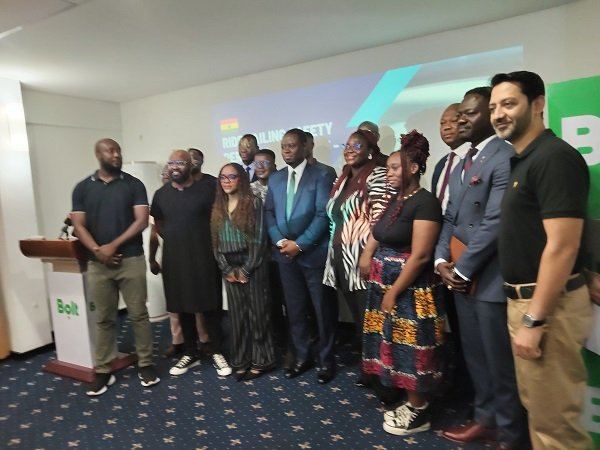
A new safety perception report conducted by Ipsos, a multinational market research and consulting firm, has revealed that 81% of passengers in Ghana feel safer using ride-hailing services compared to traditional public transport.
The report, commissioned by Bolt, was presented at a press briefing in Accra last week.
DVLA Commends Findings
Speaking at the event, Mr. Albert Potobu, Acting Deputy Director of Research, Business Development and Innovation at the Driver and Vehicle Licensing Authority (DVLA), described the report as a timely resource to support national efforts in enhancing road transport safety.
“Safety for both riders and drivers is our priority as an Authority. While we are working on a more comprehensive safety study, this report provides valuable insights that will feed into our work,” he said.
Mr. Potobu emphasised the importance of discipline, education, and technology integration to ensure safety across all transport modes.
“Before any driver is enrolled on a ride-hailing app, the DVLA ensures their license, roadworthiness, and documentation are valid. This helps maintain standards and safety on our roads,” he added.
Encouraging Technological Adaptation
With more Ghanaians shifting from traditional transport modes such as trotros to e-hailing platforms, Mr. Potobu urged the sector to adapt rather than resist technological advancement.
“Technology is evolving. Instead of seeing it as competition, other transport operators must improve safety standards to remain relevant,” he advised.
He acknowledged that, like any new technology, ride-hailing platforms present challenges, but stressed that regulators and service providers are collaborating to address emerging issues.
Bolt’s Safety Features and Commitment
Ms. Sandra Susan Boyole, Regional Public Relations Manager for Bolt Africa, expressed excitement at the high safety rating given by passengers.
“This is a great endorsement for us. It shows trust and confirms that ride-hailing is solving a major safety challenge in Ghana’s transport system,” she said.
Ms. Boyole highlighted several features currently available on the Bolt app to protect riders and drivers, including audio trip recording, live trip sharing with loved ones, and in-trip incident reporting.
She added that Bolt is continuously enhancing its safety toolkit and welcomes user feedback, including suggestions for a feature to recover items left behind by passengers.
“Feedback from regulators, drivers, and passengers helps us evolve. We are open to enhancing our systems to make our ecosystem safer,” she noted.
By Esinam Jemima Kuatsinu & Theresa Dzifa Tsetse
Spectator
Join our WhatsApp Channel now!
https://whatsapp.com/channel/0029VbBElzjInlqHhl1aTU27











The Ghana National Gas Company has denied allegations of wrongdoing in its recent procurement and insurance contract renewals.
In a press statement issued in Accra on April 13, 2026, the company explained that concerns raised in some media reports were linked to a change in its lead insurer.
It noted that the change followed the expiration of previous insurance contracts at the end of the year.
The company stressed that the new insurance arrangements are lawful and form part of efforts to improve its risk management system to protect its assets.
It further indicated that all contracts awarded so far have gone through the required approval processes by the Public Procurement Authority after receiving financial clearance from the Ministry of Finance.
The statement, signed by the Head of Corporate Affairs, Richard Ernest Kirk-Mensah, reaffirmed the company’s commitment to transparency and accountability.
It added that management remains focused on delivering gas efficiently to meet the country’s energy needs while continuing to strengthen internal systems to ensure good corporate governance and compliance.
By: Jacob Aggrey

The Importers and Exporters Association of Ghana has clarified that it now supports the implementation of the Publican Artificial Intelligence system at the country’s ports, following earlier concerns raised in 2025.
In a press statement issued on April 9, the Association explained that claims suggesting it still opposes the system are misleading and based on outdated information from a December 18, 2025 media publication.
It noted that its earlier concerns were legitimate, pointing to a lack of stakeholder consultation, as well as issues related to data security, transparency, and system integration.
At the time, it called for broader engagement to ensure the system would be credible and beneficial to all stakeholders.
According to the statement, the Government of Ghana, through the Finance Ministry and the Ghana Revenue Authority, has since engaged industry players, including the Association, to address those concerns.
The Association described the engagements as constructive, indicating that they helped resolve key issues and showed government’s commitment to improving the system’s implementation.
As a result, it affirmed its support for the Publican AI system, which has already been rolled out at the ports.
The Association acknowledged that the system is facing some operational challenges but noted that such difficulties are common with major technological reforms.
It added that authorities are taking steps to resolve the issues.
It highlighted the potential benefits of the system, including improved revenue mobilisation, increased transparency, reduced revenue leakages, and a decline in unethical practices at the ports.
The statement cautioned the public against attempts by some individuals and groups to misrepresent its position, stressing that such actions undermine national progress.
It further emphasised that it will not allow itself to be used for propaganda or agendas that do not serve the interests of importers, exporters, and the wider economy.
The Executive Secretary of the Association, Samson Asaki Awingobit, signed the statement, reaffirming the group’s commitment to supporting reforms that improve efficiency at the ports and promote a fair trading environment.
By: Jacob Aggrey