News
Women asked to screen regularly as cervical cancer claims more lives


- /home/u249204778/domains/spectator.com.gh/public_html/wp-content/plugins/mvp-social-buttons/mvp-social-buttons.php on line 27
https://spectator.com.gh/wp-content/uploads/2023/01/Mrs-Zenabu-Addo-middle-cutting-the-tape-to-launch-of-the-programme.jpg&description=Women asked to screen regularly as cervical cancer claims more lives', 'pinterestShare', 'width=750,height=350'); return false;" title="Pin This Post">
- Share
- Tweet /home/u249204778/domains/spectator.com.gh/public_html/wp-content/plugins/mvp-social-buttons/mvp-social-buttons.php on line 72
https://spectator.com.gh/wp-content/uploads/2023/01/Mrs-Zenabu-Addo-middle-cutting-the-tape-to-launch-of-the-programme.jpg&description=Women asked to screen regularly as cervical cancer claims more lives', 'pinterestShare', 'width=750,height=350'); return false;" title="Pin This Post">
●Mrs Zenabu Addo (middle) cuttingthe tape to launch the programme
Described as deadly, devastating and leaving families in misery, cervical cancer has claimed many lives in Ghana than those recorded by road accidents and maternal deaths.
Data from the Human Papilloma Virus (HPV) Information Centre in Ghana has revealed that about 3,151 new cases of cervical cancer are diagnosed annually, and the disease is ranked the second most frequent cancers among women.
In 2019, alone, the disease claimed a total of 2,103 lives in the country.
The District Deputy Director of Nursing Services, Mrs Zenabu Addo who was speaking at the launch of this year’s Cervical Cancer Awareness Month at the Madina Polyclinic, Kekele in Accra, said Cervical Cancer was caused by a sexually transmitted virus called HPV.
The programme which was organised by the Madina Polyclinic in collaboration with the Cancer Support Network Ghana was themed, “Early Detection is Key.”
Mrs Zenabu Addo enumerated the risk factors as engaging in early sex before attaining the age of 20, smoking, having multiple sexual partners at different times and one’s family history among others.
Mr Blaise Ackom, a Cervical Cancer Ambassador in a keynote address emphasised the point that women should embrace regular screening for early detection of the disease and subsequent treatment.
He said the key preventable method was for young ladies to abstain from sex and that women should take advantage of the awareness creation month and have themselves screened at a lower cost.
He noted that there was no cure for cervical cancer anywhere apart from the hospital.
Mr Ackom warned against smoking, especially shisha which he said was more dangerous than smoking many sticks of cigarette and lamented that the rate at which the youth were smoking shisha was alarming.
He called on husbands to support their wives and female children to screen regularly and parents in general to take good care of their children so that they would not fall prey to bad behaviours in society.
He advised women to study their bodies well in order to identify abnormalities and promptly report issues of post-coital bleeding.
The Cervical Cancer Ambassador appealed to the government to include free screening of the disease in the National Health Insurance Scheme.
Ms Rosetta Ntriwaa Aboagye, a Midwife at the LekMA Polyclinic at Teshie Tsuibleoo, observed that since the cervix played essential roles in the lives of women, there was the need to cherish it and ensure that it was well maintained.
“Since this is the only cancer which is preventable, why do we wait unnecessarily without embracing the preventable means for it to destroy us,” she asked.
Ms Afwoa Mireku Ampomah, also a Cervical Cancer Ambassador, called on women to take control of their lives, boost their immune system and avail themselves of vaccination.
By Raymond Kyekye

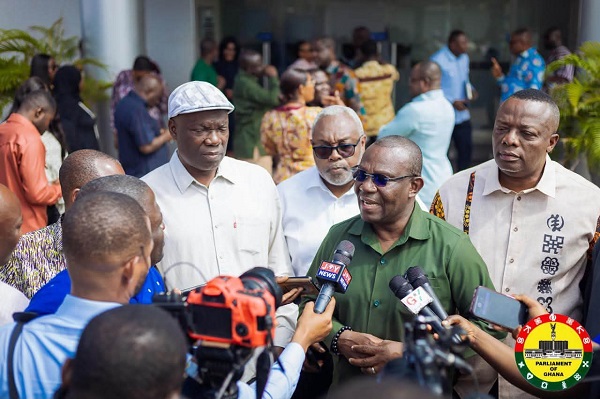
The Parliamentary Select Committee on Energy has appealed to the Ministry of Finance to release GH¢5.6 million to the Petroleum Commission to enable it to establish and operate a world-class data centre.
According to the Committee, access to the funds will strengthen the Commission’s capacity to manage critical upstream petroleum data and improve its operations.
Speaking during the appeal, Chairman of the Committee, Emmanuel Kwasi Bedzrah, said the move was crucial to efforts to revitalise Ghana’s upstream petroleum industry and increase oil production.
He noted that although investment and hydrocarbon production had declined in recent years, Parliament’s approval of an extension of the petroleum agreement to 2030 had attracted additional funding and contributed to an increase in production from about 80,000 to 120,000 barrels per day.
Meanwhile, concerns have been raised over repeated budget allocations for oil exploration in the Voltaian Basin.
Mr. Bedzrah stressed that funds approved for exploration must produce tangible results, adding that the Committee would require clear evidence of progress before supporting future budget allocations for the programme.
The appeal was made during a working visit to the Petroleum Commission as part of the Committee’s oversight activities to assess its operations and management procedures.
During the engagement, the Chief Executive Officer of the Petroleum Commission, Emeafa Hardcastle, took the Committee through the Commission’s working procedures and mandate, which includes regulating, managing and coordinating upstream petroleum activities.
She disclosed that since assuming office in 2025, government had pursued measures to reverse the decline in crude oil production, sustain output and reposition Ghana as an attractive destination for investment in Africa’s increasingly competitive petroleum sector.
In addition, she said government had secured fresh commitments of about US$35 billion to help revitalise the sector.
As part of the oversight exercise, the Committee is expected to conclude its monitoring visit with engagements at the National Petroleum Authority (NPA) and the Ghana Oil Company Limited (GOIL).
By Edem Mensah-Tsotorme
News
“No civilisation deserves to be annihilated” – Mahama calls for dialogue on global conflicts at UNGA 81

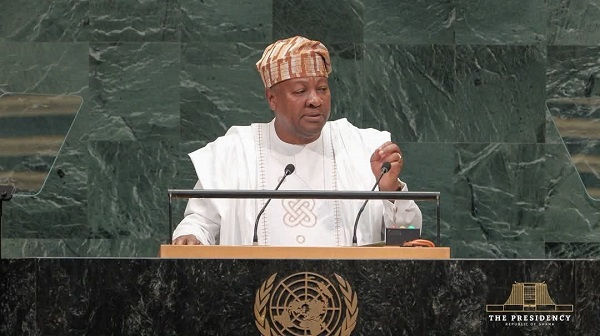
President John Dramani Mahama has called for solidarity and dialogue in resolving global conflicts, insisting that no civilisation deserves to be wiped out.
“No human civilisation deserves to be annihilated, certainly not a member state of the United Nations,” President Mahama stated in his address at the 81st United Nations General Assembly in New York.
He called for solidarity with nations facing terrorism, especially the Alliance of Sahel States (AES), and for a uniform approach to conflicts in Europe, the Middle East and Africa.
On the Middle East, the President called for a return to negotiations, saying “The current Middle East crisis is having a deleterious effect on the world economy.”
“I believe that dialogue can resolve even the most intractable of problems,” he added.
By Edem Mensah-Tsotorme