Features
When Christian Atsu followed Pelé

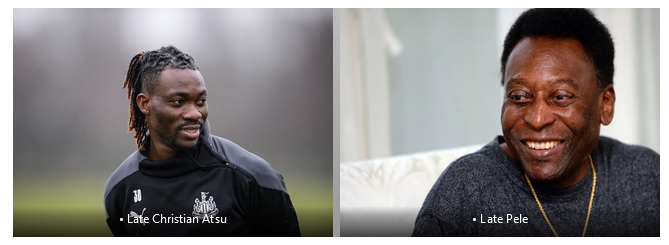
When Ednes Arantes do Nascimento died in the very twilight of 2022 the world stood still. Not that his death was unexpected; he was losing his battle against colon cancer and, at a point, was not responding to any medication. The world knew him simply as Pelé.
What endeared Pelé to the world was his persona on and off the football field. He was a gentleman par excellence, a model to budding footballers, a philanthropist and an exceptionally humble person. He was the only person to have won three World Cups, scored 1,283 (some say 1,289) goals in his career.
Many who did not see Pelé in action back in his day are quick to compare him to the Argentine legend, Diego Amardo Maradona, as the greatest footballer of all time. What put Pelé over and above Maradona was the totality of their characters. The Argentine had dented his own image by drugs that eventually caused his early demise. Maradona failed as a credible ambassador for the sweet game of football with his addiction to cocaine.
Though Pelé was almost a Don Juan, his escapades did not diminish his stature on the world scene. He was, indeed, declared athlete of the 20th Century. He was a UNICEF ambassador and supported orphanages financially. Many of these deeds became known after his death.
Then comes the tragic, untimely yet painful death of Ghana’s own Christian Atsu Twasam in the earthquake in Turkiye on the 6th of last month. Ghanaians were on tenterhooks when it was announced that Atsu was on the 9th floor of an apartment block that suffered the natural disaster.
We crossed our fingers in prayer that he should be pulled out alive and, for almost a week after, nothing was heard about his whereabouts. His partner, with whom he had three children, cried to the world to find her man. His twin sister did the same from Ghana.
And when the news broke of the discovery of his remains Ghana was totally heartbroken. In the end it put a nation’s anxiety to rest. We had a closure one way or another. That gem of a professional footballer was gone. But the pain will manifest at his funeral and after.
Atsu was just as humble as Pelé was and even more philanthropic. Though very shy before the cameras he was not as shy with his generosity.
As an ardent follower of football I have followed the life and game of many world Ghanaian footballers. Atsu was one such person. I knew he was overly philanthropic and I had met with a few people who were beneficiaries of his generosity.
But, most of them were quick to add that Atsu did not want them to make noise about what he did for them. I am told he bought instruments for a friend who wanted to establish a church, but warned him not to engage in false miracle performances.
My heart went to the poor children who I watched sobbing in a video from a school Atsu had helped establish. It was really heart-wrenching to watch.
People have spoken on radio and television attesting to Atsu’s benevolence. This is what makes me happy. Happy, because great souls will do great things and prefer no adulation and public mention of their good deeds. Atsu is a great soul. He reminds me of the Christ Jesus who healed people and told them not to tell anyone.
Of course, Christ knew that the people He healed would not keep their mouths shut. So did Atsu because some of us knew his goodness. I’m in no way comparing Christian Atsu to Jesus. I’m only trying to accentuate the esoteric that we should not let trumpets herald the good we do for others.
As there is no vacuum in nature, our goodness will get told one way or the other. It is not for us to gloat. Atsu knew his own background and did not want to see others face similar circumstances if he could help it. He did not need to earn the megabucks as some footballers did in order to help. Help he did.
I am unable to forgive the ignoramuses; I rather pity them. I have read and heard some of these characters try to chastise those who are eulogising Atsu for his deeds. Their beef is why they did not praise Atsu while he was alive. How do you celebrate a benefactor who tells you not to make noise about what he does for you?
I used to tell my children that they would only know who their Dad was at my funeral. I have even since revised this so that no tributes are presented at my cremation. If no trumpets heralded my birth, why should they herald my departure? But the only choice Atsu had was to do silent deeds.
Sadly, some of those criticising the praise singers are men of God who should know better. This only points to our lighthearted or fake approach to God’s work. I was hoping they would call on Atsu’s footballing colleagues to take over and care for those poor children who have become ‘orphaned’ by his death.
I know some of our so-called stars would rather gather friends and acquaintances to go out and chill in an all-night orgy of self indulgence. After all, no one earned the money for them. I know there are others doing bigger things than Atsu sought to do, yet make no noise about their deeds. I know those who would give goodies to their parents in the full glare of the public.
As is with every sad situation, lessons abound in the Atsu narrative. How do we in the public limelight handle our lives and our affairs? What legacy do we leave when we are no more? How do we expect to be remembered? Whether we leave a positive footprint in the sands of time is an individual choice to make.
Some died and only a paragraph was written in their memories. Some were not even made public till you asked of them before you knew they were gone. Very soon, Atsu will be all but forgotten, save the beneficiaries of his largesse. However, his benevolence will live after him.
Let us encourage those who are minded to use their public image and resources to help the less fortunate do so without let or hindrance. There is always a blessing and a sense of fulfillment in giving rather than receiving.
Pelé left a footprint on the football stage that will never be wiped out. No wonder FIFA has decreed that each member country should dedicate and name one stadium after the great Brazilian. Many countries have started. However, Ghana has a Pelé of its own in the person of Abedi Ayew.
Therefore, if any of our stadiums is named Pelé, many Ghanaians will think it is after our legend, Abedi. I am yet to know what our government and the GFA will do about this. If you asked me, I would suggest a Do Nascimento Stadium. What of Do Nascimento Pelé Stadium?
Now, is there anything the GFA can do to immortalise Christian Atsu? His could be a special case when we come to think of the circumstances of his painful exit.
May the Good Lord grant Christian Atsu Twasam eternal rest and grant his family and friends the fortitude to bear the great loss.
Writer’s email address:
akofa45@yahoo.com
By Dr. Akofa K. Segbefia

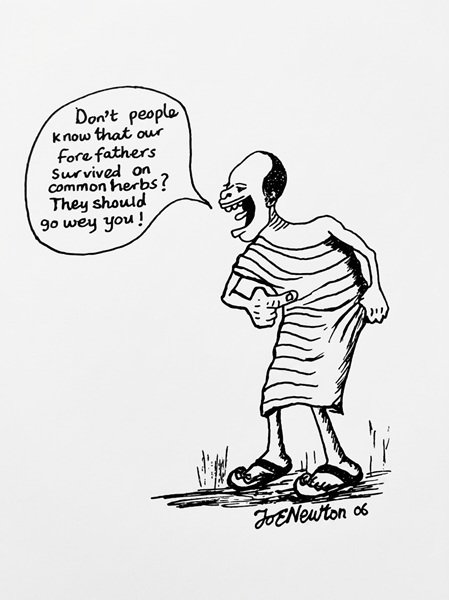
THE typical itinerant salesman in Sikaman is a herbalist. He is normally a slim macho with the capacity to perambulate the expanse of area covering the triangle of Accra-Tema-Ashiaman. In short, he can walk a total of 60 miles a day, marketing a product that cures every disease, including poverty. 
The door-to-door herbal pharmacist advertises his product by word of mouth. He has nothing to do with the Food and Drugs Board (FDB). After all, his concoctions do not feature on FM stations.
Those herbalists who cannot walk to propagate the herbal gospel, liaise with drivers of mass transportation and their mates. They are, therefore, given the chance to sell their products on Benz buses that ply the routes.
Normally, the herbalist starts his sales message with a prayer and Bible study. He asks the passengers to bow down their heads in supplication to God the father, the son, the Holy Spirit.
When a herbalist asks the passengers to close their eyes and bow their heads, Moslems on board naturally feel offended. They feel that the herbalist has no right to assume that every passenger is a Christian. They think such an assumption is an affront to Islam.
So a Moslem on board will raise the hand for a point of order. He’ll remind the herbalist that it would be in his own interest to mind his language.
“Be careful the way you address people in a public place. Not every person here is a Christian,” he’d state assertively.
Of course, the herbalist will promptly ignore him, but would all the same “watch” his tongue. Who knows whether or not the Moslem brother is inspired by Quoranic zeal to defend the tenets of Islam to the hilt?
When he starts saying, “Wallahi!” and “Inshallah!” it could be the beginning of proclaiming Islam as supreme, a point which must be driven home with talibanic precision.
So the herbalist must tread carefully lest he steps on fire.
The herbalist could even add a measure of mirth to it all, by announcing that Christians on board today have very interesting company on the journey, but that should not detract from the business of the day.
The Moslem brother will weigh the words carefully and offer a wry smile.
He must be careful the occasion does not degenerate into the use of semantics and proverbial oration to deride his conviction that public utterances must be mindful of religious sensibilities. He has made his point very clear and expects that it is taken in good faith in the interest of a peaceful journey.
The herbalist will now open the New Testament and preach salvation, stating clearly that salvation can come only through Jesus Christ and NOBODY else.
The Moslem brother will now start twitching his moustache. The visible and almost revolutionary reflexes of his upper lip can be an indication that sentiments have begun superseding reason, and the outcome could well be tragic now shift uneasily in his seat.
The time has come for him to also express his right to the religion of his fore-bears. He’ll put his hand into his pocket and rise to his feet. The time has indeed come!
This article was first published on Saturday, September 9, 2006
When the cause of a particular problem like sickness, disease, sudden illness, a social issue etc. are not known, it stands to reason that resolving it becomes a huge challenge.
Citizens would understand the government when public announcements are made to the effect that government is trying to find a solution to the issue, even though it is taking a while for it to be resolved because citizens are rational beings.
On the other hand, if the solution to a particular issue is known to everybody but the government for whatever reason, is dragging its feet in resolving it, citizens become frustrated and begin to lose trust in their leaders.
One such issue is the heavy traffic along a section of the Kasoa – Odokor road. A short stretch of bad road between the traffic light at the Weija Government Hospital and the entrance to the entrance of the overhead that leads to the N1, is the cause of the problem but nothing is being done about it, day after day, week after week, month after month. Thus is clearly unacceptable.
Another issue that requires urgent attention is the lack of pavements along a lot of streets in parts of the various Municipal Assemblies. Exercise is a prerequisite for long life and healthy living and for those of us who it has become a way of life, this issue of people putting up structures right to the edge of the drains beside the roads, are making life difficult for us.
We are compelled to walk along the roads, putting our lives at serious risk. Pedestrians should never be compelled to compete with vehicles on our streets and roads. Roads and streets are made for vehicles and pavements are made for pedestrians. That is the norm. Any attempt to normalise a situation where pedestrians are mingling with vehicles is insanity.
It is the road regulations that makes it so and therefore district or municipal assemblies are to take responsibility and ensure that spaces for pavements are not encroached upon. Citizens have rights that must be protected by their leaders and making pavements available to pedestrians, is one of them.
When we hear of teachers having sex with students, it appears it is something recent. It is not a new phenomenon. It has been there since Adam. Perhaps this issue is getting much attention due to the proliferation of social media. It was an open secret in times past when Teachers were in relationships with female students and some married them immediately after completion of school.
Some teachers were also known to be having unholy interactions with female pupils but due to the times that these acts occurred, human rights issues and the awareness around it, allowed such unscrupulous teachers to get away with their crimes.
Now we are in a different era and so a Headmaster is now in hot waters. He is alleged to have raped about 19 female students and as usual, some officials tried to cover it up and are also in hot waters and their actions or inactions in the matter are under investigation.
Why the man has been allowed to roam freely without being arrested is simply mind boggling. It appears that the law applies differently, depending on who you are. This issue came to public attention sometime in August this year, yet the police had not arrested or invited this man for question regarding the rape allegation.
It has come out that he is a Constituency Secretary of the ruling party and the question in the public domain is that, is it because he is a political figure that is why he is still walking around without questioning? I believe in the rule of law so let us hold our breadth and let the proper thing be done.
The police must however be seen to be active in this matter. God bless.
SKIP THE QUEUE, TAP THE NEWS
You can now read the Ghanaian Times and The Spectator newspapers from the comfort of your device via TimesNewsPlus.
Join our WhatsApp Channel: https://whatsapp.com/channel/0029VbBElzjInlqHhl1aTU27