Hot!
WASSCE takes off smoothly nationwide

- /home/u249204778/domains/spectator.com.gh/public_html/wp-content/plugins/mvp-social-buttons/mvp-social-buttons.php on line 27
https://spectator.com.gh/wp-content/uploads/2020/07/WASSCE-File-photo-students-writting-the-exam-.png&description=WASSCE takes off smoothly nationwide', 'pinterestShare', 'width=750,height=350'); return false;" title="Pin This Post">
- Share
- Tweet /home/u249204778/domains/spectator.com.gh/public_html/wp-content/plugins/mvp-social-buttons/mvp-social-buttons.php on line 72
https://spectator.com.gh/wp-content/uploads/2020/07/WASSCE-File-photo-students-writting-the-exam-.png&description=WASSCE takes off smoothly nationwide', 'pinterestShare', 'width=750,height=350'); return false;" title="Pin This Post">
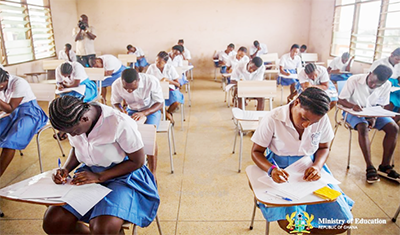
This year’s West African Secondary School Certificate Examinations (WASSCE) took off to a smooth start across the country albeit in an unusual fashion due to the outbreak of the COVID-19 pandemic.
As part of the safety protocols outlined to ensure the wellbeing of the students who are also the first batch of the Free Senior High School (FSHS) policy, the student were made to abide strictly by the all the safety protocols even as they sat for their examination.
Apart from wearing of nose masks, washing and sanitising of hand with alcohol-based sanitisers, there was strict adherence to the social distancing protocols.
Whiles some were made to undertake their practical exams in well spaced out classrooms, others were to occupy their school assembly halls with others made to undertake theirs under erected canopies.
Elsie Commodore & Gloria Nsiah Mintah report that some schools in Accra, including, Saint Thomas Aquinas SHS, Osu Salem SHS, Accra Girls SHS, Holy Trinity Cathedral SHS and the Labone SHS to monitor the ongoing examination revealed that examination took off to a smooth start.
At the Saint Thomas Aquinas SHS 46 Visual Arts Students out of the 713 final year students were taking part in the sculpture paper while 88 students out of 707at the Osu Salem SHS took part in ceramics paper.
The headmaster of Saint Thomas Aquinas, Mr Amoasi Paul Baidoo said aside using classrooms; canopies were being mounted to aid in observing social distancing.
“Because of the COVID-19, we are using three classes and the canopies for the exams, thereby, allowing 11 students in each hall and under the canopies” he stated.
On his part, the Assistant Headmaster for Osu Salem, Academics, Mr Moses Abotsi stated that some personnel had been stationed in the classrooms to make sure students were observing the protocols.
“We also insist that the temperature of each student is taken before exams is written and ensure they are well spaced out to prevent the spread of the COVID-19,” he said.
He also mentioned that, from the demeanour of students, they were psychologically prepared, as each student that came to the centre was calm and went about the process of being searched.
From Koforidua, Ama Takyiwaa Ampadu Agyeman reports that, a total of 56,467 candidates made up of 27,117 males and 29,350 females were writing the WASSCE which began yesterday.
A visit by the Ghanaian Times to New Juaben Senior High, Koforidua Secondary Technical, Oti Boateng and Oyoko Methodist Senior High School observed that, the temperature of students were checked at the entrance before they were allowed into the school.
Also Veronica buckets were placed at vantage points to promote hand washing. Students were also seen in the nose masks while social distancing was observed.
At Oti Boateng SHS, a WAEC examiner, Mr Cefas Amenu told the Times that 53 candidates were writing while Oyoko Methodist Senior High School had 50 candidates.
Some SHS in the Ho Municipality began this year’s WASSCE, also observing the COVID-19 safety measures. Grace Senam Klay reports from the Volta Region.
When the Ghanaian Times visited Mawuli SHS, it was observed that all students and invigilators at the exams center were in nose masks and the center had a hand washing station, with similar trend being observed at Mawuko Girls SHS.
In an interview with the assistant headmaster in charge of Academics at Mawuli SHS, Mr Shadrack Abiwu mentioned that 32 Visual Art students were partaking in picture making, graphic design, and textile project work, while 99 candidates were also taking part in the project work at Mawuko Girls.
Daniel Dzirasah reports from the Ahafo Region that, three schools; Ola Girls, Samuel Otoo Presbyterian SHS at Techimantia and Bechem had recorded cases of the COVID-19, the Regional Director of the Ghana Education Service (GES), Dr Peter Attafuah said.
He expressed satisfaction over the level of preparation made by the various schools in the region ahead of the ongoing WASSCE in the region.
A visit to some schools in the Sunyani Municipality where the exams had started showed that, the candidates were ready and poised for the exams as of 9:36am.
Also, from Kumasi in the Ashati Region, Kingsley E. Hope reports that, there was strict adherence to the COVID-19 protocols in various schools visited by the Ghanaian Times yesterday.
Assistant Headmaster at the Kumasi Anglican Senior High School, Samson Kofi Gyasi, told the paper that, out of a total of 942 candidates for examination, 112 of them were doing the practicals.
At the Asanteman SHS, the Headmaster, Nathaniel Antwi Asamoah said that, 928 candidates were registered to write the WASSCE for 2020, with 60 of them registered to write the practical examination at the Visual Arts department.
The Ghanaian Times’ visit to the Opoku Ware Senior High School revealed that, 1,001 registered candidates would be sitting for the WASSCE, out of which, 60 had registered to write the practical examination in graphics at the Visual Arts department.
Similarly, at the Kumasi Secondary and Technical SHS, it was gathered that, 74 candidates were present for the practical examination in graphics out of a total of 872, although two were said to be absent at the time of our visit.
Samuel Akapule also reports from Bolgatanga that, the WASSCE had started smoothly in the Upper East Region under strict supervision in the various examination centres in the region.
Meanwhile, the Headmistress of the Bolgatanga Girls’ Senior High School (BOGISS), Mrs Patricia Anaba stated that, school did not receive some of the personal protective equipment (PPE), including, nose masks and hand sanitisers, but the school managed to procure some of the hand sanitisers to be used during the examinations.
By Times Reporters



The Tema Regional Police Command has arrested a 32-year-old man for allegedly posing as a soldier and extorting money from unsuspecting members of the public at Ashaiman.
The suspect, identified as Bright Atsu Kudiabor, was arrested by the Ashaiman Police on Wednesday, September 16, 2026, at about 7:00 a.m.
According to the Police, he was arrested at an area known as “I Shall Return”, where he was allegedly parading himself as a soldier and demanding money from people.
The Police said Kudiabor, who is an ex-convict, was initially arrested by personnel of the Ghana National Fire Service in Ashaiman with assistance from other members of the public.
A search conducted on him after he was handed over to the Police reportedly led to the recovery of a set of military camouflage uniform.
The suspect is currently in Police custody and assisting with investigations.
The Tema Regional Police Command said he would be processed for court after investigations are completed.
The Police urged the public to remain vigilant and report anyone who falsely presents themselves as a soldier or a member of another security agency to deceive or extort money from the public.
By: Jacob Aggrey

Volta Regional Minister, James Gunu, says the Volta Region holds enormous agricultural potential and efforts must be geared towards connecting farmers to the needed resources to unlock that potential.
He said focus must be on linking farmers to resources, technology, financing and markets to increase production, create jobs and build sustainable livelihoods.
Hon. Gunu made the remarks at the national launch of the Ghana Tomato Self-Sufficiency Initiative (GHATSI) held at Anloga in the Volta Region on Tuesday, September 15.
The initiative, under the theme “Produce at Home. Feed the Nation. Export the Surplus,” seeks to boost local tomato production, processing and marketing while reducing Ghana’s heavy reliance on imported tomatoes.
The launch was attended by the Minister for Food and Agriculture, Eric Opoku, his Deputy, John Setor Dumelo, Feed Ghana Coordinator, Bright Demordzi, Members of Parliament, traditional leaders, MMDCEs, farmers and other stakeholders.
Mr.Gunu expressed appreciation to the Minister for Food and Agriculture for the support announced for the region, including two excavators, 200 cartons of organic fertiliser, and GH¢200,000 for Ms. Kuatudzo Esther Dela, a tomato farmer and processor from Ziope.
He described the initiative as an important step towards making agriculture a stronger driver of food security, job creation and economic growth in the Volta Region.
By Edem Mensah-Tsotorme

 Entertainment1 week ago
Fiifi Coleman Productions adapt ‘I Told You So’ stage play into feature film
- News5 days ago
48 Engineer Regiment to be major sub-contractor on Accra-Kumasi Expressway, $2bn ready- Prez Mahama
- News1 week ago
Ghanaian journalist celebrates Texas town’s ‘Eden of the Far West’ tag after mayor’s nod