Features
The Tema palaver

There is a legend about what Osagyefo Dr Kwame Nkrumah wanted Tema to be like.
According to the prophets of the pre-coup era and those who claimed to have known the Osagyefo’s plans, Tema was being gradually developed to become a model city, a workers’ paradise, not a Chinatown.
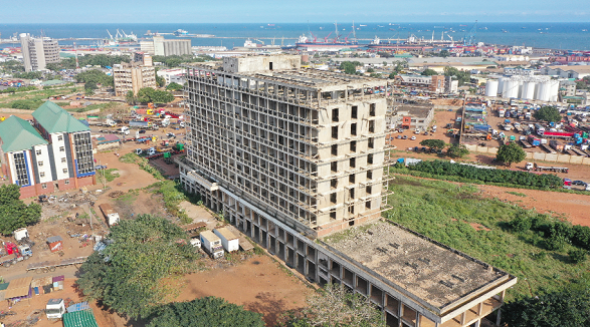
Today if you see the Meridian Hotel, you’ll think it has just suffered from a bomb attack. Kokotako recently told me he was sure the once elegant hotel was suffering from a virus infection.
Tema, it has been said, was meant to be a thoroughly planned heavenly-city under a presidential blueprint to be eventually decorated with two border posts. You couldn’t enter using bush paths and grasscutter routes. No rat-catching gimmicks!
According to the sages of those times, non-residents of the city on a visit would have been required to go through a bureaucratic and medical procedure.
First you’ll have to produce your passport cum visa, or a travelling certificate, lassez de passe or carte identite (identity card). Your forehead would have to be examined by an expert to make sure you are not a magician. No magical shows in the city. No Kofi Larteh!
You’ll also be required to produce a medical certificate to prove that you’ve been vaccinated against yellow fever, typhoid and poverty. You don’t come to the city to become a beggar. No way!
In a nutshell, the city was meant to become the model city of West Africa, the Vatican of Sikaman; a state within a state, a wonderland of no mean accolade.
The 1966 coup was a national tragedy although Ghanaians hailed the coup. To the Osagyefo, it was a personal tragedy. His dreams of a glorious harbour city, for instance, with its night-time glow and daytime glitter were washed away as the sub-machine guns rattled the signal of the advent of Ghana’s woes.
Nkrumah probably lamented the coup for one main reason that Tema would never be what he visualised it to become. Some people say the tears he shed were laden with an anathema, a bit of which has probably been visited upon Tema.
Yes, visit Tema and you’ll see vestiges of the old plan, now adulterated and totally confused with gross lack of maintenance, irregular development, over-flowing manholes, dark streets at night, beggars, and people who would have been denied access to the comforts of the city, had the Osagyefo been alive.
Tema is no longer for workers. It is now a free-for all, a boiling pot of all ethnic groups like fufu-eating Ashantis, butter-smearing Fantes, akple-eating Ewes, kontomire-swallowing Akwapims, khebab-roasting northerners and Brong self-imposed exiles who would eat nothing apart from unripe plantain. Very delicious, you know.
The shoe-shine boys are in their hundreds and wayside chop bars especially at night are common feature. You’ll be glad to meet an ex-seaman at a drinking bar talking about the good old days when Black Starline was indeed a national line. You’ll notice a retired seaman by his swag for the unmistakable seaman trademark in the gait.
Tema of today is famous for its brand of Pidgin English. It is next to the Nigerian version which is acknowledged by linguistic experts as the cremé of pidgin. Not good for SSS students, though.
The city is also famous for its high cost of living. Those who come from Accra and Kumasi to live there often pack bag and baggage after a few months and run away without anybody chasing them. Sometimes they leave their jackets behind. Life is no joke.
If you can, however, stay in Tema for over five years without suffering from financial constipation, then you are qualified and baptised to live in the ‘hard’ cities of the world including Hanoi, and Bombay. As for Mogadishu, I doubt it. Sometimes you have breakfast once in two weeks and that’s not a cheap situation. You’ve got to bow.
Surprisingly those who live in Tema and have got used to the rough weather don’t want to live anywhere else. They love the city, the breeze, the pidgin.
Today, the new SSNIT flats are giving the city a new class just as fast as the deteriorating conditions of the Tema Development Corporation (TDC)-owned houses are de-beautifying the city. No maintenance whatsoever and the corporation is beset with problems and matters that need redress.
At this very moment, the Tema Tenants Association (TTA) and TDC are at each other’s throat, in a dangerous horseplay that can degenerate into something else. The corporation intends to sell its rented units, meaning that if you can’t buy the house you’re living in, then you’ve got to quit and probably go to your hometown for good.
So whether you are a rich business tycoon or a mandated church mouse, you have to, within three months from now, make ready over three million cedis for the place you are occupying.
There is, however, an alternative. Poor tenants who can’t afford the outrageous prices will from October 1 pay 300 per cent on rent. A single room will now cost 7,000 cedis per month.
Members of the tenants’ association who are ready to take to the streets in protest have accused TDC of having woefully failed as a landlord because it has not maintained buildings it is supposed to maintain.
Some of the buildings are in a real mess.
The association has called for a commission of enquiry to investigate the matter to ensure that propriety and neglect no longer become good bedfellows and also to enable the poor worker and his family to have a place to lay their heads without being intimidated with outright sales and high rents.
The Tema Development Corporation (TDC) itself has a lot of things happening in there, the public would be very much interested in knowing. Many things in fact.
I’ll revisit the issue sooner than you’d expect. Watch out for the bombshell!
This article was published on
Saturday, August 6, 1994
Join our WhatsApp Channel now!
https://whatsapp.com/channel/0029VbBElzjInlqHhl1aTU27

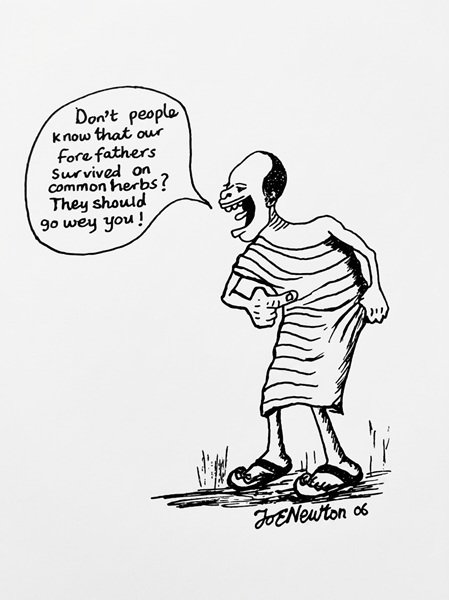
THE typical itinerant salesman in Sikaman is a herbalist. He is normally a slim macho with the capacity to perambulate the expanse of area covering the triangle of Accra-Tema-Ashiaman. In short, he can walk a total of 60 miles a day, marketing a product that cures every disease, including poverty. 
The door-to-door herbal pharmacist advertises his product by word of mouth. He has nothing to do with the Food and Drugs Board (FDB). After all, his concoctions do not feature on FM stations.
Those herbalists who cannot walk to propagate the herbal gospel, liaise with drivers of mass transportation and their mates. They are, therefore, given the chance to sell their products on Benz buses that ply the routes.
Normally, the herbalist starts his sales message with a prayer and Bible study. He asks the passengers to bow down their heads in supplication to God the father, the son, the Holy Spirit.
When a herbalist asks the passengers to close their eyes and bow their heads, Moslems on board naturally feel offended. They feel that the herbalist has no right to assume that every passenger is a Christian. They think such an assumption is an affront to Islam.
So a Moslem on board will raise the hand for a point of order. He’ll remind the herbalist that it would be in his own interest to mind his language.
“Be careful the way you address people in a public place. Not every person here is a Christian,” he’d state assertively.
Of course, the herbalist will promptly ignore him, but would all the same “watch” his tongue. Who knows whether or not the Moslem brother is inspired by Quoranic zeal to defend the tenets of Islam to the hilt?
When he starts saying, “Wallahi!” and “Inshallah!” it could be the beginning of proclaiming Islam as supreme, a point which must be driven home with talibanic precision.
So the herbalist must tread carefully lest he steps on fire.
The herbalist could even add a measure of mirth to it all, by announcing that Christians on board today have very interesting company on the journey, but that should not detract from the business of the day.
The Moslem brother will weigh the words carefully and offer a wry smile.
He must be careful the occasion does not degenerate into the use of semantics and proverbial oration to deride his conviction that public utterances must be mindful of religious sensibilities. He has made his point very clear and expects that it is taken in good faith in the interest of a peaceful journey.
The herbalist will now open the New Testament and preach salvation, stating clearly that salvation can come only through Jesus Christ and NOBODY else.
The Moslem brother will now start twitching his moustache. The visible and almost revolutionary reflexes of his upper lip can be an indication that sentiments have begun superseding reason, and the outcome could well be tragic now shift uneasily in his seat.
The time has come for him to also express his right to the religion of his fore-bears. He’ll put his hand into his pocket and rise to his feet. The time has indeed come!
This article was first published on Saturday, September 9, 2006
When the cause of a particular problem like sickness, disease, sudden illness, a social issue etc. are not known, it stands to reason that resolving it becomes a huge challenge.
Citizens would understand the government when public announcements are made to the effect that government is trying to find a solution to the issue, even though it is taking a while for it to be resolved because citizens are rational beings.
On the other hand, if the solution to a particular issue is known to everybody but the government for whatever reason, is dragging its feet in resolving it, citizens become frustrated and begin to lose trust in their leaders.
One such issue is the heavy traffic along a section of the Kasoa – Odokor road. A short stretch of bad road between the traffic light at the Weija Government Hospital and the entrance to the entrance of the overhead that leads to the N1, is the cause of the problem but nothing is being done about it, day after day, week after week, month after month. Thus is clearly unacceptable.
Another issue that requires urgent attention is the lack of pavements along a lot of streets in parts of the various Municipal Assemblies. Exercise is a prerequisite for long life and healthy living and for those of us who it has become a way of life, this issue of people putting up structures right to the edge of the drains beside the roads, are making life difficult for us.
We are compelled to walk along the roads, putting our lives at serious risk. Pedestrians should never be compelled to compete with vehicles on our streets and roads. Roads and streets are made for vehicles and pavements are made for pedestrians. That is the norm. Any attempt to normalise a situation where pedestrians are mingling with vehicles is insanity.
It is the road regulations that makes it so and therefore district or municipal assemblies are to take responsibility and ensure that spaces for pavements are not encroached upon. Citizens have rights that must be protected by their leaders and making pavements available to pedestrians, is one of them.
When we hear of teachers having sex with students, it appears it is something recent. It is not a new phenomenon. It has been there since Adam. Perhaps this issue is getting much attention due to the proliferation of social media. It was an open secret in times past when Teachers were in relationships with female students and some married them immediately after completion of school.
Some teachers were also known to be having unholy interactions with female pupils but due to the times that these acts occurred, human rights issues and the awareness around it, allowed such unscrupulous teachers to get away with their crimes.
Now we are in a different era and so a Headmaster is now in hot waters. He is alleged to have raped about 19 female students and as usual, some officials tried to cover it up and are also in hot waters and their actions or inactions in the matter are under investigation.
Why the man has been allowed to roam freely without being arrested is simply mind boggling. It appears that the law applies differently, depending on who you are. This issue came to public attention sometime in August this year, yet the police had not arrested or invited this man for question regarding the rape allegation.
It has come out that he is a Constituency Secretary of the ruling party and the question in the public domain is that, is it because he is a political figure that is why he is still walking around without questioning? I believe in the rule of law so let us hold our breadth and let the proper thing be done.
The police must however be seen to be active in this matter. God bless.
SKIP THE QUEUE, TAP THE NEWS
You can now read the Ghanaian Times and The Spectator newspapers from the comfort of your device via TimesNewsPlus.
Join our WhatsApp Channel: https://whatsapp.com/channel/0029VbBElzjInlqHhl1aTU27