Features
Tears and joy of service


The time is again ripe for us to call some people ex-national service personnel. They are the new group of people who must start learning how to sing songs like “Hark My Soul,” a sorrowful anthem of all jobless people.
The song is a choral appeal to God to intercede on their behalf so that “morning waakye” will not become a palaver.
Just as some are out-going national servicemen, others are preparing to become in-going servicemen. And I’m glad to hear that these days people are accepting postings to the rural areas because conditions in the countryside are no longer too bad. Ask Mr David Kanyi, the Greater Accra Regional Coordinator of NSS and he’d brief vou.
At least you won’t be infected by the guinea worm. If anything, it is the roundworm which would present a problem like it did to Ali, otherwise known as Emmanuel Lawer, a classmate of my younger brother Alor.
In fact, the worms, contrary to medical logic, made Ali a very prosperous person during the course of his national service. His belly was growing bigger and bigger and people began calling him “Alhaji”, thinking he was becoming wealthy.
As I once said, Ali went to the hospital and pleaded with the doctor to measure the extent of his prosperity, whereupon he was given two small pills. The next morning the entire colony of worms was decimated and Ali tearfully lost his Alhaji status in the Upper West Region where he undertook his national service.
Sometimes, going far away from home to serve the nation is like going to “hustle” in Lagos. For those forced to serve in the Upper Regions it is like slugging it out in Sokoto, and there, you can only make it if God dey your back.
You might be posted to a remote village where there is a tiny primary school and a JSS block that looks like it had just suffered from an earthquake measuring 7.5 on the Ritcher scale. You’ll think the building will collapse on you, but it won’t. You are supposed to go in there and serve the nation.
Immediately you land, you must get a place which is an accommodation whether you think it is or not. You’ve got to accept it, otherwise you will be transformed into a Son of Man with nowhere to lay your head (Matthew 8:20).
A landlord will receive you as a serviceman with open arms until you start eyeing his beautiful daughter. Some landlords don’t tolerate such non-sense. They expect you to behave like a castrated goat and be the good tenant you are supposed to be.
Anyhow, your landlord would ask you a few questions.
“Krakye, you’re from the South-eh! How’s the place like?”
“Fine. They all send their greetings”.
“Good! For how long will you be staying?”
“About a year.”
“Good. This is your room,” he’d point to a small door. “The only advice I’ll give you is that if you follow somebody’s wife, they’d stick an arrow into buttocks, Get the point? An arrow is not a small thing”
“I know Baba.”
“I’m glad you know this. So if your manhood worrying you, go and drink pito and cool it down. if you chase my daughter, worse things will happen to you. I wish you a happy stay.”
Events narrated by past servicemen are good pieces of advice to their successors. You’ll find your national service very interesting or not depending on how you conduct yourself. And you have to go by the adage that while in Rome, do as the Romans do. If you go to Cinkase don’t go behaving as if you’re from Larteh. Abandon your Larteh ways altogether.
First and foremost, you must get used to the idea that your new environment is quite different from what you used do know and that you must as much as possible adjust to the staple of the area and acclimatize to the weather.
You must also know before-hand that the first disaster you’re likely to encounter is known as diarrhea. For three days, your stomach will be cleared of southern rice and meat stew, to be filled with Zaafi and alefi soup. The first day, you may need Andrews Liver Salt, but subsequently, you’ll be swallowing the ‘tuo’ morsels like a hungry native.
Yeah you got to forget about oats and butter-bread for breakfast and eat their food, drink their pito but don’t stare at their wives while licking your lips. The fact is that matters of the heart cannot be joked with. A man might forgive you even if you slap him in public but if you go near his wife, then you’re really in for like the foolish dog who sees fire and still wants venture in. Some sins cannot be forgiven.
The most important thing to do also as a service personnel is not only to go and eat tuo zaafi and come back, but to impart knowledge to the local folks. Tell them about the need for family planning, and sex education, but please don’t demonstrate the practical use of the condom.
You must try to make an impact by teaching them about environmental cleanliness, personal hygiene and functional literacy.
All these you have to do not by becoming “too known” but by being witty and accepting their points of view and counteracting them wisely and getting the message across. But if you go and tell them alcohol is not good, they’d say you’re a bad person who doesn’t want them to enjoy life.
You may also preach the good news but if you speak in tongues, they may be tempted to think you’ve been possessed by the spirit of one of their gods. In the process, they’d say their religion is superior to yours and you can’t convince them again.
In fact, if you make good use of your time anywhere you’re posted be it a cottage in the East or a hamlet in the North, you’ll come back satisfied and fulfilled. That is the real essence of national service. The service period is not time for honeymoon. It’s time for hard work and helping society.
Coming back home after national service is another palaver. Some come back fat and jolly but for others, their own parents can’t recognise them twenty metres afar unless they use a binoculars. When Edward Alomele, my kid brother came back from Karni, Upper West, I sincerely mistook him for a Malian refugee begging for alms.
I realised that the guy was smiling to me but these refugees hardly smile. I became confused. I was about to give him 50 cedis when I realised that it was my own brother. I embraced him. He was back from war or better still he had literally deserted the army and was back home leaner than a hungry Somali.
But he was happy and fulfilled. He had served his nation admirably.
Yes, some come back wealthy others return as churchmice. Some come back alone, others with a woman and child behind them.
“Mama, this was the lady who helped me-o! If it had not been for her, I would have died of kwashior-kor. She fed me well on beans. Look how fresh I’m looking.”
“But who’s the child?”
“That’s my first born.”
Mama will then realise that his dear son didn’t eat beans alone. He ate something else too. At night!
This article was first published on Saturday, September 24, 1994








Walk into any supermarket in Accra, Kumasi, or Tamale today, and you will see the modern Ghanaian diet packaged as ‘progress.’ You will see breakfast cereals with cartoon mascots, fruit drinks that are mostly sugar and colour, and snacks promising energy and happiness in bright fonts.
Even products loaded with salt and unhealthy fats often wear a health halo labeled as fortified or natural, while the real nutritional risk is hidden in tiny print on the back. This is not just a consumer inconvenience; it is a public health blind spot. Ghana is living through a silent surge of non-communicable diseases (NCDs) like hypertension, diabetes, and stroke.
These conditions quietly drain household income and steal productive years. According to the Ghana Health Service (GHS) and World Health Organisation (WHO) estimates, NCDs are now responsible for nearly 45 per cent of all deaths in Ghana.
We cannot build a healthy nation on a food environment designed to confuse people at the point of purchase. Ghana must mandate simple front-of-pack warning labels (FOPWL) on high-sugar, high-salt, and high-fat packaged foods because consumers deserve truth at a glance, and industry must be pushed to reformulate.
Why Back-of-Pack Labels Are Not Enough
In theory, consumers can read nutrition panels. In reality, most Ghanaians shop under pressure, limited time, rising prices, and children tugging at their sleeves. The back label is a relic that requires a high cognitive load to interpret—essentially, the seller knows what is inside, but the buyer cannot easily tell.
This ‘information asymmetry’ is not fair. It is not consumer choice when the information needed to choose well is deliberately difficult to find.
Simple warning labels like the black octagons used in the Chilean Model act as a ‘stop-and-think’ nudge. They do not ban products but they simply tell the truth so people can decide.
Reshaping Our Food Environment
A generation ago, Ghana’s meals were mostly home-prepared, like kenkey and banku with soups and stews. Today, ultra-processed foods have become the norm, especially in urban areas. Children are growing up with sugary drinks and salty snacks as everyday items, not occasional treats.
If Ghana is serious about prevention, we must act where decisions are made—thus, the shelf. Warning labels protect parents from sugar traps and pressure the market to improve. When warning labels are mandatory, manufacturers start to compete to make healthier recipes to avoid the stigma of the label.
Addressing the Pushback
Industry will argue that labels create fear or that education alone is enough. However, health education is slow; labels work immediately. While the informal street food sector is a challenge, regulating pre-packaged goods is the practical starting point because the supply chain is traceable. We cannot wait until the whole system is perfect; we must start where action is feasible.
A 2026 Implementation Roadmap for Ghana
To move from talk to action, Ghana needs this 5-step plan:
- Issue mandatory regulation: The Ministry of Health, Food and Drug Authority (FDA), and Ghana Standards Authority (GSA) must define the label format and nutrient thresholds for all pre-packaged foods.
- Simple, bold symbols: Use plain language and clear symbols, such as “HIGH IN SUGAR,” designed for busy families, not experts.
- Transparent thresholds: Adopt technically defensible standards adapted to the Ghanaian diet.
- Transition and enforce: Provide a 12–18 month period for manufacturers to reformulate, followed by firm enforcement at ports and retail centers.
- National literacy campaign: The Ghana Health Service must pair labels with public messages explaining why high salt or sugar increases disease risk.
Conclusion: Truth Is Not a Luxury
Prevention is cheaper than treatment. A warning label costs little compared to the price of dialysis, stroke rehabilitation, or lifelong diabetes complications. A black octagon on a box of biscuits is more than a label; it is a shield for the health of all Ghanaians. It is time to put the truth where we can see it, right on the front.
By Abigail Amoah Sarfo
Join our WhatsApp Channel now!
https://whatsapp.com/channel/0029VbBElzjInlqHhl1aTU27

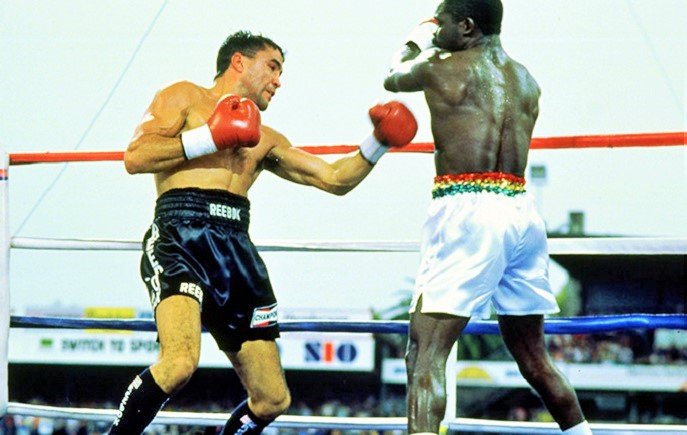
Natives of the Kenkey Kingdom were mad with joy. They were still recovering from the hangover of the kingdom’s loss of the African Cup when their spirits were rekindled. Their great warrior, Zoom Zoom, stormed Melbourne and made sure that every Australian refused food. And that was after he had drawn contour lines on the face of their idol, Jeff Fenech.
Not only did the terrible warrior transform Old Boy Jeff’s face into a contour map useful for geography lessons, but he also accomplished the feat of retaining the much-envied super-kenkeyweight title against all odds. The warrior had not been eating hot kenkey for nothing.
The Fight Against Fenech
When Jeff Fenech bit the dust in the eighth round, I was tempted to consider if Adanko Deka could not have faced him in any twelve-rounder, title or non-title bout. Adanko has improved tremendously, and soon he would be facing Pernell Whitaker.
Sincerely, I was pessimistic about Azumah’s man, who the last time took him through twelve grueling rounds of rough boxing. I expressed my fears to my colleague Christian Abbew, alias Gbonyo, who surprisingly had total confidence that the Australian brawler would fall, predictably in Round Five.
Gbonyo gave reasons for his contention, all of which I counteracted using the age factor. Fact is, I didn’t know that contrary to the laws of nature, Azumah was all the time growing younger.
When Fenech fell briefly in round one, I asked my brother whether it was the same Fenech that fought Azumah in Las Vegas. Sure, it was the same Fenech, all out to beat Azumah before his countrymen.
But the African Professor had no intention of making the Australian a hero. As he spun round the desperate Aussie, dancing and stinging out his jabs, it was not too long before I realized that the end was near.
The Eighth Round Showdown
Two minutes into the eighth round, the African ring-master proved to the whole world that he was a true son of Bukom. He himself was cornered, but like the tough nut he is, he managed to break free before overwhelming the panting Australian with several blows that made him crash headlong.
Moments after, the referee, expressing fatherly sympathy, stopped the fight to prevent an obituary. After the ordeal, Fenech’s fairly handsome face was full of newly constructed hills, valleys, ox-bow lakes—whatever. I noticed that his nose was very tired and had a miniature volcano sitting restlessly on it. Obviously, Jeff’s wife will have to nurse that nose back to its normal shape—but I’d advise her not to use iodine, otherwise her dear husband will wail like a banshee.
Reflections on Boxing
Because Mohammed Ali was the kind of boxer kids liked, many school-going kids often entertained the wish of becoming like him. I remember one day when I told my father I wanted to become a boxer, and he advised me to first complete my education to the highest level. Then, if I decided to become a boxer and was knocked out a couple of times, I’d fall back on my degrees and make a living.
Boxing used to be interesting when bouts were fought more with the mouth and tongue than with gloves. You had to brag well, psychologically belittling your opponent before beating him up physically. Mohammed Ali became a very successful pugilist because he also managed to become a poet. He often blew his horn across America, calling himself the “pretty boxer” and opponents like Joe Frazier “the gorilla.”
Ali made a living fighting hard fists like Joe Frazier, Ken Norton, Jerry Quarry, George Foreman, Leon Spinks, and Trevor Berbick. Twice he came back from retirement to fight just for money. It was Larry Holmes who finally pensioned him, and since then the great Ali has never been himself.
The Path Ahead for Azumah
When Azumah nailed Jeff Fenech on the cross and barked almost immediately that he was after the head of Pernell Whitaker, I was happy but concerned. I would have been happier if he had announced his resignation there and then—he would have been more of a hero. Beating Fenech in Australia is more newsworthy than facing Whitaker in the States.
With Whitaker, it might be a little difficult. The “Sweet Pea” is agile, has a crooked body like a snake with diarrhea, and stands awkwardly as a southpaw. He is known for having the fastest pair of fists and the rare ability to dodge punches no matter how close they may be.
Much as I do not doubt that Azumah can take his title, I also don’t want him to retire beaten. I want him to retire as a hero and live a fuller, healthy life.
As Azumah himself said after dishing Fenech, he is now a professor and has something to show for it. Like a true professor, I think it is time he resigned and took up training young talents who could draw inspiration from him and become like him in the future.
Closing Thoughts
I must say that although ageing boxers like Larry Holmes and George Foreman are making a name for themselves, boxing is not like the Civil Service, where you can even change your age and retire at 74. Zoom Zoom has delighted the hearts of the natives, and Sikaman will forever hold him in high esteem—but only when he retires as a hero.
This article was first published on Saturday, March 7, 1992.