News
President c’ssions Suhum Interchange

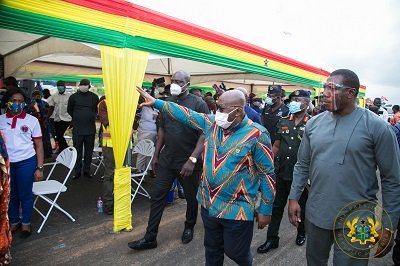
The President, Nana Addo Dankwa Akufo-Addo on Friday commissioned the Suhum Interchange and opened it to traffic.
The interchange, fully funded by the Government of Ghana consolidated fund, was part of the 31.7km Kwafokrom-Apedwa Junction Project.
It is one of the many projects along the Central corridor designated as National Route 6 (N 6) under the Ghana Highway Authority’s functional classification of road.
The project was executed by the Messrs China International Water and Electric Corporation (CWE) with Conptram Engineering Planning and Associates as the consultants.
The opening of the interchange which consisted of two bridges carrying a total of four lanes, with each of the bridges having 10 span reinforced concrete box grinder bridges with a total length of 250 metres, would provide safe and uninterrupted flow of traffic.
It would also facilitate trade between the northern and southern parts of the country and within the West African sub-region.
At a short ceremony to officially open the interchange to traffic, President Akufo-Addo explained that the project, which commenced in September 2008, was initially scheduled to be completed in March 2012.
However, it suffered several challenges mainly associated with payment delays, hence several suspension of the project by the contractor.
He revealed that work resumed in June 2017, on the south bound carriageway including the interchange after some negotiations and payments of arrears were made to the contractor, while the northern bound carriageway including the construction of eight footbridges along the road corridor were all repackaged with work commencing in January 2019, adding that the entire Kwafokrom to Apedwa junction project would be finally expected to be completed in April 2021.
President Akufo-Addo noted “the commissioning was evident of government’s commitment to continue with and complete successfully major infrastructural projects we have inherited from previous governments so that the expected socio-economic benefits can be enjoyed by all”.
He stated that the interchange would alleviate the plight of the general public who use the Accra to Kumasi road and afford residents the comfort of going about their normal activities without fear of being knocked down by vehicles and hence urged motorists and road users to follow the traffic and control management schemes that has been deployed on the road to ensure safety for all.
“Indeed, the improved conditions of our highways owes a collective duty on us the citizenry to be mindful of our responsibilities on the road and I urge motorists to be extra careful on our highways and also resist the temptation of overspeeding on good road sections, adding that improved roads should not be a catalyst of national development nor instruments of death and pain.
He however expressed gratitude of the workers, security agencies, contractors, and the supervising agencies, the GHA for a good work done on the project.
For his part, the Minister for Roads and Highways, Mr Kwesi Amoako-Atta said the project generated thousands of jobs to a number of local companies, adding that the government was committed to completing many road projects.
He called on motorists to be mindful of their act on the road and charged the police to undertake speed checks regularly to ensure safety on the road.
The Project Manager of CWE, Du Huglai said they were committed to completing the entire project if they receive more funding from government.
Source: Ghanaian Times


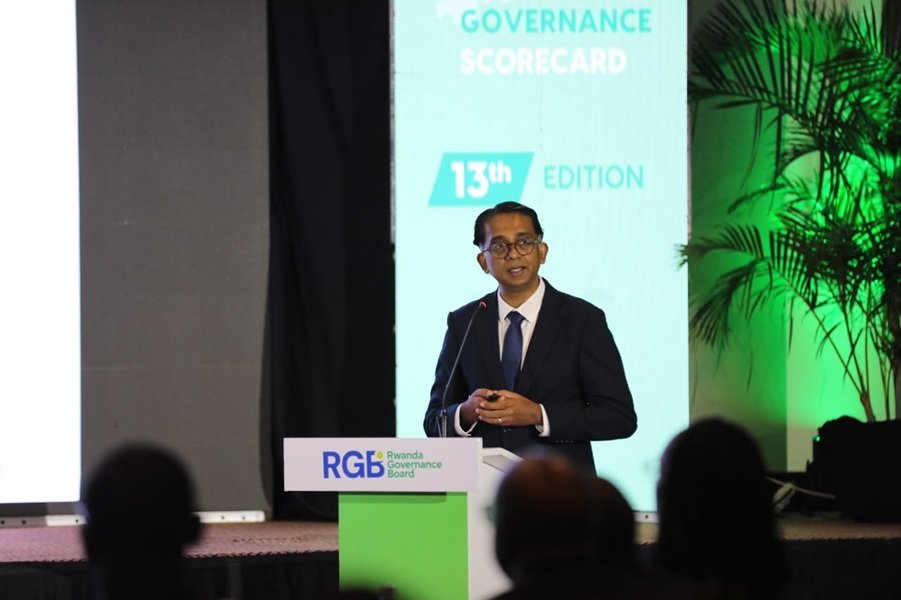
Ghana has made progress in the way it manages public resources and delivers services to citizens, with improvements in financial management and access to education and healthcare helping to raise its governance score.
The country ranked 92nd out of 133 countries worldwide and ninth in Africa in the 2026 Chandler Good Government Index (CGGI), according to a report released last Thursday.
The improvement offers a positive sign for Ghana, although the country still faces challenges in areas such as leadership, long-term planning and creating an attractive environment for businesses.
The index showed that Ghana’s performance in Financial Stewardship, which measures how governments manage public finances and maintain fiscal sustainability, almost doubled this year after declining between 2021 and 2024.
Its score in Helping People Rise, which looks at how government policies and services improve people’s lives, also increased for the second consecutive year, reflecting progress in areas including education and healthcare.
However, the country recorded declines in Leadership and Foresight and Attractive Marketplace, indicating areas where further attention may be needed.
Ghana’s performance comes at a time when several African countries are also making progress in governance. The report found that 71 per cent of African countries assessed in both 2025 and 2026 improved their overall scores.
Dinesh Naidu, Director of Knowledge at Chandler Governance Group, said the continent’s strongest gains were in financial management, followed by efforts to improve citizens’ lives.
He said the progress suggested that improvements in government capabilities were beginning to translate into tangible benefits, including better access to education and healthcare.
However, Africa continues to face significant challenges. Although average scores improved in six of the index’s seven pillars over the past year, the region’s overall average remains below its 2021 level.
The report also found that 23 of the 35 African countries assessed ranked outside the global top 100, while none made it into the top 50.
Globally, 61 per cent of the 120 countries assessed in both 2025 and 2026 recorded higher scores, representing the highest annual share of countries improving since the index began in 2021.
The Chandler Good Government Index assesses government capabilities and effectiveness across 133 countries, representing 94 per cent of the world’s population.
It uses 35 indicators grouped under seven pillars to help governments identify their strengths, recognise gaps and learn from the experiences of other countries.
Mr Naidu said rankings should not be treated as an end in themselves but as a guide to identifying areas that need improvement.
He said sustained progress depended on strong institutions, responsible use of public resources and the ability of governments to turn policies into meaningful outcomes for citizens.
For Ghana, the latest results point to progress in some important areas, while highlighting the need to strengthen other aspects of governance to ensure that improvements are felt in the daily lives of ordinary people.
By Esinam Jemima Kuatsinu
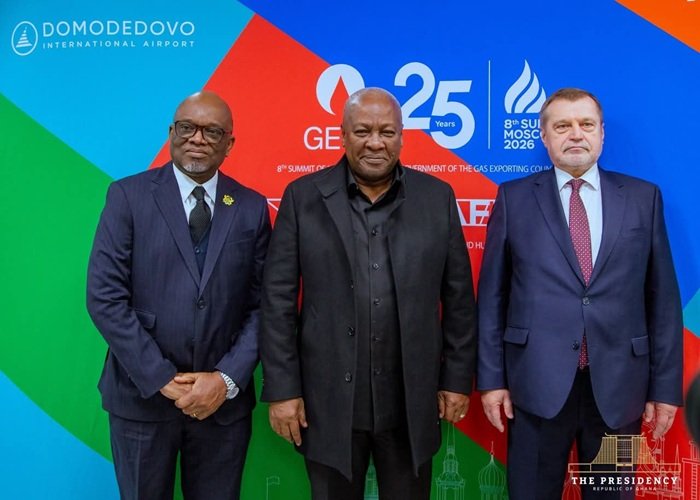
President John Mahama has arrived in Moscow, Russia, from Ethiopia to participate in the 3rd Russia-Africa Summit.
The summit is being hosted by Russian President Vladimir Putin.
During the visit, President Mahama will join fellow African leaders at the Economic and Humanitarian Forum and summit plenary sessions.
He is also scheduled to hold high-level bilateral talks with President Putin and attend a Kente exhibition organised by the Russia-Ghana Parliamentary Forum.
As part of the visit, the President will receive honorary doctorate degrees from the Russian University of Transport and the Peoples’ Friendship University of Russia.
He will also engage Russian businesses and state institutions to advance bilateral cooperation between Ghana and Russia.
By Edem Mensah-Tsotorme