Hot!
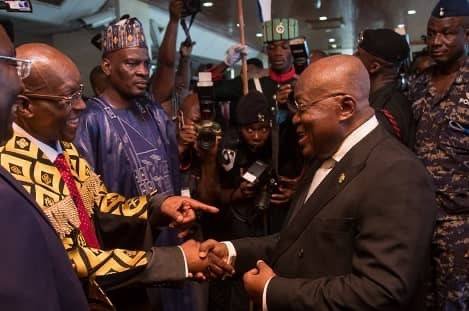
Parliament to drag Akufo-Addo to court for refusing to sign Witchcraft, Armed Forces bills

- /home/u249204778/domains/spectator.com.gh/public_html/wp-content/plugins/mvp-social-buttons/mvp-social-buttons.php on line 27
https://spectator.com.gh/wp-content/uploads/2024/01/5a8c299c-05f3-4790-b48d-252bc450ac3e.jpeg&description=Parliament to drag Akufo-Addo to court for refusing to sign Witchcraft, Armed Forces bills', 'pinterestShare', 'width=750,height=350'); return false;" title="Pin This Post">
- Share
- Tweet /home/u249204778/domains/spectator.com.gh/public_html/wp-content/plugins/mvp-social-buttons/mvp-social-buttons.php on line 72
https://spectator.com.gh/wp-content/uploads/2024/01/5a8c299c-05f3-4790-b48d-252bc450ac3e.jpeg&description=Parliament to drag Akufo-Addo to court for refusing to sign Witchcraft, Armed Forces bills', 'pinterestShare', 'width=750,height=350'); return false;" title="Pin This Post">
Speaker of Parliament, Alban Bagbin, has announced plans by Parliament to seek legal interpretation over President Nana Addo Dankwa Akufo-Addo’s decision not to sign some bills passed by the House.
President Nana Addo Dankwa Akufo-Addo, last year, refused to sign the Criminal Offences Bill of 2022, the Witchcraft Bill, and the Armed Forces Bill of 2023.
President Akufo-Addo cited the financial implications of the bills as his reason for refusing to assent to them.
But the Speaker of Parliament says they will go to court to seek interpretation.
“I want to end up by assuring you that I will definitely be in touch with my good friend the president, his excellency Nana Addo Dankwa Akufo-Addo even though I disagree with him in his refusal to assent to our bills and I have given notice that we will be in court about this matter,” he said.
The Speaker of Parliament, Alban Bagbin, insists that President Akufo-Addo cannot determine the constitutionality of the Bills in question as it was the sole purview of the Supreme Court, for which reason any allegations of misuse should be contested by it (the Supreme Court) and no one else.
President Akufo-Addo specifically identified the Ghana Armed Forces Amendment Bill, sponsored by MP Francis-Xavier Sosu, as having financial burdens associated with replacing the death penalty with life imprisonment.
The Speaker of Parliament, in an official response to the president, stressed, “The determination of any unconstitutionality is the sole purview of the Supreme Court, not the President. Hence, if there were concerns about Parliament acting beyond its constitutional authority, i.e., acting ultra vires, the appropriate course of action would be an action before the Supreme Court, not an executive declaration of unconstitutionality.”
“Again, the constitutional discretion vested in the presiding officer of Parliament, as per Article 108 and subject to Article 296, suggests that any allegations of misuse of this discretion should be contested in a court of competent jurisdiction, rather than being pre-emptively adjudicated upon by the President.”
Source: Citinewsroom.com


General Secretary of the New Patriotic Party (NPP), Justin Kodua Frimpong, has filed his nomination to contest the position of General Secretary again as the party begins its rebuilding efforts ahead of the 2028 general elections.
He was accompanied by party stalwarts and supporters who were in high spirits, expressing confidence that he is the right person to hold the position.
Speaking after filing his nomination, Mr Kodua Frimpong assured the rank and file of the party that he would not disappoint them.
“I can assure you that the faith the rank and file of the party have had in me, I will never disappoint them,” he said.
He also pledged to run a clean campaign devoid of personal attacks.
“I can assure you that our internal campaign will be devoid of personal attacks,” he told his fellow contestants and the rank and file of the party as he seeks to retain his position.
His tenure has seen the party through the 2024 general elections, where the NPP lost power to the National Democratic Congress (NDC) after eight years in government.
The party is currently in a rebuilding phase, with internal elections scheduled to elect new national executives to lead its reorganization towards the 2028 polls.
The General Secretary position is considered one of the most influential in the party’s administrative structure, responsible for the day-to-day running of the party secretariat and implementation of party decisions.
By Edem Mensah-Tsotorme

The University of Ghana Medical Centre (UGMC) has disputed claims made on social media by comedian Michael Blackson concerning the treatment given to his late mother, saying a review found that the allegations did not accurately reflect what happened during her stay at the hospital.
In a statement issued in Accra on August 5, 2026, the management of UGMC expressed condolences to Mr. Blackson and his family over the death of his 83-year-old mother, who died at the facility on July 16, 2026.
The hospital said it had taken the concerns raised by Mr. Blackson seriously and conducted a thorough review in line with its clinical and administrative procedures.
According to the statement, the facts presented by Mr. Blackson on social media contained “numerous inaccuracies” and did not accurately reflect the medical care provided to his mother.
UGMC explained that she was referred to the facility from another hospital and received treatment there from May 27 to July 16, 2026, a period of about eight weeks.
The hospital stated that it would not release details of her diagnosis, treatment, medical records or other aspects of her care because it had a duty to protect patient confidentiality, even after death.
It said the decision was intended to respect the dignity of the deceased and the privacy of her family.
UGMC further stated that all clinical decisions at the facility are made by qualified healthcare professionals based on medical judgment, established standards of care and the best interests of the patient.
The statement added that such decisions are made in consultation with authorised family representatives where necessary and that billing and financial procedures are governed by institutional policies and are separate from clinical decision-making.
The hospital noted that it values feedback from patients and their families and considers both positive and negative comments important for improving the quality of care.
Mr. Blackson had earlier used social media to criticise the care his mother received at UGMC, prompting the hospital’s response.
By: Jacob Aggrey