News
Nkonya descendants coming home from Diaspora

- /home/u249204778/domains/spectator.com.gh/public_html/wp-content/plugins/mvp-social-buttons/mvp-social-buttons.php on line 27
Warning: Trying to access array offset on false in /home/u249204778/domains/spectator.com.gh/public_html/wp-content/plugins/mvp-social-buttons/mvp-social-buttons.php on line 27
&description= Nkonya descendants coming home from Diaspora', 'pinterestShare', 'width=750,height=350'); return false;" title="Pin This Post">
- Share
- Tweet /home/u249204778/domains/spectator.com.gh/public_html/wp-content/plugins/mvp-social-buttons/mvp-social-buttons.php on line 72
Warning: Trying to access array offset on false in /home/u249204778/domains/spectator.com.gh/public_html/wp-content/plugins/mvp-social-buttons/mvp-social-buttons.php on line 72
&description= Nkonya descendants coming home from Diaspora', 'pinterestShare', 'width=750,height=350'); return false;" title="Pin This Post">
From the ancestral hills of Nkonya, a global call to remembrance is rising.
This October, the quiet village of Kromo (now Tepo) will become the epicenter of a transcontinental memorial as Ghana and the United States jointly launch African Holocaust Month-a solemn tribute to the millions of African lives lost to the transatlantic slave trade.
Held annually on the second Saturday of October, the ceremony this time will unfold simultaneously in Kromo, Ghana, and Kentucky, USA, with commemorative benches placed facing each other across the Atlantic.
At exactly 4pm Ghana time, libations will be poured, wreaths laid, and names of the departed read aloud—restoring dignity to those whose stories were silenced by history.
But this is more than ritual. It is prophecy fulfilled. Kromo, once a thriving community along the slave route from Salaga, bears the scars of betrayal.
Oral history recounts a tragic moment when slave traders raided the village during a hunting absence, capturing youth aged 16 to 20—including a revered Queen mother and her attendants.
The grief-stricken community relocated, giving birth to present-day Tepo.
For generations, the people of Nkonya prayed that the Queen mother’s descendants would return—not just in body, but in royalty.
That prayer was answered in 2007, when Ur Aua Hehimetu Ra Enkamit, Paramount King of the Ausar Auset Society in Washington, D.C, USA, returned to Nkonya following a DNA test.
He was formerly known as Dr Lee Cook Jr.
A direct descendant of David Cook (e) of Kentucky, his lineage traces back through five generations to Edmon Cooke, whose roots are believed to pass through Kromo.
“This is not just a memorial— it’s a restoration of ancestral ties,” said Ur Aua Enkamit in a chat with The Spectator.
“Kromo is both literal and symbolic. Even if your ancestors didn’t pass through here, it represents every nameless place Africans were captured and marched toward the coast,” he emphasised.
The initiative invites all people of African descent—whether from Ghana, Jamaica, the U.S., or beyond—to participate.
He encouraged families to identify ancestral land for bench placement, submit names of deceased relatives for the reading, coordinate with diaspora kin for simultaneous ceremonies, and arrive in Nkonya before the event.
Benches, he stressed, would be provided in Kromo, with wreaths available upon request. Once placed, families need only return each year with names and offerings.
African Holocaust Month draws inspiration from Ida B. Wells, the pioneering journalist who in 1909 used the term “holocaust” to describe atrocities against African people—decades before its association with World War II.
This October, her words echo across oceans, as descendants reclaim memory, identity, and sacred ground.
From Kingsley E. Hope Kumasi
Join our WhatsApp Channel now!
https://whatsapp.com/channel/0029VbBElzjInlqHhl1aTU27


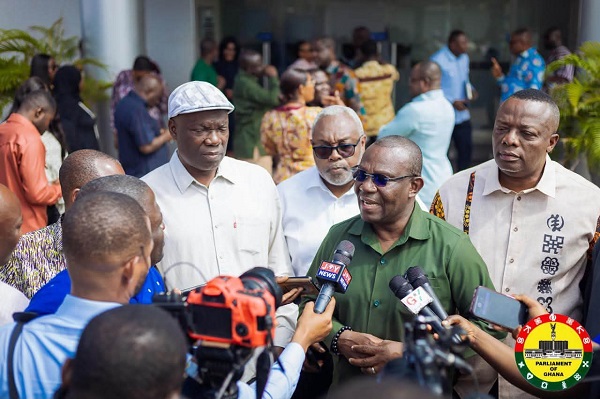
The Parliamentary Select Committee on Energy has appealed to the Ministry of Finance to release GH¢5.6 million to the Petroleum Commission to enable it to establish and operate a world-class data centre.
According to the Committee, access to the funds will strengthen the Commission’s capacity to manage critical upstream petroleum data and improve its operations.
Speaking during the appeal, Chairman of the Committee, Emmanuel Kwasi Bedzrah, said the move was crucial to efforts to revitalise Ghana’s upstream petroleum industry and increase oil production.
He noted that although investment and hydrocarbon production had declined in recent years, Parliament’s approval of an extension of the petroleum agreement to 2030 had attracted additional funding and contributed to an increase in production from about 80,000 to 120,000 barrels per day.
Meanwhile, concerns have been raised over repeated budget allocations for oil exploration in the Voltaian Basin.
Mr. Bedzrah stressed that funds approved for exploration must produce tangible results, adding that the Committee would require clear evidence of progress before supporting future budget allocations for the programme.
The appeal was made during a working visit to the Petroleum Commission as part of the Committee’s oversight activities to assess its operations and management procedures.
During the engagement, the Chief Executive Officer of the Petroleum Commission, Emeafa Hardcastle, took the Committee through the Commission’s working procedures and mandate, which includes regulating, managing and coordinating upstream petroleum activities.
She disclosed that since assuming office in 2025, government had pursued measures to reverse the decline in crude oil production, sustain output and reposition Ghana as an attractive destination for investment in Africa’s increasingly competitive petroleum sector.
In addition, she said government had secured fresh commitments of about US$35 billion to help revitalise the sector.
As part of the oversight exercise, the Committee is expected to conclude its monitoring visit with engagements at the National Petroleum Authority (NPA) and the Ghana Oil Company Limited (GOIL).
By Edem Mensah-Tsotorme
News
“No civilisation deserves to be annihilated” – Mahama calls for dialogue on global conflicts at UNGA 81
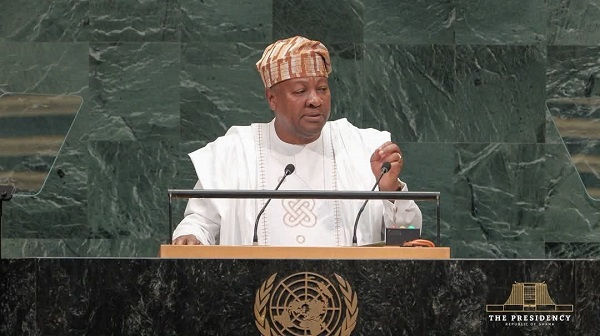
President John Dramani Mahama has called for solidarity and dialogue in resolving global conflicts, insisting that no civilisation deserves to be wiped out.
“No human civilisation deserves to be annihilated, certainly not a member state of the United Nations,” President Mahama stated in his address at the 81st United Nations General Assembly in New York.
He called for solidarity with nations facing terrorism, especially the Alliance of Sahel States (AES), and for a uniform approach to conflicts in Europe, the Middle East and Africa.
On the Middle East, the President called for a return to negotiations, saying “The current Middle East crisis is having a deleterious effect on the world economy.”
“I believe that dialogue can resolve even the most intractable of problems,” he added.
By Edem Mensah-Tsotorme