News
Nana Kwesi Coomson honoured by British Council at Study UK Alumni Awards


Media strategist and youth empowerment advocate, Nana Kwesi Coomson has been recognised by the British Council at the Study UK Alumni Awards for his outstanding contribution to strategic communications, public relations and media.
The ceremony, held on Friday, February 21, 2025, at the British Council in Accra, celebrated alumni who have made significant impacts in their respective fields after studying in the UK.
The awards are in four categories namely; Social Action, Culture and Creativity, Business and Innovation and Science and Sustainability.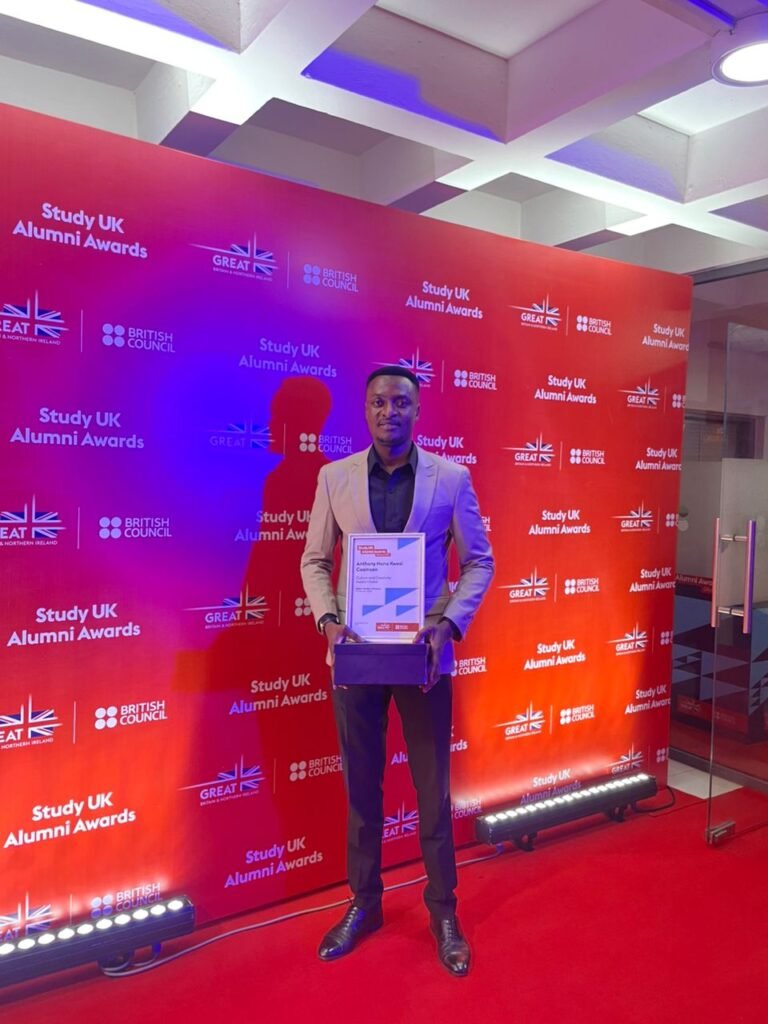
Mr. Coomson who was recognised in the Culture and Creativity category is a Tullow Group Scholarship recipient who pursued a Master’s degree in Corporate Social Responsibility and Energy at Robert Gordon University, Aberdeen in 2016.
Over the years, he has leveraged his expertise in media and communication to spotlight talents, empower young people, and support the underprivileged in society.
He has been instrumental in driving youth development initiatives across the country and is a public speaker who empowers students and the youth in general to aspire to greater heights.
His efforts in strategic media engagement have provided a platform for many rising talents in various industries, particularly in the creative and entrepreneurial sectors.
In the creative arts space, he is the public relations manager for multiple award-winning Artiste, Kofi Kinaata and also the head of communications for Western Music Awards. He as well head Chronicle newspaper’s Arts and Entertainment column and also the Editor-in-Chief of online news portal www.233times.net.
In the youth empowerment space, he is the convener of ‘Yes We Can,’ an annual pep-talk with Basic Education Certificate Examination (BECE) Candidates which seeks to help them fight exams fright and help them on how to answer the questions in the BECE.
Speaking on the recognition on Facebook, Mr. Coomson expressed gratitude to Tullow Group Scholarship Scheme, British Council for the honour and reaffirmed his commitment to using the power of strategic communication and media to drive social change.
“This recognition is a reminder that when we tell the right stories, amplify the right voices, and use media as a tool for change, we can transform lives. I dedicate this to all young people striving to make a difference and to everyone supporting the journey of impact. Special mention to my Coach and Mentor, Philip Osei Bonsu for continued guidance,” he said.
Mr. Coomson is also a Mandela Washington Fellow who pursued Business and Entrepreneurship at the Clark Atlanta University in Georgia, USA in 2018.
The Study UK Alumni Awards highlight the achievements of outstanding UK alumni worldwide, celebrating their contributions to their communities and industries. Mr. Coomson’s recognition serves as an inspiration for many young professionals seeking to use their skills and knowledge for societal good.



The New Patriotic Party (NPP) says it has successfully conducted constituency executive elections in 245 out of its 276 constituencies across the country.
The party’s General Secretary, Justin Kodua Frimpong, said the exercise recorded an 88.7 per cent success rate and was conducted peacefully in the constituencies where voting took place.
In an update posted on his Facebook page, he said elections in 23 constituencies were put on hold because of various disputes.
He added that four constituencies Ningo Prampram, Atwima Mponua, Obuasi West and Trobu could not hold their elections due to last minute challenges.
According to him, the party’s National Steering Committee will also review election activities in Afigya Sekyere East, Adansi Asokwa, Bantama and Asante Akyem Central.
Mr Frimpong said the National Secretariat is committed to resolving all outstanding issues to ensure the successful completion of the constituency executive elections.
He expressed appreciation to members of the party for their support and discipline throughout the exercise.
“We extend our sincere appreciation to all Patriots for their commitment, discipline, and support, which contributed to the successful conduct of these elections,” he stated.
By: Jacob Aggrey
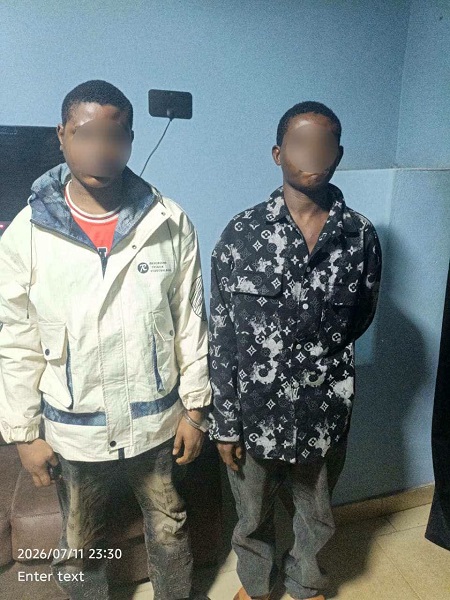
The Northern Regional Police Command has arrested two Nigerian nationals in connection with the murder of a 36-year-old Nigerian man at Sanzirigu in Tamale.
The suspects, identified as Daniel Victor Eze and David Oko Ewa, were arrested on Saturday, July 11, shortly after the body of Nkemujika Uzorchuku Eze was found in his bedroom.
According to the Police, preliminary investigations showed that the deceased lived in a three-bedroom apartment with his wife, Peace Uzorchuku, the two suspects and another Nigerian national, Godwin Nwafor.
The Police said officers began investigations after receiving a report that the deceased had been found lying in a pool of blood in his room.
A team that visited the scene found that he had suffered a deep cut to the forehead and had a towel stuffed into his mouth. The room had also been ransacked.
The Police said a wooden pestle believed to have been used in the attack, together with other items, was recovered from the scene for forensic examination.
The body was taken to the Tamale Teaching Hospital, where a medical officer confirmed him dead before it was deposited at the hospital mortuary for preservation and an autopsy.
According to the Police, intelligence-led operations led to the arrest of the two suspects at Tatale on the same day while they were allegedly attempting to escape into the Republic of Togo.
They were later handed over to the Tamale District Criminal Investigations Department to assist with investigations.
The Police said the suspects allegedly admitted during interrogation that they had conspired to kill the deceased because he had been withholding money they claimed was obtained through internet fraud.
A search conducted after their arrest led to the recovery of several items suspected to have been stolen from the deceased’s room, including mobile phones, laptop computers, a tablet, jewellery, clothing, wristwatches, personal documents and other valuables. The Police said the items have been kept as exhibits to support the investigations.
The suspects remain in Police custody and are expected to appear before court on Monday, July 13, to facilitate the ongoing investigations.
The Northern Regional Police Command said it remains committed to bringing everyone involved in the crime to justice and urged the public to provide credible information to help fight crime.
By: Jacob Aggrey