Hot!
Nana Kwasi Gyan-Appenteng’s AFCON 24-2


- /home/u249204778/domains/spectator.com.gh/public_html/wp-content/plugins/mvp-social-buttons/mvp-social-buttons.php on line 27
https://spectator.com.gh/wp-content/uploads/2024/01/f5b94803-88b1-420a-8fe8-3cd93bd172cc.jpeg&description=Nana Kwasi Gyan-Appenteng’s AFCON 24-2', 'pinterestShare', 'width=750,height=350'); return false;" title="Pin This Post">
- Share
- Tweet /home/u249204778/domains/spectator.com.gh/public_html/wp-content/plugins/mvp-social-buttons/mvp-social-buttons.php on line 72
https://spectator.com.gh/wp-content/uploads/2024/01/f5b94803-88b1-420a-8fe8-3cd93bd172cc.jpeg&description=Nana Kwasi Gyan-Appenteng’s AFCON 24-2', 'pinterestShare', 'width=750,height=350'); return false;" title="Pin This Post">
What shall we say – about the 42-year curse on the Black Stars?
Putting an optimistic gloss on a Black Stars match has become increasingly demanding, even at the best of times.
The worst of times demand more cryptic adjectives that suppress instead of describing the reality of our mass depression. In that sense, the reporter must act in response to a psychological emergency instead of filling a gap of ignorance. In truth, it serves a better purpose to throw up one’s hands and ask: What shall we say?
Let us begin with the facts, or rather the fact. Ghana’s Black Stars lost their opening match of the 2024 AFCON tournament to Cape Verde’s Blue Sharks.
Cape Verde’s national team’s nickname comes from the country being a small island (obviously surrounded by the blue sea) with supersized ambitions.
In FIFA’s global ranking, Ghana is in the 61st position with Cape Verde at 74. On the field of play, the Sharks were better than the Stars in most departments, including ball possession, goal attempts, corner kicks, and shots on goal.
The most telling stat is this: the Cape Verde Goalkeeper did not have to make a single save. These are the facts. No adjectives required.
However, this is a match from which Ghana could have taken a point. The best we can say is that the Black Stars were on course to do so, but for a calamitous, ruinous, catastrophic defensive lapse in the dying minutes of the game.
That is our excuse, and we are sticking to it. The truth is bitter, but that is its taste, so we have to swallow it. We were second best for most of the evening, although again, we can point to refereeing decisions that could have gone our way if the gods of football had favoured us on the night.
To paraphrase MTN, the headline sponsor of the Black Stars, EVERYWHERE YOU GO, you will meet a Ghanaian coach, and as one of Ghana’s accredited 30 million coaches, I insist that we lost this opening match in the midfield.
Without any offence to the players, this coach believes that the Ghana formation cried out for at least two creative midfielders to hold the ball when it needed holding, to distribute it when that was needed, but to be accurate at all times, or most of the time.
That could have relieved the pressure on the full backs and the hapless goalkeeper, whose performance exemplifies a curious Akan word-play: kumfo-domfo: killer-redeemer. He was brilliant when he was, and out of his depth when he needed to stay between the sticks.
This was the first match, and it was against an opponent that should have shown Ghana a measure of respect, for history’s sake. But the days are long gone when teams used to fear the Black Stars. Post-Comoros, we Ghanaians fear every team.
What shall we say? On paper, our team is as good as any other team at this year’s AFCON. There were glimpses of the brilliance that is begging to come out but something is stopping the team from performing. If I am permitted to switch from coach to psychologist, I would suggest that the team don’t look like a happy bunch. Are we too hard on them, or perhaps the gods are to blame after all.
A couple of days ago, I watched a Citi News TV documentary on the Black Stars in which former Black Star legend George Alhassan explained that there is a curse on the team.
He explained that in 1982, the players felt betrayed when the PNDC Chairman and Head of State Flt Lt. Rawlings only gave them a salute after they won the cup for the fourth time. The precise moment of the curse was when they entered the team but that took them away from Burma Camp, where the snub occurred.
Obviously, the time has come to remove this curse, at least to prevent the Black Stars goalkeeper from grabbing empty air on the 90 minute mark.
Unfortunately, the little I know about reversing curses makes this a depressing prospect. As I understand it, a curse can be reversed only by the curser(s) at the same spot at which this curse was pronounced. Mr Alhassan said that the curse was laid collectively by the whole team.
The mere thought of assembling the 1982 Black Stars all in one bus at Burma Camp hurts my brain. I can’t think far. It is easier to remain a coach than a curse remover; or put another way, we need a person who can remove this curse as the national coach.
kgapenteng@gmail.com



The Tema Regional Police Command has arrested a 32-year-old man for allegedly posing as a soldier and extorting money from unsuspecting members of the public at Ashaiman.
The suspect, identified as Bright Atsu Kudiabor, was arrested by the Ashaiman Police on Wednesday, September 16, 2026, at about 7:00 a.m.
According to the Police, he was arrested at an area known as “I Shall Return”, where he was allegedly parading himself as a soldier and demanding money from people.
The Police said Kudiabor, who is an ex-convict, was initially arrested by personnel of the Ghana National Fire Service in Ashaiman with assistance from other members of the public.
A search conducted on him after he was handed over to the Police reportedly led to the recovery of a set of military camouflage uniform.
The suspect is currently in Police custody and assisting with investigations.
The Tema Regional Police Command said he would be processed for court after investigations are completed.
The Police urged the public to remain vigilant and report anyone who falsely presents themselves as a soldier or a member of another security agency to deceive or extort money from the public.
By: Jacob Aggrey
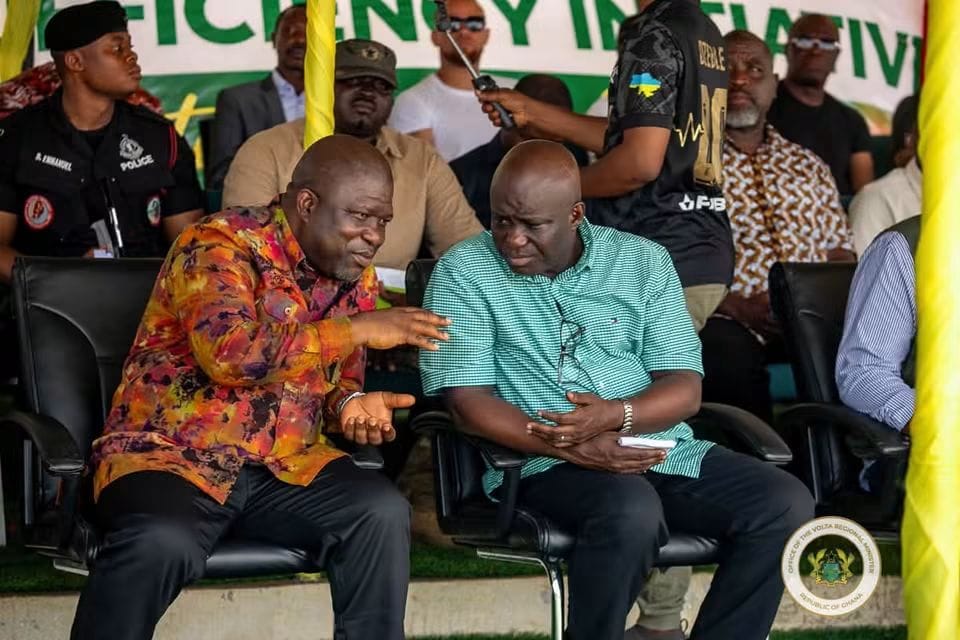
Volta Regional Minister, James Gunu, says the Volta Region holds enormous agricultural potential and efforts must be geared towards connecting farmers to the needed resources to unlock that potential.
He said focus must be on linking farmers to resources, technology, financing and markets to increase production, create jobs and build sustainable livelihoods.
Hon. Gunu made the remarks at the national launch of the Ghana Tomato Self-Sufficiency Initiative (GHATSI) held at Anloga in the Volta Region on Tuesday, September 15.
The initiative, under the theme “Produce at Home. Feed the Nation. Export the Surplus,” seeks to boost local tomato production, processing and marketing while reducing Ghana’s heavy reliance on imported tomatoes.
The launch was attended by the Minister for Food and Agriculture, Eric Opoku, his Deputy, John Setor Dumelo, Feed Ghana Coordinator, Bright Demordzi, Members of Parliament, traditional leaders, MMDCEs, farmers and other stakeholders.
Mr.Gunu expressed appreciation to the Minister for Food and Agriculture for the support announced for the region, including two excavators, 200 cartons of organic fertiliser, and GH¢200,000 for Ms. Kuatudzo Esther Dela, a tomato farmer and processor from Ziope.
He described the initiative as an important step towards making agriculture a stronger driver of food security, job creation and economic growth in the Volta Region.
By Edem Mensah-Tsotorme