Hot!
Most countries ‘woefully unprepared’ for changing climate: analysis

- /home/u249204778/domains/spectator.com.gh/public_html/wp-content/plugins/mvp-social-buttons/mvp-social-buttons.php on line 27
https://spectator.com.gh/wp-content/uploads/2022/07/17d5ac4ec4224ec7.jpg&description=Most countries ‘woefully unprepared’ for changing climate: analysis', 'pinterestShare', 'width=750,height=350'); return false;" title="Pin This Post">
- Share
- Tweet /home/u249204778/domains/spectator.com.gh/public_html/wp-content/plugins/mvp-social-buttons/mvp-social-buttons.php on line 72
https://spectator.com.gh/wp-content/uploads/2022/07/17d5ac4ec4224ec7.jpg&description=Most countries ‘woefully unprepared’ for changing climate: analysis', 'pinterestShare', 'width=750,height=350'); return false;" title="Pin This Post">
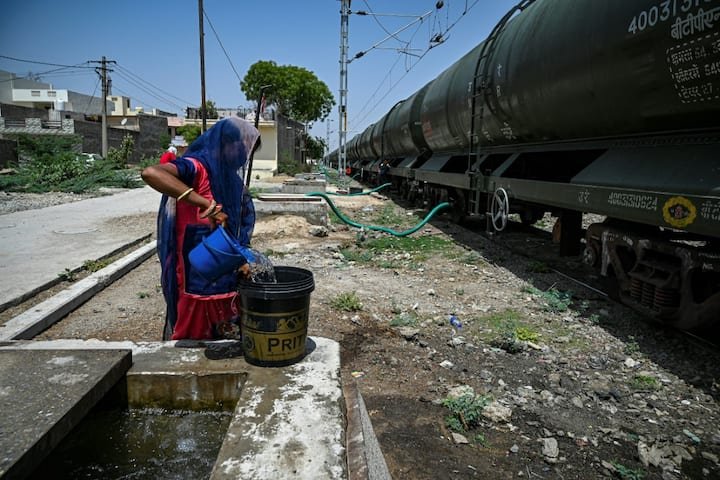
Some middle-income nations lack the infrastructure and
legislative freedom to keep pace with the changing climate.
Photo: Prakash SINGH / AFP/File
Major economies such as India, Brazil and Russia face “cascading” crises driven by climate change such as food insecurity, energy shortages and civil unrest, an industry analysis warned Thursday.
While developing nations of Africa and Southeast Asia are predicted to be worst hit by higher temperatures, extreme weather and sea-level rise, some middle-income nations lack the infrastructure and legislative freedom to keep pace with the changing climate.
And, as Europe counts the cost of another record-shattering heatwave, the analysis showed how even nations with typically few climate-linked crises will need to adapt as global temperatures rise.
The analysis looked at countries’ performances across 32 structural issues — including weather-related events, political stability, economic power, resource security, poverty and human rights — to assess each nations’ capacity to manage crises.
Unsurprisingly, most wealthy nations performed well and were found to be the most insulated against climate shocks thanks to a combination of good governance, purchasing power and robust infrastructure.
Developing nations were mainly deemed to be in the vulnerable category for lacking these safeguards. Several middle-income countries, however, including India, Indonesia and South Africa also fell into this grouping.
Risks will spill over
“The low levels of investment in looking at the secondary risks show that most countries are almost entirely unprepared to deal with the wider political, economic and developmental impacts of a warming planet,” said the analysis.
Will Nichols, head of climate and resilience at consultancy firm Verisk Maplecroft that conducted the assessment, said the major surprise was in the middle — or the “precarious” category — which contained powerhouses such as Brazil, Mexico, Russia and Saudi Arabia.
“A slight change could see it drop into that bottom group and we are certainly seeing the erosion of environmental and social protections under (President Jair) Bolsonaro.
“In Russia, Arctic infrastructure is going to be undermined by warming and you could see a leader like (President Vladimir) Putin point the finger at other groups and seek to expand its territory,” Nichols said.
Although a G20 economy, Mexico landed in the precarious category largely due to its proximity to Central and South American nations such as Venezuela facing extreme climate-linked disruption, particularly in the form of mass migration.
“These risks aren’t contained by political boundaries, they will spill over,” said Nichols.
“Even if you have your house in order, if your neighbour is a basket case that can seriously undermine your ability to protect yourself.”
‘Don’t have resilience’
Under the UN-led climate action plan, rich nations promised in 2009 to provide $100 billion annually to at-risk countries by 2020 but have so far failed to even approach that level of funding.
Nichols said the analysis showed the need for developed countries to help nations that cannot help themselves.
“We’ve seen relatively small amounts of people arriving in Europe and the US due to climate impacts causing major issues,” he said.
“There’s an argument that we as insulated nations have a responsibility to help vulnerable nations to protect themselves, which in turn helps protect us.”
Nichols said this week’s deadly heatwave in Europe was proof that even rich countries needed to factor climate change into future business and governance decisions.
“The scale of the climate threat isn’t diminishing — it is obviously going to have a huge impact,” he said.
“But countries in Sub-Saharan Africa, Southeast Asia and South America don’t have the resilience to manage both the physical climate threat and the knock-on effects of political and supply chain instability.”
Source: AFP


General Secretary of the New Patriotic Party (NPP), Justin Kodua Frimpong, has filed his nomination to contest the position of General Secretary again as the party begins its rebuilding efforts ahead of the 2028 general elections.
He was accompanied by party stalwarts and supporters who were in high spirits, expressing confidence that he is the right person to hold the position.
Speaking after filing his nomination, Mr Kodua Frimpong assured the rank and file of the party that he would not disappoint them.
“I can assure you that the faith the rank and file of the party have had in me, I will never disappoint them,” he said.
He also pledged to run a clean campaign devoid of personal attacks.
“I can assure you that our internal campaign will be devoid of personal attacks,” he told his fellow contestants and the rank and file of the party as he seeks to retain his position.
His tenure has seen the party through the 2024 general elections, where the NPP lost power to the National Democratic Congress (NDC) after eight years in government.
The party is currently in a rebuilding phase, with internal elections scheduled to elect new national executives to lead its reorganization towards the 2028 polls.
The General Secretary position is considered one of the most influential in the party’s administrative structure, responsible for the day-to-day running of the party secretariat and implementation of party decisions.
By Edem Mensah-Tsotorme

The University of Ghana Medical Centre (UGMC) has disputed claims made on social media by comedian Michael Blackson concerning the treatment given to his late mother, saying a review found that the allegations did not accurately reflect what happened during her stay at the hospital.
In a statement issued in Accra on August 5, 2026, the management of UGMC expressed condolences to Mr. Blackson and his family over the death of his 83-year-old mother, who died at the facility on July 16, 2026.
The hospital said it had taken the concerns raised by Mr. Blackson seriously and conducted a thorough review in line with its clinical and administrative procedures.
According to the statement, the facts presented by Mr. Blackson on social media contained “numerous inaccuracies” and did not accurately reflect the medical care provided to his mother.
UGMC explained that she was referred to the facility from another hospital and received treatment there from May 27 to July 16, 2026, a period of about eight weeks.
The hospital stated that it would not release details of her diagnosis, treatment, medical records or other aspects of her care because it had a duty to protect patient confidentiality, even after death.
It said the decision was intended to respect the dignity of the deceased and the privacy of her family.
UGMC further stated that all clinical decisions at the facility are made by qualified healthcare professionals based on medical judgment, established standards of care and the best interests of the patient.
The statement added that such decisions are made in consultation with authorised family representatives where necessary and that billing and financial procedures are governed by institutional policies and are separate from clinical decision-making.
The hospital noted that it values feedback from patients and their families and considers both positive and negative comments important for improving the quality of care.
Mr. Blackson had earlier used social media to criticise the care his mother received at UGMC, prompting the hospital’s response.
By: Jacob Aggrey