Features
Jobless thousands in Sikaman – Final part


I MY former classmate, Kofi Owuo, alias ‘Death By Poverty’ told me last week that it is a sin to be unemployed in Sikaman.
According to him, every unemployed or redeployed person, whether he is a born-again or not, is a potential suspect when it comes to cases involving missing fowls, disappeared cats and monies that cannot be found where they are supposed to be.
Unfortunately still, the unemployed are regarded as sinful because they are perceived as lazy people who do not want to work, moreso when the Holy Bible is against sloth.
The unemployed are never free from suspicion. It is always predicted that sooner or later he’d impregnate a JSS school-girl and attempt to abort, or deny responsibility, or both.
And no one is keen on inviting an unemployed person to an outdooring, birthday party or wedding. The fear is that with a virtually empty stomach, he’d vent his spleen on the food and devour with all his might, drink to his utmost satisfaction and quietly sneak out without offering a little donation.
Indeed the unemployed person is perceived to be very dangerous person with a long throat and an elastic stomach that can do wonders during outdoorings. He must be kept at bay.
Everyone really forgets that it is no fault of his that he remains jobless. Fact is that it is a taboo to find ready employment in Sikaman.
As I suggested last week, it is only in heaven that getting employed is not a problem. But heaven is quite distant from here. Even born-agains who speak in Swahili and Hebrew simultaneously can only get there after they die. So the problem lies here and must be solved here.
Today, jobs are so scarce that one needs a power- torchlight to find wherever they are hiding. Many well-qualified graduates have no say but to accept jobs as bank clerks which normally is taken by O’ level certificate holders or even those with GCE passes.
But that is better than being a graduate ‘house-wife’. At least such a graduate would not chew stones, neither will he munch grass. But he can’t look after his ageing mother after settling all the bills, has got a cocoa farm, he could go and mortgage it and then he can get some cash and marry.
Graduates who are lucky to get jobs as clerks are better off. There are hundreds of jobless others with equally good qualifications who cannot get employed even as bank messengers. No vacancy, mister!
So many of them have to stoop low, going from one rich man’s house to another soliciting part-time jobs to teach their preparatory school children for a fee. In Tema, this is termed COACHING. Even here, the competition is great because teachers are also all out to get such jobs to supplement their incomes.
Still, are the luckless ones who have nothing doing apart from being always busy writing applications to private companies and public organisations.
The reply to such an application is normally enclosed in beautiful envelop spelling hope of success.
The applicant, however, opens the envelope with trembling hands, fumbling with everything. Awkwardly, he manages to extract the letter, hurriedly opens it to read the good news.
And the good news is this “….. Thank you for showing keen interest in our company…… Sorry, all vacancies are filled….. Wish you luck else-where……. “
When the applicant, however, writes in response to an advert in the dailies, the chances are that he’d be called to an interview. That day he dons his X’mas dress, wears a new haircut (not punk), borrows a decent shoe from a friend and attends the interview with the Lord’s Prayer and Psalm 23 on his lips. “The Lord is my shepherd, I shall not want…
No one should blame him! He has attended over nine such interviews and none had proved successful. Perhaps on those previous occasions he had forgotten to say the Lord’s prayer, so why be silly enough to forget it this time!
Although he goes for the interview with confidence he is still at a disadvantage. He recalls that the advertiser had been deliberately cruel: “Young graduates wanted as management trainees…… Age limit 26”.
But the applicant is 29 because he completed university at 25, did a year of national service and thereafter became jobless for three years. So, he is automatically disqualified age-wise.
The advertiser may have requested something like this: “Wanted for immediate employment….. Applicants must have not less than five years practical experience.
When it comes to responding to such an advert, the disillusioned applicant would have to be bold enough to state, “Sir, I have five years practical experience in sleeping and snoring at home….. I hope my application would be granted favourable consideration…..Signed!
Anyhow, he is still called to attend an interview. But in most cases he must be smart enough to understand the procedure before-hand. You don’t have to be ‘too-know’.
Understanding the procedure can be a complex issue. But in its simplest terms, you only have to trace the home of one panel member and hand him a fat envelope. That settles it.
So on the D-day, the interview becomes a mere formality, successful candidates are determined long before the interview commences.
With girl applicants, the procedure often becomes different in format, if the boss is unscrupulous. She may not need to attend a panel interview after all. The interview can be held quietly in a hotel room with the boss, while the secretary types out the appointment letter.
Born-again female applicants do not yield to such unorthodox procedure and they cry out to Jesus Christ and Elijah to intercede on their behalf. Sikaman is really a tough ground for school leavers.
At least 3,000 graduates are eligible for employment every year after national service. At least 1,000 do not get employed and half of this number are forced to leave the country to Zambia, Namibia, Zimbabwe or Germany which is better pronounced as JAAMANI, where they slug it out the hard way.
The other half languish in the capital employed writing applications after application. Each year their number increases in geometric progression.
And I predict that it would soon come to a time when frustrated graduates will start doing what they are not supposed to be doing – for instance joining the ‘stowaway’ gang.
That would not be all. I wouldn’t also be surprise if some die-hards among them start enlisting as armed robbers. In a situation of destitution and acute frustration, anything can happen, even the seemingly undreamt of. The devil finds work for the idle mind.
And don’t forget, man must eat every day, buy clothes to cover his nakedness, pay the bills, get married and have children. They are not supposed to be breathing down the necks of their ageing parents for food thrice daily.
A radical solution must be found to this problem of joblessness. And the saddest part is that while everyone is overly concerned about the plight of workers, nobody is seriously concerned about the plight of the jobless. At least workers have some- thing to live on. The jobless have nothing at all. See the difference?
Admittedly, certain attempts have been made to make available job opportunities. For instance the National Board for Small Scale Industries (NBSSI) is doing its best to train and equip certain categories of the unemployed and redeployed. But how many of them can they take on in a year? The programme must be expanded.
The National Mobilization Programme has done creditably in the rural areas. In the cities, they have not tackled the problem at all. There is more room for improvement.
As we are all prepared to enter into a new political era, let’s also think about creating a new era for the jobless thousands living in abject destitution. It is only then that they can actively participate in the evolving democratic process.
This article was first published on May 11, 1991


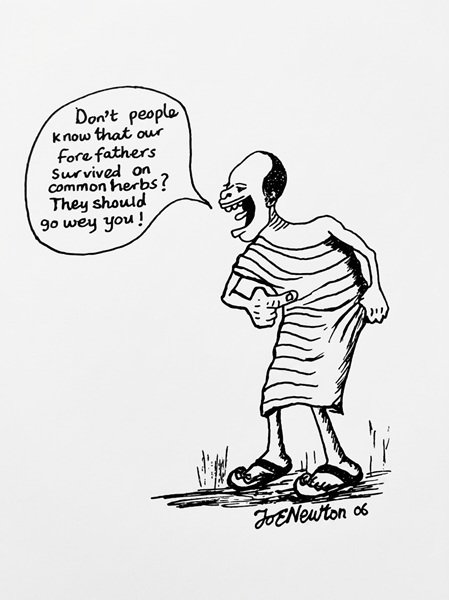
THE typical itinerant salesman in Sikaman is a herbalist. He is normally a slim macho with the capacity to perambulate the expanse of area covering the triangle of Accra-Tema-Ashiaman. In short, he can walk a total of 60 miles a day, marketing a product that cures every disease, including poverty.
The door-to-door herbal pharmacist advertises his product by word of mouth. He has nothing to do with the Food and Drugs Board (FDB). After all, his concoctions do not feature on FM stations.
Those herbalists who cannot walk to propagate the herbal gospel, liaise with drivers of mass transportation and their mates. They are, therefore, given the chance to sell their products on Benz buses that ply the routes.
Normally, the herbalist starts his sales message with a prayer and Bible study. He asks the passengers to bow down their heads in supplication to God the father, the son, the Holy Spirit.
When a herbalist asks the passengers to close their eyes and bow their heads, Moslems on board naturally feel offended. They feel that the herbalist has no right to assume that every passenger is a Christian. They think such an assumption is an affront to Islam.
So a Moslem on board will raise the hand for a point of order. He’ll remind the herbalist that it would be in his own interest to mind his language.
“Be careful the way you address people in a public place. Not every person here is a Christian,” he’d state assertively.
Of course, the herbalist will promptly ignore him, but would all the same “watch” his tongue. Who knows whether or not the Moslem brother is inspired by Quoranic zeal to defend the tenets of Islam to the hilt?
When he starts saying, “Wallahi!” and “Inshallah!” it could be the beginning of proclaiming Islam as supreme, a point which must be driven home with talibanic precision.
So the herbalist must tread carefully lest he steps on fire.
The herbalist could even add a measure of mirth to it all, by announcing that Christians on board today have very interesting company on the journey, but that should not detract from the business of the day.
The Moslem brother will weigh the words carefully and offer a wry smile.
He must be careful the occasion does not degenerate into the use of semantics and proverbial oration to deride his conviction that public utterances must be mindful of religious sensibilities. He has made his point very clear and expects that it is taken in good faith in the interest of a peaceful journey.
The herbalist will now open the New Testament and preach salvation, stating clearly that salvation can come only through Jesus Christ and NOBODY else.
The Moslem brother will now start twitching his moustache. The visible and almost revolutionary reflexes of his upper lip can be an indication that sentiments have begun superseding reason, and the outcome could well be tragic now shift uneasily in his seat.
The time has come for him to also express his right to the religion of his fore-bears. He’ll put his hand into his pocket and rise to his feet. The time has indeed come!
This article was first published on Saturday, September 9, 2006
When the cause of a particular problem like sickness, disease, sudden illness, a social issue etc. are not known, it stands to reason that resolving it becomes a huge challenge.
Citizens would understand the government when public announcements are made to the effect that government is trying to find a solution to the issue, even though it is taking a while for it to be resolved because citizens are rational beings.
On the other hand, if the solution to a particular issue is known to everybody but the government for whatever reason, is dragging its feet in resolving it, citizens become frustrated and begin to lose trust in their leaders.
One such issue is the heavy traffic along a section of the Kasoa – Odokor road. A short stretch of bad road between the traffic light at the Weija Government Hospital and the entrance to the entrance of the overhead that leads to the N1, is the cause of the problem but nothing is being done about it, day after day, week after week, month after month. Thus is clearly unacceptable.
Another issue that requires urgent attention is the lack of pavements along a lot of streets in parts of the various Municipal Assemblies. Exercise is a prerequisite for long life and healthy living and for those of us who it has become a way of life, this issue of people putting up structures right to the edge of the drains beside the roads, are making life difficult for us.
We are compelled to walk along the roads, putting our lives at serious risk. Pedestrians should never be compelled to compete with vehicles on our streets and roads. Roads and streets are made for vehicles and pavements are made for pedestrians. That is the norm. Any attempt to normalise a situation where pedestrians are mingling with vehicles is insanity.
It is the road regulations that makes it so and therefore district or municipal assemblies are to take responsibility and ensure that spaces for pavements are not encroached upon. Citizens have rights that must be protected by their leaders and making pavements available to pedestrians, is one of them.
When we hear of teachers having sex with students, it appears it is something recent. It is not a new phenomenon. It has been there since Adam. Perhaps this issue is getting much attention due to the proliferation of social media. It was an open secret in times past when Teachers were in relationships with female students and some married them immediately after completion of school.
Some teachers were also known to be having unholy interactions with female pupils but due to the times that these acts occurred, human rights issues and the awareness around it, allowed such unscrupulous teachers to get away with their crimes.
Now we are in a different era and so a Headmaster is now in hot waters. He is alleged to have raped about 19 female students and as usual, some officials tried to cover it up and are also in hot waters and their actions or inactions in the matter are under investigation.
Why the man has been allowed to roam freely without being arrested is simply mind boggling. It appears that the law applies differently, depending on who you are. This issue came to public attention sometime in August this year, yet the police had not arrested or invited this man for question regarding the rape allegation.
It has come out that he is a Constituency Secretary of the ruling party and the question in the public domain is that, is it because he is a political figure that is why he is still walking around without questioning? I believe in the rule of law so let us hold our breadth and let the proper thing be done.
The police must however be seen to be active in this matter. God bless.
SKIP THE QUEUE, TAP THE NEWS
You can now read the Ghanaian Times and The Spectator newspapers from the comfort of your device via TimesNewsPlus.
Join our WhatsApp Channel: https://whatsapp.com/channel/0029VbBElzjInlqHhl1aTU27