News
Ghana’s journeying through COVID-19.

- /home/u249204778/domains/spectator.com.gh/public_html/wp-content/plugins/mvp-social-buttons/mvp-social-buttons.php on line 27
Warning: Trying to access array offset on false in /home/u249204778/domains/spectator.com.gh/public_html/wp-content/plugins/mvp-social-buttons/mvp-social-buttons.php on line 27
&description=Ghana’s journeying through COVID-19.', 'pinterestShare', 'width=750,height=350'); return false;" title="Pin This Post">
- Share
- Tweet /home/u249204778/domains/spectator.com.gh/public_html/wp-content/plugins/mvp-social-buttons/mvp-social-buttons.php on line 72
Warning: Trying to access array offset on false in /home/u249204778/domains/spectator.com.gh/public_html/wp-content/plugins/mvp-social-buttons/mvp-social-buttons.php on line 72
&description=Ghana’s journeying through COVID-19.', 'pinterestShare', 'width=750,height=350'); return false;" title="Pin This Post">
Coronavirus started in some parts of China in a town called Wuhan who are into farm animal marketing.
The virus was first identified in early December 2019. Coronavirus is a large group of viruses that are common among animals and it is formed in a genetic material which has enveloped protein spires around it.
In the haste of events, countries such as Spain, USA and Italy, immediately evacuated their citizens from China, an action which later accounted for to the wide spread of the virus in such countries.
Moreover, when these foreign countries hurriedly went for their citizens in China, they did not put any precautionary measures in place to check if those citizens had contracted the virus or not which led to escalation of the virus spread.
But in Ghana, the President together with the Chief of Staff placed a temporarily ban on all government officials travelling outside the country.
Some few days later Ghana recorded its first case on March 12, 2019.
Surprisingly, the day after the President had announced the closure of the country’s borders, many travellers entered Ghana and since the authorities could not send them back to wherever they came from, they rather placed them under quarantine to reduce the spread of the virus.
The government therefore established isolation centres to quarantine these travellers. They were not just left at the isolation centres but were given good health care. With regards to those who came before the closure, the authorities placed an extensive measure to trace people who came into contact with persons who had tested positive.
Looking at the media’s role in this pandemic, there is an increase in surveillance on how Ghanaians would adhere to protocols from authorities.
Although some media houses are not providing the breakdown of the active cases, recovery cases and death cases to Ghanaians to know how measures are helping the country, media houses, traditional rulers and politicians are educating Ghanaians on the implications that will come if protocols from authorities are not adhered to.
The Ghana Medical Association (GMA) called upon the government to declare a nationwide lockdown to reduce community spread which some Ghanaians did not seem to appreciate because, poor people needed to work in order to provide shelter for themselves and family members as well.
The GMA was able to back their demand based on science, which made the President to declare the partial lockdown in certain parts of Ghana (Greater Accra, Kasoa, and Greater Kumasi).
In Ghana’s handling of the COVID-19, the President called on the nation to fast and seek divine intervention concerning the virus for the country.
Various opinion leaders also gave their views on how the pandemic could be contained. It is worthy of note that, during the partial lockdown several organisations and individuals came together to provide shelter for the vulnerable people in our society to curb the spread.
When we look at some of the policies of the government during this era, there is provisions of free usage of water, and of 50 per cent reduction in cost of electricity as well as increasing the salaries of health workers to help Ghanaians.
Government later issued a policy that all Ghanaians should wear nose masks to help curb the spread of the virus. It is now an offence not to wear nose mask. However, some Ghanaians don’t seem to appreciate this because it is new and would take some time to adjust.
In conclusion, even though some citizens are politicising the pandemic and do not appreciate what is being done by the government, the more we are able to detect the inffected persons the more we are able to handle the virus in the country.
Helena Decker Arthur
Level 300 Student,
Ghana Institute of Journalism (GIJ).


Deputy National Women Organiser of the New Patriotic Party (NPP), Mimi Duah, has openly declared her support for Mavis Hawa Koomson as the next National Women’s Organiser of the party.
In a statement endorsing Hawa Koomson’s candidature, Ms Duah outlined four key reasons why she believes the former MP and Minister of State is best placed to lead the party’s women’s wing.
According to her, Hawa Koomson is a motherly figure who rose from the grassroots and is widely noted for her forgiving nature and ability to foster unity.
“She is a true grassroots mother who easily forgives, fosters unity, provides guidance and arbitrates to ensure all aggrieved party women are brought on board to ensure a unified women’s wing,” she stated.
Ms Duah also pointed to Hawa Koomson’s vast experience, having served as a Constituency Women’s Organiser, Member of Parliament and Minister of State, noting that the experience positions her to provide effective leadership as National Women’s Organiser.
She further described Hawa Koomson as capable of making the women’s wing resourceful, through her extensive network and business contacts, to lobby for logistics, training and financial support for women organisers at all levels.
Lastly, she said the NPP as an opposition party needs fearless, bold and assertive leadership at the women’s front to inspire regional, constituency and polling station women organisers as the party reorganises towards the 2028 elections.
“We need a Women’s Organiser who has been tested, who is bold, who understands grassroots women, and who can lead us to victory in 2028. Hon. Mavis Hawa Koomson is that leader,” she stressed.
By Edem Mensah-Tsotorme
News
Tourism, Culture and Creative Arts Minister inaugurates Ghana-Korea Heritage Project Steering Committee

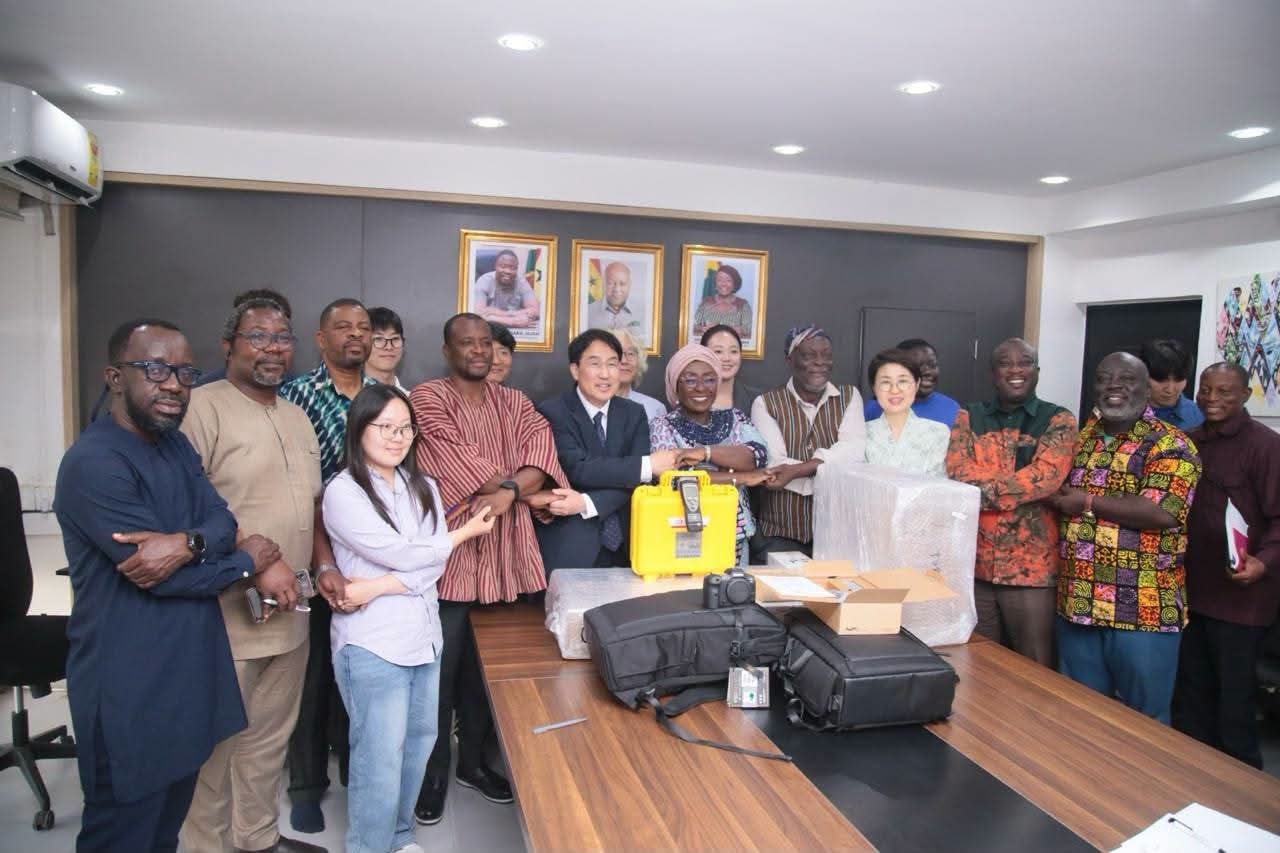
Tourism, Culture and Creative Arts Minister, Abla Dzifa Gomashie, has inaugurated the Ghana-Korea Heritage Project Steering Committee to provide strategic oversight for a five-year programme focused on preserving Ghana’s heritage sites and strengthening their resilience to climate change.
The project will support climate-risk mapping, digital surveying and 3D modelling, joint research, capacity building, community engagement and modern monitoring technologies.
Korea is also providing specialised equipment, including drones, 3D scanners, digital microscopes, thermal imaging cameras and GPS survey instruments, to enhance Ghana’s capacity to scientifically assess, document and conserve heritage structures.
The partnership, which will run through 2030 and beyond, is expected to deepen Ghana-Korea cultural ties while promoting sustainable, technology-driven and climate-adaptive heritage management for future generations.
By Edem Mensah-Tsotorme