Editorial
Ghanaians Must Stop Politicising Every Arrest

- /home/u249204778/domains/spectator.com.gh/public_html/wp-content/plugins/mvp-social-buttons/mvp-social-buttons.php on line 27
https://spectator.com.gh/wp-content/uploads/2026/08/protestors-picketing-on-the-road-after-the-arrest-of-Wontumi.webp&description=Ghanaians Must Stop Politicising Every Arrest', 'pinterestShare', 'width=750,height=350'); return false;" title="Pin This Post">
- Share
- Tweet /home/u249204778/domains/spectator.com.gh/public_html/wp-content/plugins/mvp-social-buttons/mvp-social-buttons.php on line 72
https://spectator.com.gh/wp-content/uploads/2026/08/protestors-picketing-on-the-road-after-the-arrest-of-Wontumi.webp&description=Ghanaians Must Stop Politicising Every Arrest', 'pinterestShare', 'width=750,height=350'); return false;" title="Pin This Post">
Dear Editor,
In Ghana, it appears that the moment a prominent politician is arrested or convicted, we fail to ask of the person’s offence but rather think of the person’s political affiliation.
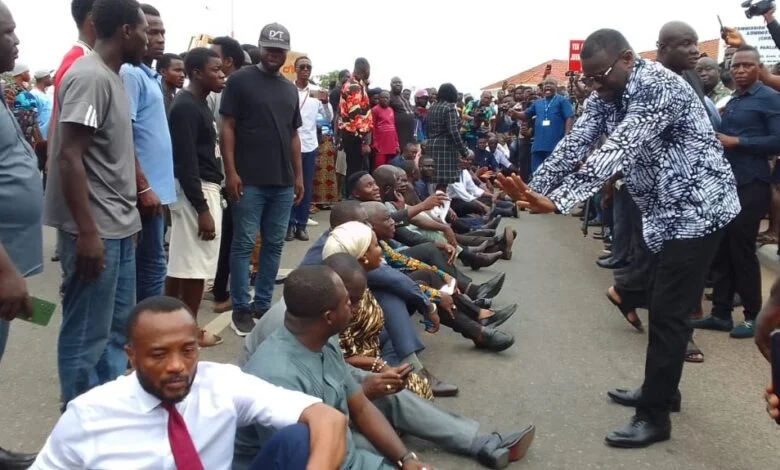
Taking the recent 20-year imprisonment handed to New Patriotic Party (NPP) Ashanti regional chairman, Bernard Antwi-Boasiako, popularly known as Chairman Wontumi has once again exposed this troubling culture.
An Accra high court convicted him on illegal-mining related charges and sentenced him to 20 years in prison. The NPP has since announced its intention to appeal the conviction.
What concerns me is not whether one belongs to the NPP or the NDC, what concern me is our growing tendency to attach a political identity to every arrest, investigation or court judgment. If an NPP member is arrested, some immediately say the NDC government is targeting the opposition. If an NDC member faces legal trouble the same argument will easily be reversed when political circumstances change.
We must ask ourselves; Are we defending justice or are we simply depending on our political colours? Political affiliation should never determine whether we believe a person deserves investigation, prosecution or a fair trial. If someone is accused of wrongdoing the proper institution must investigate, the court must determine guilt and the accused must have the right to challenge the decision through legal process.
Ghana cannot build a strong democracy if every criminal investigation becomes a political battle. Let us learn to separate politics from justice, a wrongdoing does not become right because the accused belong to your party and an accusation does not become true simply because the person belong to the opposing party.
Our loyalty should first be Ghana, the rule of the law and justice not to political colors.
From Desmond Yaw Frimpong
Pentecost University







It has been the belief of most Ghanaians that heart disease affects only old people. This belief is wrong and must change.
Heart disease can affect both the young and the old. Therefore, people should not ignore symptoms simply because they believe they are too young to have a heart problem.
Dr Penelope Adinku, a cardiothoracic surgeon at the National Cardiothoracic Centre of the Korle-Bu Teaching Hospital, has cautioned the public against such misconceptions.
She urged Ghanaians to pay attention to warning signs including chest pain or discomfort, unexplained shortness of breath, unusual tiredness, palpitations, dizziness or fainting, and swelling of the legs.
Although these symptoms do not always mean that someone has heart disease, persistent, new or worsening symptoms should be assessed by a health professional.
Sadly, many people wait until their condition becomes serious before seeking medical help. Some dismiss symptoms, while others believe that heart disease cannot affect them because of their age. This must change.
Regular health checks are important because conditions such as high blood pressure, diabetes and high cholesterol may not show clear symptoms but can increase the risk of heart disease.
Speaking with The Spectator, Dr Adinku rightly noted that, “prevention and early detection are just as important as treatment.”
The paper therefore urges Ghanaians to take greater responsibility for their health by eating healthier foods, staying physically active, avoiding tobacco and going for regular health checks.
However, individuals cannot do this alone. Ghana’s health system must also be strengthened to provide timely and affordable cardiac care.
Limited access to specialised heart services remains a concern. Some patients report late to health facilities, while others face financial difficulties that delay diagnosis and treatment.
Government and other stakeholders must invest in specialised equipment, improve referral systems and train and retain more cardiac specialists and other health professionals.
The cost of treatment must also be addressed so that patients are not denied essential care because they cannot afford it.
Public education is equally important. Schools, workplaces, communities and the media must help dispel myths about heart disease and promote healthy living.
Ghana has made progress in cardiac care, but more needs to be done.
The country must focus not only on treating heart disease but also on preventing it and detecting it early.

Dear Editor,
Going viral can make someone famous overnight, but fame alone cannot build a sustainable entertainment industry.
Ghana is blessed with talented musicians, actors, comedians, content creators and other creative professionals. Social media has also created opportunities for young people to showcase their talents to audiences beyond Ghana.
However, we must ask whether we are building lasting careers or simply celebrating the next person to trend online.
Today, a song, skit or video can become popular within hours and disappear from public attention just as quickly. This culture of virality can create the impression that numbers, followers and online attention are the only measures of success.
Our creative industry needs to go beyond that. Young creative need proper management, business knowledge, financial literacy, education and opportunities to develop their skills. They also need structures that can help them turn talent into sustainable careers.
Ghana has the talent to become a major force in Africa’s creative economy. But talent without investment, structure and professional development can easily be wasted
Let us therefore stop asking only, “Who is trending?”, and begin asking, “Who is building a lasting career?” Our creative deserves more than temporary applause, they deserve an industry capable of turning Ghanaian talent into sustainable success.
From Elijah Arkoh
Kaneshie.