Features
Festivals and human stomachs

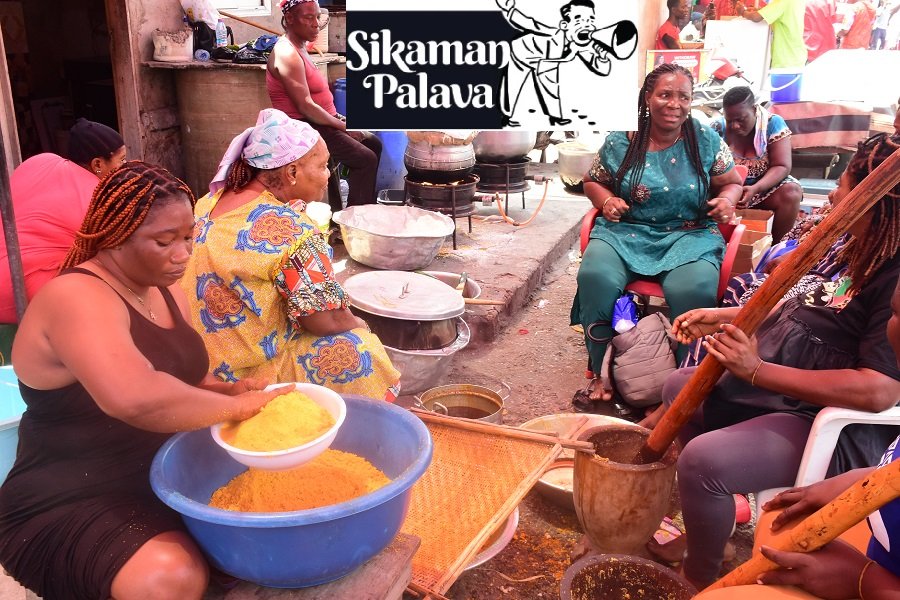
Some Ga women preparing the delicious festive dish known as kpokpoi
Festivals are supposed to be an important part of our lives such that once in every year, every single soul in the capital is supposed to go back to his or her people to celebrate, drink fresh palm wine and crack grass- cutter bones.
But how many people think of going back to celebrate the festivals of their origin?
Perhaps if we had a Secretary for Festival Affairs with plenary powers to ensure that once in a year, everyone goes back to his grandfather’s village to celebrate the festival of his people, the importance of festivals might be more appreciated.
It is so sad to note that because of financial, mourning and ‘brokages,’ many don’t dare go back to their villages during annual leaves and festivals.
Festivals as we know are inseparable from our culture and as such, indissolubly linked with our roots.
Anyone who is therefore a hopeless ignoramus as far as the festivals of his people are concerned is in a cultural wilderness, lost and cannot be found. A search-party would be on a wild goose chase unless he himself retraces his steps to his origin to learn the ways of old.
Since most people have taken the capital of Sikaman as their hometown, many Anlos for instance do not know about Hogbetsotso, the northerners, bom and bred in Accra have never witnessed the Dambai festival; Oguaas forget the Fetu and the Ada’s, the Asafotufiam. Instead, every- one becomes well-acquainted with Homowo.
The very first time I joined the Gas to celebrate their Homowo festival was way back in 1973, I was a little kid. As I had many Ga friends, I was in high spirits. I took my time and consumed an unholy quantity of kpokpoi, the cherished traditional meal for the festival. In fact, I enjoyed it so much, but I was uninformed about the dosage.
It was getting close to midnight when I realised that kpokpoi was not only a very delicious festive dish, but also a rather powerful traditional purgative.
It took me some four hours to get through since it was a wake-keeping of commuting from my bedroom to the lavatory to cope with the frequency of my free bowels. The following year I was more cautious and took the right dosage.
Quite ironically, I have celebrated, or should I say, witnessed more Homowo festivals than the Yam Festival of my people. But that does not make me ignorant. We used to look forward to it every year and the most interesting aspect was the contests organised to select the most attractive, largest or weightiest “new” yam. It was a sort of beauty pageant where yams were the exuberant contestants.
Today, when my people are celebrating the Yam Festival back home, and I’m unable to go, I also celebrate mine quietly in the capital with my mother, brothers and sisters. We eat otor, yam slices, yam fufu and chicken soup, with yam-balls as dessert. We don’t have drumming and dancing, though.
Most festivals are celebrated following the harvest season in farming and fishing communities. The festivals are celebrated to praise and acknowledge the blessings of the gods for the bountiful harvests bestowed upon us mortals. With poor harvests therefore, the celebrations become lukewarm. Man must chop!
Traditional African societies have superstitious beliefs associated with folkways, norms and general manner of life. The celebration of festivals is therefore not entirely free from certain taboos and superstitions.
The reader would please, allow for a little digression. A child who grows in the capital of Sikaman knows nothing about the taboos associated with his origin. He, for instance, refuses to believe that some clans do not kill snakes just because it is their belief that a snake had something to do with the perpetration of their clan. Others do not eat corn because they believe one of their great chiefs was poisoned through a meal prepared from corn etc.
Other taboos are observed because the gods say they must be. There is a river god in Sikaman which forbids anyone going to the river at night with lantern.
A white man on tour who said he never believed that ‘superstitious nonsense’ since he was a devout Christian who had been fully baptised and receives communion regularly, defied the villagers and took a lantern to the riverside one night.
Of course, what he met at the place, I can’t quite describe. Fact is he himself could not even describe it because he had to do a fast sprint to escape the monster that pursued him. Since then, our Kwasi Broni friend has learnt to respect some of our dos and don’ts. I know he had quite a story to tell his countrymen when he went back, unless he wanted to stay here forever to do thorough research into African taboos.
It is a taboo to be seen eating newly harvested yam before the fetish priest performs the necessary rites that usher in the celebration of the Yam Festival at my area. This is to ensure that the gods taste of it before dwellers of the land take their turn.
I had occasion to talk to Togbi Teiku (V), Dufia of Matse Dzeve (not my hometown), known in private life as Mr Joshua Addo. The Yam Festival celebrated at his area, he says, are preceded by certain rites, which he cannot ignore irrespective of his Christian background and intellectual attainments.
He does not take alcohol, not even occasionally. But when it comes to performing the rites associated with the stool and the land during festivals, he must forget about his healthy conscious habits and let the palm wine descend his throat, enroute to the stomach.
Indeed, festivals have a meaning to our lives. However, receptive we might be to the impact of western culture, we must not forget that we have our own culture which we must enrich through the endeavour of going back from where we’ve run.
What would be the meaning of our lives as a clan, tribe or people when we cannot find time once every year to revel in festivity for the enjoyment of it, to meet old friends, and make more acquaintances, get used to our folklores and customs, and above all rejoice the blessings of good harvests and the like?
Festivals are also useful to non-resident citizens of every locality. It affords the city dweller the opportunity to ascertain the true condition prevailling in their rural communities so that when the Town Development Committee comes out to say that non-resident females must contribute GH¢1,000 and their male counterparts GH¢1,500 for development projects, they cannot grumble.
You certainly wouldn’t complain because after a heavy festive meal you will sooner or later need the services of a KVIP since you cannot carry the stuff in your stomach back to a city water-closet.
And when you realise that there is no KVIP around, except for a dangerous-looking pit-laterine that had been constructed half a century ago, you’ll understand that if you do not contribute the specified amount you may not be able to retire to the village to spend your pension days, when it is due.
This article was first published
on Saturday August 25, 1990





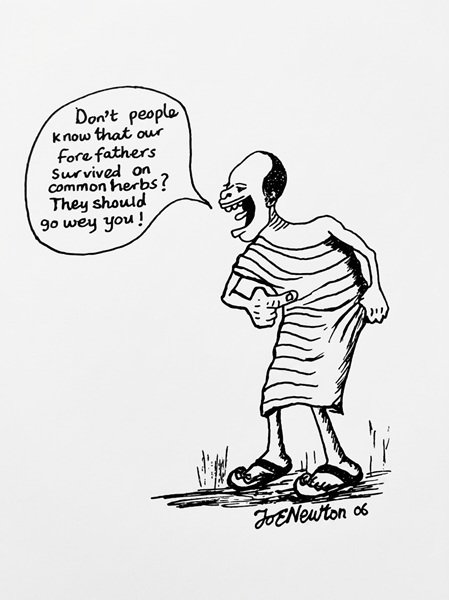
THE typical itinerant salesman in Sikaman is a herbalist. He is normally a slim macho with the capacity to perambulate the expanse of area covering the triangle of Accra-Tema-Ashiaman. In short, he can walk a total of 60 miles a day, marketing a product that cures every disease, including poverty. 
The door-to-door herbal pharmacist advertises his product by word of mouth. He has nothing to do with the Food and Drugs Board (FDB). After all, his concoctions do not feature on FM stations.
Those herbalists who cannot walk to propagate the herbal gospel, liaise with drivers of mass transportation and their mates. They are, therefore, given the chance to sell their products on Benz buses that ply the routes.
Normally, the herbalist starts his sales message with a prayer and Bible study. He asks the passengers to bow down their heads in supplication to God the father, the son, the Holy Spirit.
When a herbalist asks the passengers to close their eyes and bow their heads, Moslems on board naturally feel offended. They feel that the herbalist has no right to assume that every passenger is a Christian. They think such an assumption is an affront to Islam.
So a Moslem on board will raise the hand for a point of order. He’ll remind the herbalist that it would be in his own interest to mind his language.
“Be careful the way you address people in a public place. Not every person here is a Christian,” he’d state assertively.
Of course, the herbalist will promptly ignore him, but would all the same “watch” his tongue. Who knows whether or not the Moslem brother is inspired by Quoranic zeal to defend the tenets of Islam to the hilt?
When he starts saying, “Wallahi!” and “Inshallah!” it could be the beginning of proclaiming Islam as supreme, a point which must be driven home with talibanic precision.
So the herbalist must tread carefully lest he steps on fire.
The herbalist could even add a measure of mirth to it all, by announcing that Christians on board today have very interesting company on the journey, but that should not detract from the business of the day.
The Moslem brother will weigh the words carefully and offer a wry smile.
He must be careful the occasion does not degenerate into the use of semantics and proverbial oration to deride his conviction that public utterances must be mindful of religious sensibilities. He has made his point very clear and expects that it is taken in good faith in the interest of a peaceful journey.
The herbalist will now open the New Testament and preach salvation, stating clearly that salvation can come only through Jesus Christ and NOBODY else.
The Moslem brother will now start twitching his moustache. The visible and almost revolutionary reflexes of his upper lip can be an indication that sentiments have begun superseding reason, and the outcome could well be tragic now shift uneasily in his seat.
The time has come for him to also express his right to the religion of his fore-bears. He’ll put his hand into his pocket and rise to his feet. The time has indeed come!
This article was first published on Saturday, September 9, 2006
When the cause of a particular problem like sickness, disease, sudden illness, a social issue etc. are not known, it stands to reason that resolving it becomes a huge challenge.
Citizens would understand the government when public announcements are made to the effect that government is trying to find a solution to the issue, even though it is taking a while for it to be resolved because citizens are rational beings.
On the other hand, if the solution to a particular issue is known to everybody but the government for whatever reason, is dragging its feet in resolving it, citizens become frustrated and begin to lose trust in their leaders.
One such issue is the heavy traffic along a section of the Kasoa – Odokor road. A short stretch of bad road between the traffic light at the Weija Government Hospital and the entrance to the entrance of the overhead that leads to the N1, is the cause of the problem but nothing is being done about it, day after day, week after week, month after month. Thus is clearly unacceptable.
Another issue that requires urgent attention is the lack of pavements along a lot of streets in parts of the various Municipal Assemblies. Exercise is a prerequisite for long life and healthy living and for those of us who it has become a way of life, this issue of people putting up structures right to the edge of the drains beside the roads, are making life difficult for us.
We are compelled to walk along the roads, putting our lives at serious risk. Pedestrians should never be compelled to compete with vehicles on our streets and roads. Roads and streets are made for vehicles and pavements are made for pedestrians. That is the norm. Any attempt to normalise a situation where pedestrians are mingling with vehicles is insanity.
It is the road regulations that makes it so and therefore district or municipal assemblies are to take responsibility and ensure that spaces for pavements are not encroached upon. Citizens have rights that must be protected by their leaders and making pavements available to pedestrians, is one of them.
When we hear of teachers having sex with students, it appears it is something recent. It is not a new phenomenon. It has been there since Adam. Perhaps this issue is getting much attention due to the proliferation of social media. It was an open secret in times past when Teachers were in relationships with female students and some married them immediately after completion of school.
Some teachers were also known to be having unholy interactions with female pupils but due to the times that these acts occurred, human rights issues and the awareness around it, allowed such unscrupulous teachers to get away with their crimes.
Now we are in a different era and so a Headmaster is now in hot waters. He is alleged to have raped about 19 female students and as usual, some officials tried to cover it up and are also in hot waters and their actions or inactions in the matter are under investigation.
Why the man has been allowed to roam freely without being arrested is simply mind boggling. It appears that the law applies differently, depending on who you are. This issue came to public attention sometime in August this year, yet the police had not arrested or invited this man for question regarding the rape allegation.
It has come out that he is a Constituency Secretary of the ruling party and the question in the public domain is that, is it because he is a political figure that is why he is still walking around without questioning? I believe in the rule of law so let us hold our breadth and let the proper thing be done.
The police must however be seen to be active in this matter. God bless.
SKIP THE QUEUE, TAP THE NEWS
You can now read the Ghanaian Times and The Spectator newspapers from the comfort of your device via TimesNewsPlus.
Join our WhatsApp Channel: https://whatsapp.com/channel/0029VbBElzjInlqHhl1aTU27