News
Failing sooner rather than later may be a blessing, says Dylan Suitor


There isn’t a single person, book, or algorithm in the world that can produce a surefire way to succeed in business. There are too many moving parts, too many things to consider, and too many ways everything could go wrong for anyone to suggest that there’s a business strategy that guarantees success.
There are, however, ways to approach the world of business that, even though they might seem counterintuitive, might help some people achieve success. Dylan Suitor, a realtor at the head of many real estate-related businesses, including Elevation Realty Network Inc. and Keller Williams Neighbourhood Realty, thinks that failing forward is the way to plow ahead.
Dylan learned this lesson early on. “I scaled my first real estate business, Dylan Suitor and Associates, through constantly failing forward,” he says. “The road was filled with one setback after another but overcoming them only served as fuel that kept me going forward.”
Why is this concept of growing through failure so important? For starters, it’s at the core of the idea of entrepreneurship. In the startup world, for example, it’s an accepted fact that the vast majority of startups won’t live past their first anniversary. Statistics agree, too. Does that stop people from becoming serial startup entrepreneurs? Of course not!
One of the reasons it’s possible to talk about failure and use the “forward” in conjunction with it is because every failure presents a teachable moment, or an opportunity to move in another direction. When failure is supposed to teach entrepreneurs something, it might almost be in their best interest to, as long as they are going to fail, do it as quickly as possible.
The ability to move quickly after failure was what brought Dylan some of his initial success and led to the companies he has today. But the most interesting thing about this mentality is that it’s easily found in the biggest setback and the biggest accomplishments. A story of acquisition and renovation that reads like an epic battle between Dylan’s company and a 32-unit building that Dylan Suitor was losing most of the time turned into one of his biggest successes.
That’s why failing forward is so valuable; it lets entrepreneurs, or anyone willing to try it out, reframe their losses and move on strengthened by the experience. Does it mean that people should haphazardly enter into situations where the possibility for dire consequences is real? Of course not. But in the world of business, everything that prevents a person from taking risks is preventing them from growing; it’s as simple as that.
A mentality that says how a fall might get people further ahead than they were when they were standing is extremely valuable, not in the least because everyone is going to experience that failure eventually. It could be said that people who manage to fail and live to say that they’ve failed forward are the lucky ones, rather than the people whose only failure was to try.



The Ghana High Commission in Pretoria has advised Ghanaians living in South Africa to remain vigilant and take precautionary measures ahead of planned protest activities expected on June 30.
In a public advisory issued on Monday, June 29, the Mission urged Ghanaian nationals to prioritise their safety following a deadline announced by a group known as “March and March” and its affiliated organisations, which could lead to demonstrations and disruptions in parts of the country.
The High Commission advised Ghanaians to stay indoors, especially in central business districts, transport hubs, informal trading areas and other locations where protests may occur.
It encouraged them to temporarily close their businesses where necessary and avoid unnecessary movement until the situation stabilises.
The Mission further urged members of the Ghanaian community to avoid confrontations or provocative discussions, including on social media, and to ensure that their passports, residence permits and other identification documents were readily available at all times.
According to the High Commission, emergency telephone lines have been activated to provide assistance and receive reports from Ghanaians who may require help during the period.
It encouraged Ghanaians to remain calm, obey the laws of South Africa and cooperate fully with local authorities.
The Mission advised them to rely only on information from credible official sources and avoid sharing unverified reports or rumours that could create unnecessary panic.
The Ghana High Commission assured the Ghanaian community that it would continue to monitor developments and provide updates when necessary, adding that it remained committed to protecting the welfare of all Ghanaian nationals in South Africa.
By: Jacob Aggrey
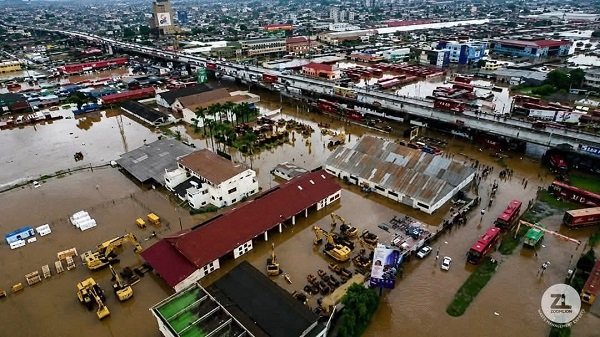
The New Patriotic Party (NPP) has criticised the government’s handling of the flooding that hit parts of Accra and surrounding communities on Monday, urging it to move beyond what it described as public relations activities and take decisive action to address the country’s flood challenges.
In a press release issued on June 29, the party expressed sympathy to thousands of people affected by the floods but maintained that the government had failed to respond effectively to the recurring disaster.
The NPP noted that communities including the N1 Highway, Apenkwa, Achimota, Kaneshie, Weija, Spintex, Darkuman Junction and the Kwame Nkrumah Interchange were flooded after heavy rains.
According to the party, these communities have experienced flooding repeatedly over the years, making it necessary for government to adopt long term solutions.
The NPP argued that the current administration had created confusion by splitting responsibility for flood management between the Ministry of Local Government and the Ministry of Works, Housing and Water Resources.
It claimed that the arrangement had resulted in poor coordination, with the two ministries competing over responsibilities instead of working together to address the problem.
The party questioned the decision to place Deputy Chief of Staff Stan Dogbe in charge of coordinating flood response efforts.
According to the NPP, he does not have the authority to direct ministers, making the current command structure ineffective.
The opposition party further alleged that some anti flood measures announced by the government had either not been implemented or had been poorly executed.
It claimed that delays in the release of funds for flood mitigation programmes had affected ongoing interventions.
The NPP rejected recent comments by President John Dramani Mahama that flooding was partly caused by poor environmental practices and indiscipline among some citizens.
It argued that while public cooperation was important, the government should take responsibility for designing and implementing effective flood management policies.
The party called on the President to place flood management under one ministry, appoint a single minister to lead the response, and provide a public account of the work and spending of the Anti Flood Task Force.
It also urged the government to work closely with Metropolitan, Municipal and District Assemblies and technical experts to improve land use planning, sanitation management and drainage infrastructure.
The statement, signed by the NPP General Secretary, Justin Kodua Frimpong, stressed that the party would continue to hold the government accountable while standing with families affected by the floods.
By: Jacob Aggrey