News
Effective implementation of Affirmative Action Law key to gender equality — Convenor

- /home/u249204778/domains/spectator.com.gh/public_html/wp-content/plugins/mvp-social-buttons/mvp-social-buttons.php on line 27
https://spectator.com.gh/wp-content/uploads/2025/09/Participants-at-the-workshop.jpg&description= Effective implementation of Affirmative Action Law key to gender equality — Convenor', 'pinterestShare', 'width=750,height=350'); return false;" title="Pin This Post">
- Share
- Tweet /home/u249204778/domains/spectator.com.gh/public_html/wp-content/plugins/mvp-social-buttons/mvp-social-buttons.php on line 72
https://spectator.com.gh/wp-content/uploads/2025/09/Participants-at-the-workshop.jpg&description= Effective implementation of Affirmative Action Law key to gender equality — Convenor', 'pinterestShare', 'width=750,height=350'); return false;" title="Pin This Post">
Mrs Sheila Minkah-Premo, Convenor of the Affirmative Action Law Coalition, has stressed that the effective implementation of the Affirmative Action (Gender Equity) Act, 2024 (Act 1121), is critical to achieving genuine gender equality in Ghana.
She said while the passage of the law in July 2024 was a landmark achievement after more than a decade of advocacy, its true impact would depend on how well institutions, policymakers, and society commit to its enforcement.
“The law itself will not change the position of women unless we take deliberate steps to ensure that it is fully implemented. By 2026, the law requires that women hold at least 30 per cent of positions in governance and decision-making, and this target must not be taken lightly,” Mrs Minkah-Premo stated.
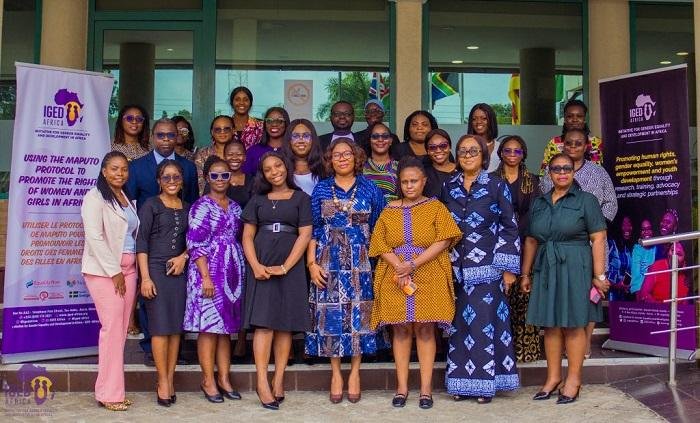
Mrs Minkah-Premo was speaking at the opening of a two-day stakeholder workshop on family law reform in Accra, organised by the Initiative for Gender Equality and Development in Africa (IGED-Africa) in collaboration with the Solidarity of African Women’s Rights (SOAWR) Coalition hosted by Equality Now.
The stakeholder workshop, which runs from September 10 to 11, 2025, has brought together civil society actors, legal experts, and policymakers to deepen advocacy on Ghana’s family law reform agenda.
It seeks to accelerate progress on pending legislations such as the Property Rights of Spouses Bill and the Interstate Succession Bill, which have faced years of delays in Parliament despite their potential to safeguard women’s economic and social rights.
Part of wider efforts to consolidate gender equality gains across Africa, the outcomes of the workshop would contribute to regional strategies aimed at tackling persistent barriers to women’s rights and representation.
Mrs Minkah-Premo, who has been involved in the drafting and advocacy of the Affirmative Action Law, said the Act provided a legal framework to progressively increase women’s participation in governance – 30 percent by 2026, 35 percent by 2028, and 50 percent by 2034.
It also establishes a Gender Equity Committee to oversee compliance and issue certificates to institutions that meet set targets.
However, she warned that implementation challenges were already evident, and that, “We are seeing early signs of non-compliance in presidential appointments, funding gaps for the Gender Equity Committee, and delays in setting up the structures needed to make the law effective. These must be urgently addressed,” she said.
The Convener highlighted that cultural barriers, entrenched stereotypes, and a patriarchal political system continued to undermine women’s representation.
She noted that despite women making up more than 50 per cent of Ghana’s population, their presence in Parliament stood at only 14.8 per cent, with just 41 female MPs out of 276.
She added that the Affirmative Action law was designed not only to meet constitutional requirements but also to align Ghana with its international obligations, including the Convention on the Elimination of All Forms of Discrimination against Women (CEDAW), the Maputo Protocol, and the Beijing Platform for Action.
Mrs Minkah-Premo urged stakeholders to keep pushing for results, and that “The law is only as strong as the people who defend it. It is up to all of us, civil society, policymakers, and citizens, to hold duty bearers accountable so that gender equality moves from paper to practice.”
Participants emphasised that reforming family laws alongside enforcing the Affirmative Action Act would provide stronger protection for women’s rights and create a more inclusive governance system.
They agreed that coalition-building, public education, and consistent monitoring would be critical in sustaining advocacy and ensuring accountability.
—GNA
Join our WhatsApp Channel now!
https://whatsapp.com/channel/0029VbBElzjInlqHhl1aTU27


Ghana Post on Tuesday launched the ‘Skool Box’ initiative, one aimed at supporting education and delivery services to students in Accra.
The initiative forms part of Ghana Post’s broader transformation agenda to diversify its services and provide innovative solutions to everyday challenges faced by Ghanaians.
Launching the initiative, the Managing Director of the company, Mrs Rita Sraha, said the idea was inspired by the practical difficulties students and parents often faced in transporting school items, particularly at the beginning of the academic term.
According to her, the increasing space constraints in schools also makes it difficult for students to carry large quantities of belongings with them, creating the need for parents to find alternative ways of sending additional items to their children.
Mrs Sraha said the initiative aligns with the broader national agenda of using digital technology and innovation to expand opportunities, improve public services and strengthen Ghana’s economic capabilities.
The Managing Director however, stressed that the success of the initiative would depend on Ghana Post’s willingness to listen to users, learn from experience and continuously improve the service.
Mrs Sraha explained that Ghana Post was gradually expanding beyond its traditional postal operations through partnerships and services in areas including last-mile delivery, agency banking, logistics and insurance.
She said the School Box Service was another example of how the organisation was using its institutional capabilities to develop solutions to practical challenges within communities.
The Acting Chief Commercial Officer of Ghana Post, Mr Benard Yaw Atta-Sonno, said the service was designed to provide convenient and reliable delivery of school-related items while creating new business opportunities within the education sector.
According to him, the company was also strengthening its focus on digitalisation, customer experience, strategic partnerships and data-driven commercial decision-making.
“Our objective is clear: to build multiple sustainable revenue streams around the assets and capabilities that Ghana Post already possesses, while developing new capabilities for emerging markets,” he said.
He explained that, in the short term, the initiatives were expected to increase transaction volumes, improve the digitalisation of the company’s network, attract new customer segments and generate additional revenue from services that complemented its traditional postal operations.
He noted that the School Box, in particular, provided an opportunity for Ghana Post to develop recurring business around the annual school cycle, while creating opportunities to cross-sell other logistics and delivery services.
The launch forms part of Ghana Post’s wider efforts to modernise its operations and position the company as a diversified logistics and service provider beyond its traditional postal business.
By Linda Abrefi Wadie
SKIP THE QUEUE, TAP THE NEWS

You can now read the Ghanaian Times and The Spectator newspapers from the comfort of your device via TimesNewsPlus.
Join our WhatsApp Channel: https://whatsapp.com/channel/0029VbBElzjInlqHhl1aTU27

The Ghana Education Service (GES) has asked heads of schools not to turn away newly admitted students or refuse to accommodate them over metal trunks or wooden chop boxes.
“These practices may impose unnecessary financial burdens on parents and guardians who may be unable to afford alternative storage containers prescribed by individual schools,” the GES said in a statement.
“All students admitted to boarding accommodation should be treated fairly and accommodated without discrimination based on their economic circumstances or ability of their parents or guardians to purchase a particular brand or type of personal effects.”
The statement, signed by Professor Mrs Smile Dzisi, the Deputy GES Director-General, comes after Management of the Service received reports that some senior high schools and senior high technical schools (SHS/SHTS) were turning newly admitted students or refusing to accommodate them because they brought metal trunks, wooden chop boxes or other personal storage containers to school.
Consequently, the GES has asked regional directors to inform all heads to desist from turning away or refusing admissions to duly admitted students solely on the basis of the type of trunk, chop box, or personal storage container they bought to school.
Provided the item was reasonably sized, safe and did not pose risk to the health, safety or welfare of other students, those students must not be refused accommodation, it added.
The statement said: “Any reported case of a duly admitted student being denied accommodation or turned away solely because of the type of trunk, chop box or personal storage container brought to school should be investigated and same reported to management.”
“Any head of SHS/SHSTS who flouts this directive shall be dealt with in accordance with the applicable standards, regulation and laws of the service.” –GNA
SKIP THE QUEUE, TAP THE NEWS
You can now read the Ghanaian Times and The Spectator newspapers from the comfort of your device via TimesNewsPlus.
Join our WhatsApp Channel: https://whatsapp.com/channel/0029VbBElzjInlqHhl1aTU27