Features
Chopmoney wahala!


Chopmoney should be dished out with extreme care
In some homes, money is no problem. As Kwame Korkorti would put it, money is not a small boy! That is when money flows like the Rivers of Babylon and chopmoney is no problem at all.
Anyone who wants cash goes to Daddy’s drawer and collects a handful. It is an offence to account for any money you take, for the simple reason that to account for monies taken from Daddy’s drawer would be seen as undermining Daddy’s credibility as someone who is filthy rich. Standards must be maintained. Everyone must feel free to spend.
It is the responsibility of someone to always make sure that the drawer is filled to capacity. Such a person faces severe sanctions if Madam comes to pick up the day’s chop money and finds the drawer only half-full.
SABOTAGE
It would be regarded as sabotage of the highest order. The person is likely to be charged with the domestic version of treasonable felony. The punishment is that the person’s daily pocket money of ¢300,000 will be reduced by a quarter.
Madam goes to shop with a househelp who is perpetually excited. She sees new things everyday, eats new varieties of baked beans and cornflakes. In the process, she refuses to believe that heaven is anywhere else other than in Daddy’s home.
All men are not equal! As it were, every human society is one akin to an animal farm. Some are born with a silver spoon in their mouths; others die like church mice. Still others simply do not exist.
Whatever it is, both the poor and rich must eat everyday, so the issuance of chopmoney is common to every home. It is the mode of disbursement that differs.
Where money is a scarce commodity, the chopmoney must be dished out with extreme care. It must be balanced against rent, electricity and water bills, food and medicare. Where the balance is thrown out of gear, then the man must either become a magician and do wonders or turn a financial wizard and engage himself in mysteries.
Financial magic is a professional course most Sikaman husbands take in order to enable them qualify as responsible husbands. The only problem is that they are not issued with certificates after graduation. Most laughable is the fact that they never realise that they have enrolled to study Financial Magic and have passed out with flying colours.
Furthermore, in the days of Kutu Acheampong, Ghana started receiving world acclaim as a country, where every man is a magician who has studied in the college of how to make ends meet.
Those were the days when Ghanaians were asked to tighten their belts. But it was needless to ask them to tighten their belts, because they naturally had to, since their waistlines were nothing to write home about; and anyone who didn’t tighten his belt was bound to walk about naked. His pair of trousers would simply give way.
SECRET
In those ways, husbands were wary about the chopmoney they dished out. They were aware that wives had also gone to school to study how to over-estimate the daily chopmoney by discreetly inflating prices by a secret percentage on groceries and all consumables.
The wives were skilled-in over and under-invoicing, and the husbands had clear evidence of the newly acquired skills of their dear wives.
The wives were constantly buying new funeral cloths, changing hairstyles, purchasing fashionable footwear, surprisingly without accessing foreign loans. It was a mystery husbands who could not unravel unless they became aware that their wives’ domestic accounting skills had become legendary.
Somehow, the women were justified in engaging in domestic budgetary acrobatics and gymnastics to buy for themselves their needs because their husbands were not prepared to do that.
Moreover, they complained that their husbands smoked, drank akpeteshie and chased women with their meagre salaries. After all these, they came back home and snored like pigs. So why shouldn’t the women resort to ‘chobo’ to get a few things for themselves?
DEMAND
Today, men have started demanding that their wives should get ready to start dishing out chopmoney in the wake of a new Bill that is seeking to make man and woman equal before God and Man. Men will no longer be considered head of the home and cannot insist on sex when their wives are not in the mood.
In that case, it would be difficult to come to terms with the fact that he who pays the piper does not call the tune. In any event of equality, rights as well as responsibilities must be shared across board.
Women should be required to give 50 per cent of the chopmoney and retain the right to ‘no sex’ and the freedom to wear double shorts to bed instead of a simple nightgown.
I wonder what will become of the culture that has propelled African marriages to outlast their European counterparts. Our fathers and fore-fathers, mothers and their forebears stayed put in marriage, sustained through an ideal cultural setting.
Should this cultural setting become disturbed by man-made laws, the introduction of alien values and whims, marriage as an institution is bound to undergo a cataclysmic transformation.
The result will be widespread divorce, the proliferation of single mothers and a new breed of prostitutes, the abandonment of marital responsibilities, and the perpetration and perpetuation of marital and domestic license and anarchy. God bless Sikaman.
This article was first published
on February 22, 2003


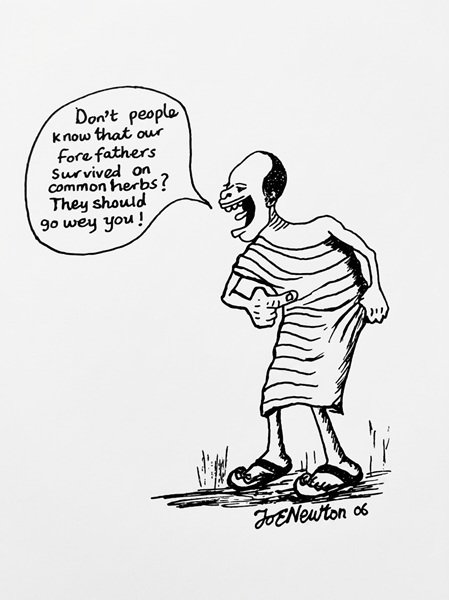
THE typical itinerant salesman in Sikaman is a herbalist. He is normally a slim macho with the capacity to perambulate the expanse of area covering the triangle of Accra-Tema-Ashiaman. In short, he can walk a total of 60 miles a day, marketing a product that cures every disease, including poverty. 
The door-to-door herbal pharmacist advertises his product by word of mouth. He has nothing to do with the Food and Drugs Board (FDB). After all, his concoctions do not feature on FM stations.
Those herbalists who cannot walk to propagate the herbal gospel, liaise with drivers of mass transportation and their mates. They are, therefore, given the chance to sell their products on Benz buses that ply the routes.
Normally, the herbalist starts his sales message with a prayer and Bible study. He asks the passengers to bow down their heads in supplication to God the father, the son, the Holy Spirit.
When a herbalist asks the passengers to close their eyes and bow their heads, Moslems on board naturally feel offended. They feel that the herbalist has no right to assume that every passenger is a Christian. They think such an assumption is an affront to Islam.
So a Moslem on board will raise the hand for a point of order. He’ll remind the herbalist that it would be in his own interest to mind his language.
“Be careful the way you address people in a public place. Not every person here is a Christian,” he’d state assertively.
Of course, the herbalist will promptly ignore him, but would all the same “watch” his tongue. Who knows whether or not the Moslem brother is inspired by Quoranic zeal to defend the tenets of Islam to the hilt?
When he starts saying, “Wallahi!” and “Inshallah!” it could be the beginning of proclaiming Islam as supreme, a point which must be driven home with talibanic precision.
So the herbalist must tread carefully lest he steps on fire.
The herbalist could even add a measure of mirth to it all, by announcing that Christians on board today have very interesting company on the journey, but that should not detract from the business of the day.
The Moslem brother will weigh the words carefully and offer a wry smile.
He must be careful the occasion does not degenerate into the use of semantics and proverbial oration to deride his conviction that public utterances must be mindful of religious sensibilities. He has made his point very clear and expects that it is taken in good faith in the interest of a peaceful journey.
The herbalist will now open the New Testament and preach salvation, stating clearly that salvation can come only through Jesus Christ and NOBODY else.
The Moslem brother will now start twitching his moustache. The visible and almost revolutionary reflexes of his upper lip can be an indication that sentiments have begun superseding reason, and the outcome could well be tragic now shift uneasily in his seat.
The time has come for him to also express his right to the religion of his fore-bears. He’ll put his hand into his pocket and rise to his feet. The time has indeed come!
This article was first published on Saturday, September 9, 2006
When the cause of a particular problem like sickness, disease, sudden illness, a social issue etc. are not known, it stands to reason that resolving it becomes a huge challenge.
Citizens would understand the government when public announcements are made to the effect that government is trying to find a solution to the issue, even though it is taking a while for it to be resolved because citizens are rational beings.
On the other hand, if the solution to a particular issue is known to everybody but the government for whatever reason, is dragging its feet in resolving it, citizens become frustrated and begin to lose trust in their leaders.
One such issue is the heavy traffic along a section of the Kasoa – Odokor road. A short stretch of bad road between the traffic light at the Weija Government Hospital and the entrance to the entrance of the overhead that leads to the N1, is the cause of the problem but nothing is being done about it, day after day, week after week, month after month. Thus is clearly unacceptable.
Another issue that requires urgent attention is the lack of pavements along a lot of streets in parts of the various Municipal Assemblies. Exercise is a prerequisite for long life and healthy living and for those of us who it has become a way of life, this issue of people putting up structures right to the edge of the drains beside the roads, are making life difficult for us.
We are compelled to walk along the roads, putting our lives at serious risk. Pedestrians should never be compelled to compete with vehicles on our streets and roads. Roads and streets are made for vehicles and pavements are made for pedestrians. That is the norm. Any attempt to normalise a situation where pedestrians are mingling with vehicles is insanity.
It is the road regulations that makes it so and therefore district or municipal assemblies are to take responsibility and ensure that spaces for pavements are not encroached upon. Citizens have rights that must be protected by their leaders and making pavements available to pedestrians, is one of them.
When we hear of teachers having sex with students, it appears it is something recent. It is not a new phenomenon. It has been there since Adam. Perhaps this issue is getting much attention due to the proliferation of social media. It was an open secret in times past when Teachers were in relationships with female students and some married them immediately after completion of school.
Some teachers were also known to be having unholy interactions with female pupils but due to the times that these acts occurred, human rights issues and the awareness around it, allowed such unscrupulous teachers to get away with their crimes.
Now we are in a different era and so a Headmaster is now in hot waters. He is alleged to have raped about 19 female students and as usual, some officials tried to cover it up and are also in hot waters and their actions or inactions in the matter are under investigation.
Why the man has been allowed to roam freely without being arrested is simply mind boggling. It appears that the law applies differently, depending on who you are. This issue came to public attention sometime in August this year, yet the police had not arrested or invited this man for question regarding the rape allegation.
It has come out that he is a Constituency Secretary of the ruling party and the question in the public domain is that, is it because he is a political figure that is why he is still walking around without questioning? I believe in the rule of law so let us hold our breadth and let the proper thing be done.
The police must however be seen to be active in this matter. God bless.
SKIP THE QUEUE, TAP THE NEWS
You can now read the Ghanaian Times and The Spectator newspapers from the comfort of your device via TimesNewsPlus.
Join our WhatsApp Channel: https://whatsapp.com/channel/0029VbBElzjInlqHhl1aTU27