Hot!
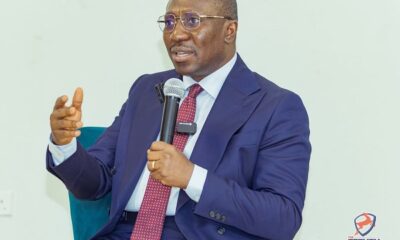
Check inefficiencies in tax system – Prof. Bokpin


- /home/u249204778/domains/spectator.com.gh/public_html/wp-content/plugins/mvp-social-buttons/mvp-social-buttons.php on line 27
https://spectator.com.gh/wp-content/uploads/2022/01/Prof.-Godfred-Alufar-Bokpin.jpg&description=Check inefficiencies in tax system – Prof. Bokpin', 'pinterestShare', 'width=750,height=350'); return false;" title="Pin This Post">
- Share
- Tweet /home/u249204778/domains/spectator.com.gh/public_html/wp-content/plugins/mvp-social-buttons/mvp-social-buttons.php on line 72
https://spectator.com.gh/wp-content/uploads/2022/01/Prof.-Godfred-Alufar-Bokpin.jpg&description=Check inefficiencies in tax system – Prof. Bokpin', 'pinterestShare', 'width=750,height=350'); return false;" title="Pin This Post">
A Professor of Finance at the University of Ghana, Prof. Godfred Alufar Bokpin, has advised government to check inefficiencies in the country’s tax system as it mobilises more revenue for development.
He said leakages in the system exceeded total revenue accrued to government but there could be more earnings when the loopholes were plugged.
Speaking on the sidelines of a SEND Ghana multi-stakeholder forum last Wednesday in Accra, Prof. Bokpin urged the government to focus on collecting more direct taxes instead of introducing indirect taxes that burdened the poor.
He noted there was “considerable room to collect more taxes without burdening the faithful few and without introducing fresh taxes” such as the Electronic Transaction Levy (E-levy).
He again called on the government to reconsider various tax exemptions granted foreign entities to the detriment of local businesses.
The forum on the “Commitment to Reducing Inequality (CRI) Index Report” was to discuss the state of inequality in Ghana and propose measures to address existing challenges.
The CRI report put together by Oxfam International, recommends that all governments “adopt strong anti-inequality policies on public services, tax and labour rights, to radically reduce the gap between rich and poor.”
The Economist, in a presentation, asserted that inequality in the country was at “crisis level” and affecting the ability of government to improve the wellbeing of Ghanaians.
He said that the worsening inequality gap was a security threat and steps must be taken to bridge the gap between the rich and the poor.
“The fact that a few Ghanaians are well to do but majority of Ghanaians go to bed not knowing where their next meal will come from makes it unsafe for all of us. Until every Ghanaian is okay, no Ghanaian is okay,” he said.
He noted society could become conducive for everyone if government checked public sector spending while improving the education, health and social protection sectors.
Citing connivance between tax officials and tax payers as contributing to revenue losses in the country, he further observed that government social intervention initiatives were one of many channels through which corruption was perpetuated.
He insisted that the growing poverty in the country is “fueling anxiety and causing people to cut corners,” hence the need for government to create equal and conducive environment for all.
Dr. George Domfe, Senior Research Fellow at the Centre for Social Policy Studies, University of Ghana also stressed the need to improve upon existing economic structures as interest payment on loans procured by government continued to impact the economy negatively.
He said the regressive nature of the country’s tax system must be addressed as the government focused on production instead of consumption to help attain the ‘Ghana Beyond Aid Agenda.’
By Ernest Nutsugah


General Secretary of the New Patriotic Party (NPP), Justin Kodua Frimpong, has filed his nomination to contest the position of General Secretary again as the party begins its rebuilding efforts ahead of the 2028 general elections.
He was accompanied by party stalwarts and supporters who were in high spirits, expressing confidence that he is the right person to hold the position.
Speaking after filing his nomination, Mr Kodua Frimpong assured the rank and file of the party that he would not disappoint them.
“I can assure you that the faith the rank and file of the party have had in me, I will never disappoint them,” he said.
He also pledged to run a clean campaign devoid of personal attacks.
“I can assure you that our internal campaign will be devoid of personal attacks,” he told his fellow contestants and the rank and file of the party as he seeks to retain his position.
His tenure has seen the party through the 2024 general elections, where the NPP lost power to the National Democratic Congress (NDC) after eight years in government.
The party is currently in a rebuilding phase, with internal elections scheduled to elect new national executives to lead its reorganization towards the 2028 polls.
The General Secretary position is considered one of the most influential in the party’s administrative structure, responsible for the day-to-day running of the party secretariat and implementation of party decisions.
By Edem Mensah-Tsotorme

The University of Ghana Medical Centre (UGMC) has disputed claims made on social media by comedian Michael Blackson concerning the treatment given to his late mother, saying a review found that the allegations did not accurately reflect what happened during her stay at the hospital.
In a statement issued in Accra on August 5, 2026, the management of UGMC expressed condolences to Mr. Blackson and his family over the death of his 83-year-old mother, who died at the facility on July 16, 2026.
The hospital said it had taken the concerns raised by Mr. Blackson seriously and conducted a thorough review in line with its clinical and administrative procedures.
According to the statement, the facts presented by Mr. Blackson on social media contained “numerous inaccuracies” and did not accurately reflect the medical care provided to his mother.
UGMC explained that she was referred to the facility from another hospital and received treatment there from May 27 to July 16, 2026, a period of about eight weeks.
The hospital stated that it would not release details of her diagnosis, treatment, medical records or other aspects of her care because it had a duty to protect patient confidentiality, even after death.
It said the decision was intended to respect the dignity of the deceased and the privacy of her family.
UGMC further stated that all clinical decisions at the facility are made by qualified healthcare professionals based on medical judgment, established standards of care and the best interests of the patient.
The statement added that such decisions are made in consultation with authorised family representatives where necessary and that billing and financial procedures are governed by institutional policies and are separate from clinical decision-making.
The hospital noted that it values feedback from patients and their families and considers both positive and negative comments important for improving the quality of care.
Mr. Blackson had earlier used social media to criticise the care his mother received at UGMC, prompting the hospital’s response.
By: Jacob Aggrey