Hot!
Call For Reparations A Valid Demand For Justice – President Akufo-Addo


- /home/u249204778/domains/spectator.com.gh/public_html/wp-content/plugins/mvp-social-buttons/mvp-social-buttons.php on line 27
https://spectator.com.gh/wp-content/uploads/2023/11/WhatsApp-Image-2023-11-17-at-11.23.21-AM.jpeg&description=Call For Reparations A Valid Demand For Justice – President Akufo-Addo', 'pinterestShare', 'width=750,height=350'); return false;" title="Pin This Post">
- Share
- Tweet /home/u249204778/domains/spectator.com.gh/public_html/wp-content/plugins/mvp-social-buttons/mvp-social-buttons.php on line 72
https://spectator.com.gh/wp-content/uploads/2023/11/WhatsApp-Image-2023-11-17-at-11.23.21-AM.jpeg&description=Call For Reparations A Valid Demand For Justice – President Akufo-Addo', 'pinterestShare', 'width=750,height=350'); return false;" title="Pin This Post">
“Let me reiterate that the call for reparations is not a plea for alms, but a valid demand for justice. If reparations can rightfully be paid to victims and descendants of the victims of the Holocaust, so can reparations also be paid to the descendants of the victims of the Slave Trade. It has been four hundred (400) years, and we want closure to this tragedy.”
These were the words of the President of the Republic, Nana Addo Dankwa Akufo-Addo, when he delivered an address at the opening of the Accra Reparations Summit, held at the Kempinski Hotel, on Tuesday, 14th November 2023.
Delivering his address at the event, President Akufo-Addo stated that the Trans-Atlantic Slave Trade, which begun with some twenty (20) slaves from West Africa being forcibly sent in 1619 to the United States of America, was devastating to the continent and to the African Diaspora, as it stifled the economic, cultural and psychological progress of Africa.
“But what we do know is that the African peoples built and contributed to the successes of the Americas, and even though they did not willingly make the journeys in the two hundred (200) years of the slave trade, once there, they were and have been an integral part of the success in their new homes, even though they have not benefitted nearly as much as they should have from their toil,” he said
The President noted, however, that reparations for Africa and the African diaspora are long overdue, with the question of reparations becoming a debate only when it comes to Africa and Africans.
“When the British ended slavery, all the owners of enslaved Africans received reparations to the tune of twenty million pounds sterling, the equivalent today of twenty billion pounds sterling, but enslaved Africans themselves did not receive a penny. Likewise in the United States, owners of slaves received three hundred dollars for every slave they owned; the slaves themselves received nothing,” he said.
President Akufo-Addo continued, “Take the case of Haiti, which had to pay reparations amounting to twenty-one billion dollars ($21 billion) to French slaveholders in 1825 for the victory of the great Haitian Revolution, the first in the Americas and the Caribbean which freed the slaves. It was a payment made under duress that impoverished Haiti throughout the 19th century till today.”
The President also indicated that native Americans have received and continue to receive reparations; Japanese-American families, who were incarcerated in internment camps in America during World War II, received reparations.
He added that Jewish people, six million of whom perished in the concentration camps of Hitlerite Germany, received reparations, including homeland grants and support.
“So, it is time for Africa, twenty million of whose sons and daughters had their freedoms curtailed and sold into slavery, also to receive reparations. No amount of money can restore the damage caused by the Trans-Atlantic Slave Trade and its consequences, which have spanned many centuries. Surely, this is a matter that the world must confront, and can no longer ignore,” he indicated.
And, even before these discussions on reparations conclude, President Akufo-Addo noted that the entire continent of Africa deserves a formal apology from the European nations involved in the slave trade for the crimes and damage it has caused to the population, psyche, image and character of the African the world over.
Whilst at it, the President pointed out that the subject of restitutions must go along with the matter of reparations.
“The initiative for the return and restitution of African cultural properties to the continent must also be a major issue of concern for all Africans. We must call for the return of African cultural properties that were illegally and shamelessly transported from the continent,” he said.
The President stated that he was aware of the efforts made by countries such as Senegal, Nigeria and Benin in successfully regaining possession of some of their cultural properties that were illegally moved out of their territories.
Ghana, he added, has also successfully recovered some of its stolen cultural properties and relics, pointing to the collaboration of Government and elders of Ahanta to return the severed head of Nana Badu II, who was executed in 1838.
Other success stories, he stated, include the return of some family collections of the Ashanti Royal Family and an Asante Stool in 1985, by the British Government.
“The return and restitution of African cultural properties to the continent will help Africans, and, in particular, the descendants of the communities, groups, and individuals who created and produced these cultural properties, to reconnect to their history, to their pioneers, to their knowledge and their skills,” the President added.



The Tema Regional Police Command has arrested a 32-year-old man for allegedly posing as a soldier and extorting money from unsuspecting members of the public at Ashaiman.
The suspect, identified as Bright Atsu Kudiabor, was arrested by the Ashaiman Police on Wednesday, September 16, 2026, at about 7:00 a.m.
According to the Police, he was arrested at an area known as “I Shall Return”, where he was allegedly parading himself as a soldier and demanding money from people.
The Police said Kudiabor, who is an ex-convict, was initially arrested by personnel of the Ghana National Fire Service in Ashaiman with assistance from other members of the public.
A search conducted on him after he was handed over to the Police reportedly led to the recovery of a set of military camouflage uniform.
The suspect is currently in Police custody and assisting with investigations.
The Tema Regional Police Command said he would be processed for court after investigations are completed.
The Police urged the public to remain vigilant and report anyone who falsely presents themselves as a soldier or a member of another security agency to deceive or extort money from the public.
By: Jacob Aggrey
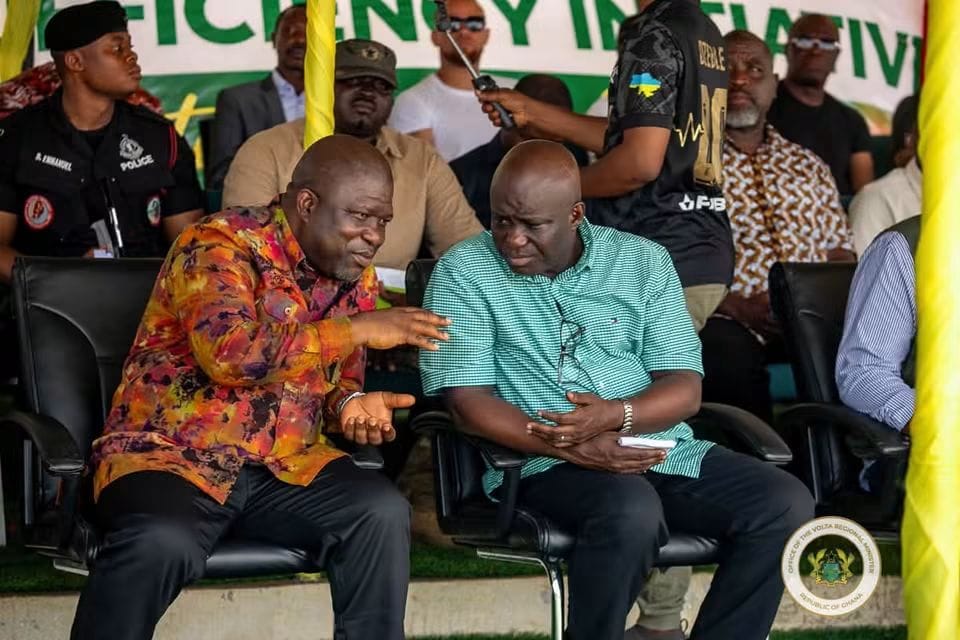
Volta Regional Minister, James Gunu, says the Volta Region holds enormous agricultural potential and efforts must be geared towards connecting farmers to the needed resources to unlock that potential.
He said focus must be on linking farmers to resources, technology, financing and markets to increase production, create jobs and build sustainable livelihoods.
Hon. Gunu made the remarks at the national launch of the Ghana Tomato Self-Sufficiency Initiative (GHATSI) held at Anloga in the Volta Region on Tuesday, September 15.
The initiative, under the theme “Produce at Home. Feed the Nation. Export the Surplus,” seeks to boost local tomato production, processing and marketing while reducing Ghana’s heavy reliance on imported tomatoes.
The launch was attended by the Minister for Food and Agriculture, Eric Opoku, his Deputy, John Setor Dumelo, Feed Ghana Coordinator, Bright Demordzi, Members of Parliament, traditional leaders, MMDCEs, farmers and other stakeholders.
Mr.Gunu expressed appreciation to the Minister for Food and Agriculture for the support announced for the region, including two excavators, 200 cartons of organic fertiliser, and GH¢200,000 for Ms. Kuatudzo Esther Dela, a tomato farmer and processor from Ziope.
He described the initiative as an important step towards making agriculture a stronger driver of food security, job creation and economic growth in the Volta Region.
By Edem Mensah-Tsotorme