Hot!
Building profitable ventures: The story of three audacious entrepreneurs


Starting a business can be quite challenging as it requires a tough mind-set and clear vision in order to succeed. In this edition, we highlight the stories of three young Ghanaian entrepreneurs who have trodden slippery roads to establish viable ventures.
They are Ms. Ruby Buah, the Founder of Kua Designs and Kua Kids, Mr. Kevin Okyere, Founder & C.E.O of Springfield Energy, as well as Kimberley and Priscilla Addison, Founders of ’57 Chocolate brand.
Ruby Buah
In 2009, she transitioned from working as a Financial Analyst to start her fashion business. She worked at Coca Cola Enterprises in Atlanta, Georgia, before looking for a creative outlet and began experimenting with various types of art in her leisure time.

What began as a pastime in jewellery-making swiftly grew into a company. She moved to New York three years after starting her part-time jewellery company to get a degree in Jewellery Design at the famed Fashion Institute of Technology.
Unsurprisingly, she expanded her jewellery range by adding an equally exciting handbag line. After a few years of running her elegant store in Ghana, she expanded it further in 2015 by introducing a children’s brand.
Ruby says “she makes an effort to appreciate the less glamorous aspects of her profession as much as she treasures the finished items that line the shelves of her luxury store in Accra.”
The brand name ‘Kua’ has a dual meaning: It is Ruby’s mother’s name and also means “Keeping us Authentic”. The name, according to her, “is most appropriate for her collection which incorporate authentic gemstones and original African fabrics straight from Ghana.”
Kevin Okyere
The CEO and philanthropist displayed entrepreneurial potentials at a very young age. By the time he was 11, he was already selling iced water to football supporters at the Kumasi Sports Stadium to make extra pocket money.

During his family’s annual summer vacation trips to London, he would take on jobs with textile companies in the U.K. After completing his High School education in Ghana, he proceeded to the United States where he studied Accounting at George Mason University in Virginia. While studying, he took several jobs at varying points.
He moved backed to Ghana in 2004 and joined his elder sister in her business to understand how the country worked. A year after working for his sister, he put together a small team of investors and established Westland Alliance Ltd, a telecoms company that provided international call routing services for AT&T and several international calling card companies.
The company was extremely successful, but it was not long before he got tired of the telecoms business and decided to opt-out.
Later, he started working with a business acquaintance who supplied crude oil and condensates to the Tema refinery. As he interacted frequently with this associate, he learned that there was a shortfall of storage facilities for petroleum products in Tema.
Flush with cash from his telecom adventures, he acquired land and began building a storage tank farm in Tema, close to the refinery. This marked the genesis of Springfield Energy’s flagship trading business.
“Unlike in the U.S, Ghana was virgin territory for a lot of businesses. There were too many opportunities to explore in Ghana and I knew I could be more successful home than abroad. I knew I wanted to run my own business, but I wasn’t even sure of what I was going to do,” he told Forbes in 2018.
Kimberley & Priscilla Addison
Starting a bean-to-bar chocolate business in Ghana was not the sisters’ original career trajectory.

Kimberly studied French and International Relations with a concentration in social justice at Boston College while Priscilla majored in French and International Development, with focus on food security, at Dickinson College in Pennsylvania.
Both were interested in non-profit sectors addressing women’s education, human trafficking, value chains and agriculture. But a visit to one of Switzerland’s largest chocolate factories inspired their venture into confectionery.
Once they returned to Ghana, they started by roasting raw cacao with a standard kitchen oven in their home. They took courses on chocolate making and confections and trained with people in the field and did lot of research and reading about the industry.
They developed their chocolate recipes through trial and error and received feedback from family, friends, and visitors who worked within and outside of the chocolate industry, while seeking advice from people who worked in the industry.
The Chocolate was first launched in 2016 with five signature flavours: 73 per cent dark chocolate, 55 per cent milk, white, mocha latte (coffee flavour) and bissap (hibiscus flavour). The company name ’57 is short for 1957, the year of Ghana’s independence.
“57 is about patriotism and sparking the entrepreneurial spirit among the Ghanaian youth and using unique Ghanaian symbols.
“Over the long-term, we aim to create an African chocolate brand that is known world-wide, but most importantly one that surpasses our lifetime. We are working towards having our chocolate sold across the continent of Africa and around the globe.
“We hope for our chocolate to continue to reflect and build upon the unique traditions and culture that make us call Ghana and Africa at large home! We hope that ‘57 Chocolate inspires people from Ghana, and across the continent especially the youth, to create, develop, and consume made in Africa products of premium value,” the sisters noted.
By Spectator Reporter


The professor who spends his days exploring the intricacies of African languages found himself at the centre of a different kind of lesson on Friday, October 2, 2026. 
This time, there were no lecture notes, academic arguments or university classrooms. Instead, there was the weight of tradition, the rhythm of a community celebration and the solemnity of an oath at a royal palace.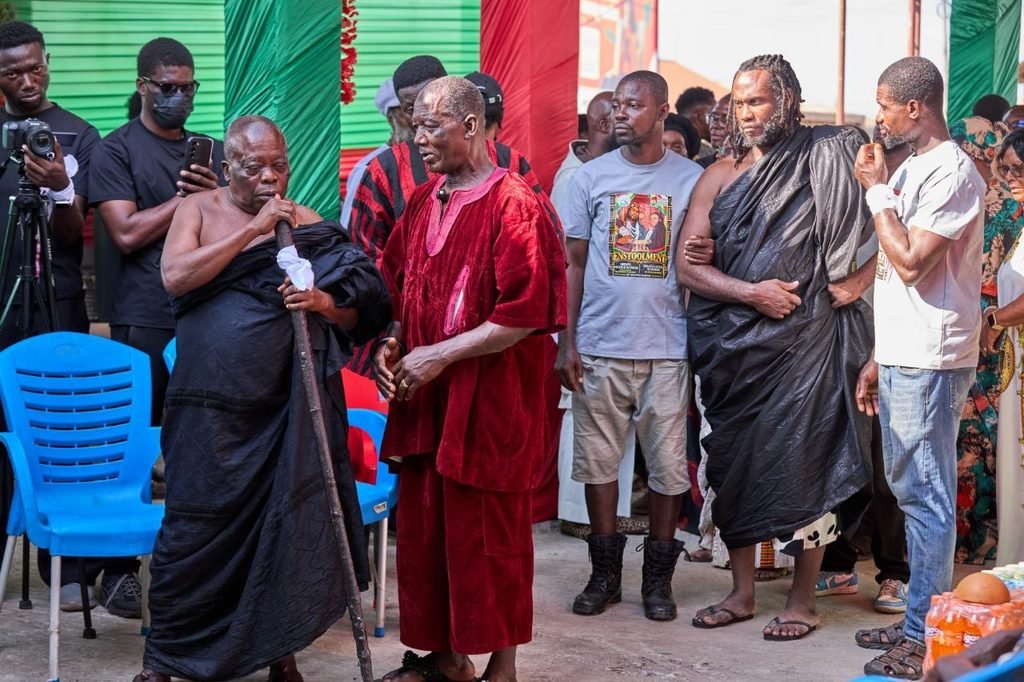
Professor Ọbádélé Kambon, a full Professor of African Linguistics at the University of Ghana, was enstooled as Apagyahene and Sunsum Ɔsahene of Akuapem Mampong in the Eastern Region in a ceremony that brought academia and traditional authority together.
For the professor, the occasion was more than a new title. It was a moment that connected his academic interests in African languages and indigenous knowledge with the living traditions of an Akan community.
The day’s events unfolded through a series of customary observances. Kambon was first taken to the compounds of the Ɔkyeamehene and Gyasehene, where the preparations for his installation continued.
Then came the application of hyire, the white kaolin powder associated with traditional rites.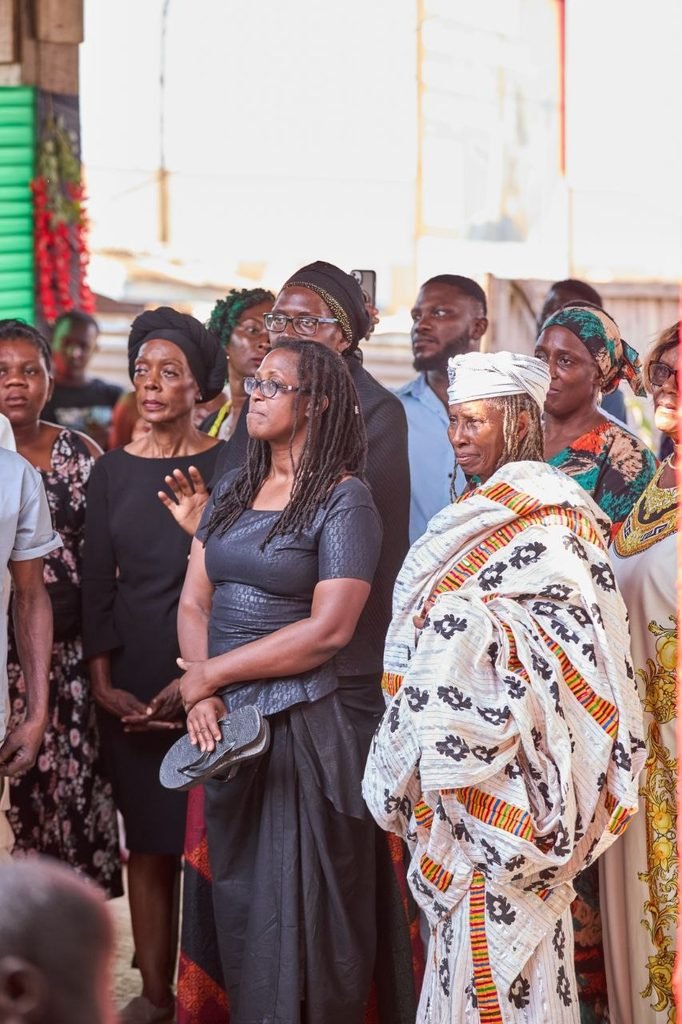
With the customary proceedings underway, the new chief was lifted onto the shoulders of celebrants and carried along the main thoroughfare of Akuapem Mampong.
The procession transformed the streets into a public stage for a ceremony rooted in the community’s traditional institutions.
There was something striking about the image, a university professor, accustomed to the measured language of academic discourse, being carried through the town in a display of traditional recognition.
Yet the celebration was not complete with the procession.
A ram was sacrificed at the Mamponghene’s compound before Kambon was taken to the palace, to swear the oath associated with his new offices.

The ceremony brought him formally into his roles as Apagyahene and Sunsum Ɔsahene.
Beyond the colourful proceedings, the titles themselves carry layers of historical meaning.
Kambon in his research explores the historical connections between Apagya and Akan political and military organisation.
Accounts cited in his work linked Apagya to an asafo, or military company, while historical writing traces an Apagya stool in Asante to the reign of Opoku Ware I in the eighteenth century.
These historical associations offer a glimpse into the institutions that have shaped Akan society over generations, although they do not automatically define the precise responsibilities of the office in Akuapem Mampong.
Kambon’s own professional life reflects a similar interest in preserving and examining African knowledge.
His work encompasses Akan language structure, naming practices across the Black world, proverbs and indigenous intellectual traditions.
Through Abibitumi, the platform he founded, he also promotes language learning, scholarship and cultural engagement.
But tradition was only one part of the story that day.
When the formal ceremony gave way to a reception, the occasion expanded into a celebration of three milestones: Kambon’s enstoolment, his promotion to full professor and his daughter Ama’s admission to the University of Ghana.
The gathering therefore carried a personal significance that went beyond the honours bestowed on one man. 
It celebrated professional advancement, the continuation of family aspirations and a connection to cultural heritage.
For a father, seeing a daughter gain admission to the same university where he holds a distinguished academic position offered another reason to celebrate.


For the professor, the moment placed family achievement alongside his own professional and traditional milestones.
Kambon had already established a place in the traditional life of Akuapem Mampɔn through an earlier installation as Banmuhene Kyidɔmhene, recorded in 2017.
His latest enstoolment adds another chapter to that relationship.
In Akuapem Mampɔn, the day brought together the university, the palace and the family table in one celebration. And for Kambon, the journey from the lecture room to the traditional procession showed how scholarship, cultural responsibility and family achievement could converge in a single memorable occasion.
By Enoch Ntiamoah Siaw
SKIP THE QUEUE, TAP THE NEWS
You can now read the Ghanaian Times and The Spectator newspapers from the comfort of your device via TimesNewsPlus.
Join our WhatsApp Channel: https://whatsapp.com/channel/0029VbBElzjInlqHhl1aTU27

Intercity STC Coaches Limited has interdicted a driver captured in a viral video allegedly hitting a Sprinter bus during an overtaking manoeuvre at Pokuase before driving away from the scene.
In a public notice, the company described the driver’s conduct as unacceptable, stressing that it did not reflect the safety standards and professionalism it upholds.
Management said it had commenced an immediate investigation into the incident and identified the driver, who has been interdicted pending the outcome of the disciplinary process.
The company added that it was awaiting an official report from the Pokuase Police Command to help establish the facts surrounding the incident.
STC reaffirmed its commitment to passenger safety and responsible road use, while thanking members of the public for bringing the incident to its attention.
Management assured the public that appropriate action would be taken following the investigation.
By: Jacob Aggrey