Hot!
2021 BECE begins smoothly

- /home/u249204778/domains/spectator.com.gh/public_html/wp-content/plugins/mvp-social-buttons/mvp-social-buttons.php on line 27
https://spectator.com.gh/wp-content/uploads/2021/11/1.21257869.jpg&description=2021 BECE begins smoothly', 'pinterestShare', 'width=750,height=350'); return false;" title="Pin This Post">
- Share
- Tweet /home/u249204778/domains/spectator.com.gh/public_html/wp-content/plugins/mvp-social-buttons/mvp-social-buttons.php on line 72
https://spectator.com.gh/wp-content/uploads/2021/11/1.21257869.jpg&description=2021 BECE begins smoothly', 'pinterestShare', 'width=750,height=350'); return false;" title="Pin This Post">
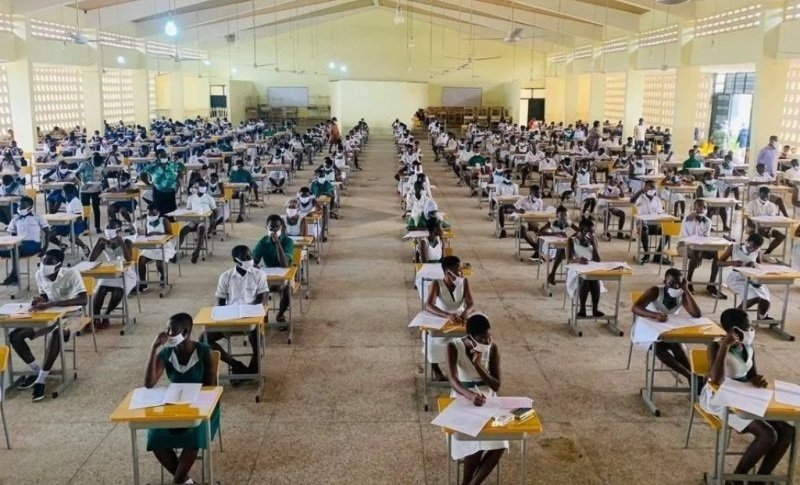
This year’s Basic Education Certificate Examination (BECE) has started smoothly across the country.
Apart from the late start of the examination at a few centres in the Greater Accra Region, no major irregularity was recorded an hour into the examination.
A total of 571, 894 candidates are writing the examination from today, Monday, November 15, 2021, to Friday November 19, 2021 at 2,158 centres nationwide with a total of 20,124 invigilators, 2,158 supervisors and 1,853 assistant supervisors.
Mrs Agnes Teye-Cudjoe, Head of Public Affairs, West African Examinations Council’s National Office, in an interview with the Ghana News Agency (GNA), said the Council had put in place stringent security measures to prevent leakages in this year’s examinations.
She said officials of the National Intelligence Bureau monitored the production process – printing, sorting and packaging of the papers- and confident that there would be no leakages of the papers before and during the exams.
“The Council has also increased the number of depots storing confidential materials under strict surveillance to ensure that the papers did not leak before and during the examinations,” she said.
Mrs Teye-Cudjoe said all COVID-19 safety protocols would be observed during the examination, stressing that all candidates would be given hand sanitisers and that “should a candidate fall sick and a medical report is available, a committee will look into the situation and take a decision.”
A statement signed by Mrs Cassandra Twum Ampofo, the Head of Public Relations, Ghana Education Service, commended teachers, school heads, parents, and other stakeholders for preparing the candidates for the examination.
The statement entreated all stakeholders to desist from any form of examination malpractice.
It said details of the selection process for the Senior High School would be communicated in due course and wished all candidates success and good luck.
Mr Peter Korda, Head of Public Relations, Ghana National Association of Teachers, said they expected the BECE results to be better this year despite the long COVID-19 break.
He said teachers did their best to catch up with the curriculum after the 10-month break in 2020 during the COVID-19 pandemic.
“COVID-19 pushed teachers to go the extra mile to adequately prepare students for the examinations through extra classes and online teaching and assignments,” he said.
He advised the candidates to adhere to rules and regulations of the exams.
Meanwhile, male candidates continue to dominate the examination with 287, 605 males writing this year’s examination as against 284, 289 females.
In 2020, out of a total of 531, 705 candidates, the females were 262, 286 against 269,419 males.
In 2019, out of 517, 331 candidates, there were 253, 729 females and 263, 602 males.
For 2018, the females were 246,529 against 263,295 males, totalling 509, 824.
The year 2017 was not different. A total of 226, 905 females wrote the examination against 241, 148 males.
The Ashanti Region, for a very long time, has been registering the highest number of candidates with males outnumbering the females.
In 2017, it had 47,702 males against 45,868 females. In 2018, the males were 54,487 as against 51,121. Similarly, there were 52,945 males and 51,516 females in 2019. A total of 54,025 males and 52,832 females in 2020. And in 2021, the males were 55,829 whereas the females were 55,603.
The case is different for Greater Accra Region, which records more females than males.
In this year’s examination, the Region (Greater Accra) registered 50,815 males and 54,824 females.
There were 45,172 males against 49,271 females in 2020.
Also, whereas 43,273 males were recorded in 2019, the females were 47,311.
In 2018, the male candidates stood at 42, 643 against 45,710 females.
The males in 2017 were 41,022 against 44,019 females.
Below is the regional breakdown for this year’s examination:
Eastern Region, 28,475 males, 27, 455 females.
Central Region, 31,954 males and 31,773 females.
Western and Western North Regions will have 29,718 males and 28,598.
The Bono, Ahafo and Bono East Regions registered 27,138 males against 26127 females.
A total of 21,871 males and 20,222 will represent the Volta and Oti Regions.
The Northern, North East and Savannah Regions will have 24,029 males and 20,809 females.
Upper East, 10,586 males and 11,530 females.
The Upper West Region, 7,290 males and 7,348 females. -GNA


General Secretary of the New Patriotic Party (NPP), Justin Kodua Frimpong, has filed his nomination to contest the position of General Secretary again as the party begins its rebuilding efforts ahead of the 2028 general elections.
He was accompanied by party stalwarts and supporters who were in high spirits, expressing confidence that he is the right person to hold the position.
Speaking after filing his nomination, Mr Kodua Frimpong assured the rank and file of the party that he would not disappoint them.
“I can assure you that the faith the rank and file of the party have had in me, I will never disappoint them,” he said.
He also pledged to run a clean campaign devoid of personal attacks.
“I can assure you that our internal campaign will be devoid of personal attacks,” he told his fellow contestants and the rank and file of the party as he seeks to retain his position.
His tenure has seen the party through the 2024 general elections, where the NPP lost power to the National Democratic Congress (NDC) after eight years in government.
The party is currently in a rebuilding phase, with internal elections scheduled to elect new national executives to lead its reorganization towards the 2028 polls.
The General Secretary position is considered one of the most influential in the party’s administrative structure, responsible for the day-to-day running of the party secretariat and implementation of party decisions.
By Edem Mensah-Tsotorme

The University of Ghana Medical Centre (UGMC) has disputed claims made on social media by comedian Michael Blackson concerning the treatment given to his late mother, saying a review found that the allegations did not accurately reflect what happened during her stay at the hospital.
In a statement issued in Accra on August 5, 2026, the management of UGMC expressed condolences to Mr. Blackson and his family over the death of his 83-year-old mother, who died at the facility on July 16, 2026.
The hospital said it had taken the concerns raised by Mr. Blackson seriously and conducted a thorough review in line with its clinical and administrative procedures.
According to the statement, the facts presented by Mr. Blackson on social media contained “numerous inaccuracies” and did not accurately reflect the medical care provided to his mother.
UGMC explained that she was referred to the facility from another hospital and received treatment there from May 27 to July 16, 2026, a period of about eight weeks.
The hospital stated that it would not release details of her diagnosis, treatment, medical records or other aspects of her care because it had a duty to protect patient confidentiality, even after death.
It said the decision was intended to respect the dignity of the deceased and the privacy of her family.
UGMC further stated that all clinical decisions at the facility are made by qualified healthcare professionals based on medical judgment, established standards of care and the best interests of the patient.
The statement added that such decisions are made in consultation with authorised family representatives where necessary and that billing and financial procedures are governed by institutional policies and are separate from clinical decision-making.
The hospital noted that it values feedback from patients and their families and considers both positive and negative comments important for improving the quality of care.
Mr. Blackson had earlier used social media to criticise the care his mother received at UGMC, prompting the hospital’s response.
By: Jacob Aggrey