Features
Organic farming: A national strategy for Ghana’s food strategy


- /home/u249204778/domains/spectator.com.gh/public_html/wp-content/plugins/mvp-social-buttons/mvp-social-buttons.php on line 27
https://spectator.com.gh/wp-content/uploads/2026/03/The-author.jpeg&description=Organic farming: A national strategy for Ghana’s food strategy', 'pinterestShare', 'width=750,height=350'); return false;" title="Pin This Post">
- Share
- Tweet /home/u249204778/domains/spectator.com.gh/public_html/wp-content/plugins/mvp-social-buttons/mvp-social-buttons.php on line 72
https://spectator.com.gh/wp-content/uploads/2026/03/The-author.jpeg&description=Organic farming: A national strategy for Ghana’s food strategy', 'pinterestShare', 'width=750,height=350'); return false;" title="Pin This Post">
The quiet crisis in the Ghanaian field
In many Ghanaian communities today, from the vegetable hubs of Akumadan to the grain belts of the Northern Region, farmers are being squeezed from both ends. On one side are the suffocating rising costs of imported inputs. Synthetic fertiliser prices that jump without warning and chemical pesticides that are not only expensive but often misused due to a lack of technical oversight. On the other side is the relentless pressure to produce in the face of exhausted soils, erratic rainfall patterns, and the emergence of aggressive new pest outbreaks like the Fall Armyworm.
The result is a quiet, systemic crisis; thus, our smallholder farmers are working harder and spending more of their meager capital on external inputs, yet they are struggling to secure stable yields or achieve decent profits.
Redefining organic: From boutique to backbone
In the current national conversation, organic farming is often misunderstood. It is frequently treated as a “boutique” label, something meant for the export shelves of Europe or the high-end health shops in suburban Accra. This narrow thinking is dangerous. Organic farming, properly understood, is not a niche lifestyle choice; it is a sophisticated biological system built around soil health, compost restoration, and integrated pest management.
For Ghana, this is not a fashionable trend; it is a vital National Resilience Strategy. If Ghana invests in organic and agroecological practices at scale, starting with decentralised compost production and credible safety standards, we can sever the cord of input vulnerability and rebuild our agricultural heritage from the ground up.
The problem: The trap of imported dependency
Ghana’s food production has become dangerously addicted to inputs we do not control. Our current model relies on a global supply chain that is increasingly volatile. Synthetic fertilisers and agro-chemicals are tethered to the price of natural gas and vulnerable to currency swings. When the Cedi fluctuates or global shipping is disrupted, the burden falls squarely on the Ghanaian farmer.
Organic approaches offer a practical escape from this dependency trap by shifting the center of productivity back to local Biological Capital: compost, green manure, and cover crops. These methods do not just reduce immediate costs; they treat the soil as a long-term asset. A nation that depends on imported fertility is always just one global crisis away from a hunger epidemic. By focusing on organic soil restoration, we transform the soil from a mere medium for chemicals into a living, self-sustaining engine of growth.
Climate change and the yield gap myth
One of the loudest arguments against organic farming is the question: “Can it produce enough?” Critics point to a potential yield drop during the transition phase from chemical-heavy systems. However, in the context of the climate crisis, this argument is incomplete.
Most of Ghana’s farming is rain-fed. As our rainy seasons become more unpredictable, synthetic-heavy soils, which are often low in organic matter, struggle to retain moisture. In contrast, organic systems perform significantly better under drought conditions. Carbon-rich, composted soil acts like a sponge, holding water longer and keeping crops alive during dry spells.
A slightly lower yield that is stable, resilient, and cheaper to produce is far better for a Ghanaian farmer’s pocket than a high yield that requires expensive chemicals and collapses entirely when the rains fail. Stability is the true measure of food security, not just peak volume.
Public health: The farm-to-table connection
The pressure to produce market-perfect vegetables for consumers in Kumasi or Accra often leads to the cocktail effect, where farmers mix multiple high-toxicity pesticides to ensure no insect damage is visible. This carries hidden, staggering costs: acute respiratory illnesses for farmers, long-term hospital visits for consumers, and a growing public mistrust in local produce.
Organic practices, such as biological pest control and crop rotation, reduce the reliance on these heavy chemical sprays. When we support organic-by-practice farming, we are investing in a preventive healthcare strategy. We protect the farmer in the field and the Ghanaian family at the dinner table.
The economic multiplier: Jobs in the green economy
Scaling organic farming creates a new value chain that could employ thousands of youth. Unlike imported fertilisers, compost and bio-pesticides must be produced locally.
• The compost economy: Establishing municipal organic waste processing plants creates jobs in waste collection, processing, and distribution.
• Bio-inputs: Local entrepreneurs can lead the way in producing botanical extracts and neem-based bio-pesticides, keeping money circulating within the Ghanaian economy rather than sending it abroad to multinational chemical firms.
A five-point action plan for a greener Ghana
To move organic farming from the fringe to the mainstream, we need a “who-does-what” roadmap that moves beyond rhetoric into institutional action:
- Scale up compost as national infrastructure
Municipal assemblies, in partnership with the Ministry of Food and Agriculture (MoFA), must prioritise the conversion of city organic waste into high-quality compost. We should establish regional compost hubs near major farming belts. Compost should be treated with the same importance as roads or electricity for it is fundamental infrastructure of food security. - Re-tooling extension services
The current extension model is often geared toward chemical-intensive agriculture. MoFA extension officers must be retrained to provide practical, hands-on modules for farmers. This includes teaching Indigenous Microorganisms (IMO) collection, advanced composting techniques, and multi-cropping strategies that naturally suppress pests. - Build truth-in-labelling and consumer trust
We need the Ghana Standards Authority (GSA) and the Food and Drugs Authority (FDA) to establish credible, low-cost certification systems. We don’t need expensive international labels; we need a Verified Safe or Organic-by-Practice seal that allows a consumer at Agbogbloshie market to buy with confidence, knowing the produce is free from toxic residues. - Leverage institutional procurement
The government is one of the biggest food buyers in the country. The Ghana School Feeding Programme and government hospitals should pilot sourcing from verified organic-by-practice farms. This provides a guaranteed market and a price floor for farmers who take the risk to transition away from chemicals. - Incentives for the next generation
Organic farming is high-knowledge farming. We must provide small grants or low-interest Green Credits for youth-led cooperatives. If we give young graduates the tools to start Soil Clinics or composting businesses, we make agriculture attractive, modern, and profitable.
Conclusion: The choice before us
Organic farming is not a luxury for the wealthy; it is a strategy for national survival. It is the path toward a Ghana that is less dependent on the whims of global markets and more reliant on the strength of its own ecological intelligence.
Ghana must decide now! Will we keep chasing short-term productivity through expensive, imported dependency? Or will we build a lasting food system through soil restoration and biological wisdom? The sooner we treat our soil as a living national asset, the sooner we can secure a food system that truly serves all Ghanaians. The time to transition is not when the next crisis hits; the time to transition is now.
By Felicia Bonnah Quansah

There is a scripture that is found in Matthew 6:22 which says that the lamp of the body is the eye and therefore the eye must see well to enable the body to get to its destination.
What most people do not know is that behind the scenes, there is a strong interaction between the eyes and the brain before a picture becomes clear. The state of mind therefore is crucial to the eye seeing clearly to enable the body to process accurately the information the eyes are feeding it for proper identification of what the eyes see.
This is similar to how a person behaves i.e. what informs the decisions that forms in the mind that results in the actions that a person performs. The actions of a person does not therefore just happen but is as a result of things that went on in the mind, which in most cases resulted from information passed on to it by the eyes either consciously or unconsciously.
There are so many issues that affect our society which makes one wonder, whether the people who displayed such acts were created by someone or something other than God.
How can a person see a beach created by God with beautiful beaches and fresh air blowing all around, decides to defecate at such places, and therefore desecrate the environment? lt is simply mind boggling?
When other people in other countries who dwell on the coast are using their beaches for tourist attraction purposes as a means of livelihood and also to promote environmental health, some people living around our beaches, have turned them into rubbish dumping sites and toilets.
It is a very sad situation and the earlier we did something about it the better. It is a national emergency that must engage the attention, first of the government and then the citizenry, where religious bodies and NGOs must play a critical role.
The things we focus on in this country, needs to be addressed. Our minds which processes the info the eyes send to the brain, must be disciplined. There are certain behaviours that a disciplined mind can ignore even when the eye has provided info to the brain. One of the things a disciplined mind does, is the avoidance of a second look, which is critical for every person who wants to avoid adultery or fornication.
Once a person is not blind, he will see things. The boobs, the ‘shankus’, the coca cola shapes, the light complexioned, the dark complexioned etc. the eyes will definitely see and report same to the brain. What the brain or the mind decides to do or instructs the eye to do is the issue.
It can decide to instruct the eye to take a second look and let the mind drool over it or say ignore it and that will be the end.
If the mind becomes trained to focus on environmental issues like clean environment, the eyes will automatically be reporting on insanitary conditions to the brain as and when it sees them. The mind will pay attention to such data and begin to process them and to identify solutions to deal with the reported insanitary conditions.
There is the need to encourage citizens to train the mind to focus on the right thing so that in tandem with the eyes, focus will be maintained. When the mind is so trained, it communicates with the eye to also focus on hood things that helps in both are spiritual life and our secular lives, for indeed the eyes are the lamp of the body. God bless.
THE relationship between New Times Corporation (NTC) and African Concrete Productions (ACP) is based entirely on matters of the stomach. Each depends on the other in a dietary symbiosis, reinforced by the close proximity of each other
At lunchtime, you’d see a particular set of Times workers marching regimentally to ACP to face the wall. You’d think they are soldiers. It has long been declared that the company manufactures the best kokonte in the Greater Accra Region. ACP is, therefore, a culinary haven for those NTC kokonte fans, both male and female.
As the NTC kokonte warriors cross the border to ACP, you’d see some ACP banku fanatics dancing joyously to NTC. They are lucky folks because they do not have to obtain visa to enter into ‘Times’ to attack the balls of banku with precision and accuracy. They also claim that the lightsoup at ‘Times’ is arguably the best in West Africa.
So the relationship between the two entities was quite cordial and based practically on stomach palaver, until ACP workers staged an industrial revolution, whereupon the managing director, accountant and estate manager were allegedly stripped naked and locked up in a room. An insurgency had began in earnest.
An ACP worker came to ‘Times’, this time not to eat banku and okro. He had come to inform newsmen that juicy stuff awaited them at ACP. It could make a front page lead story.
A camerawoman and a female reporter were accordingly dispatched to go and bring back news, juicy news as juicy as kokonte and groundnut soup.
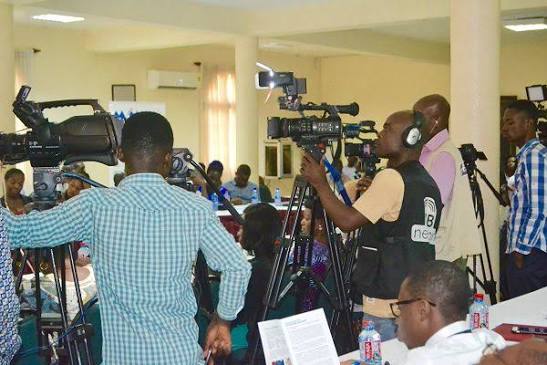
I was driving to work when I espied the familiar camerawoman clicking away outside the ACP premises. I didn’t see any ‘Times’ reporter but angry workers who were on the verge of getting violent. I slowed down and the driver behind blew his horn at me like a lunatic. I drove on.
Later, I heard the reporter and camerawoman were harassed and brutalised. The report came,. “The camerawoman, Mrs Salome Adonu-Agbottah and reporter Mrs Doreen Allotey, in an attempt to retrieve the camera which the workers had seized from them were severely beaten. They were manhandled and almost pushed into a big gutter opposite the company’s premises.
BRUISES
“….The camerawoman had bruises on her body, her hand bag was destroyed and the money in it stolen. Mrs Allotey’s watch was also snatched and her feet stamped on.”
Luckily, it was not her nose that was trampled upon. She has a beautiful nose.
The bad news was received with extreme sorrow. If the victims had been men, it would not have seemed too bad. But to brutalise women is just unacceptable. The New Times Corporation has not stopped mourning the incident which has been condemned in many circles.
Some people keep asking me why Times sent females to cover a potentially violent demonstration. I tell them they might as well ask why CNN’s amazon, Christina Amanpour, is assigned to cover the carnage in Bosnia-Herzegovina and Rwanda. She is always on the frontline in jeans and jacket.
Journalism is a potentially hazardous profession, and once you accept to study and practise the trade, you might as well bone up to face any assignment as long as your superiors feel you are capable of handling it or you have demonstrated the capacity to handle it. Both males and females can be assigned anywhere, anytime just like policemen and women are assigned.
The only difference between cops and pressmen is that the latter are armed only with a pen and the former with a gun. The question is should newsmen also arm themselves so that in any event of an assault they would not be found wanting in self-defence? They can’t adequately defend themselves with a pen and a jotter. A pen cannot even disfigure an opponent’s upper lip.
Photo-journalists have particularly suffered violence. Spectator ace-cameraman Vincent Dzatse was severely assaulted by AMA men when he attempted to take pictures of their indiscretions.
Sports cameraman, P. K. Arthur has been beaten more than once at the sports stadium when riots errupted and he wanted to capture it on his lenses.
Some sports journalists have been banned from entering the Accra Sports Stadium by supporters because in their comments, they didn’t write “sense”. Some supporters once nearly lynched Christian Abbew, Spectator Sports Editor, near a courtroom. He was stoned like the biblical Stephen. He had gone to defend a contempt charge.
I think it is time journalists met and discussed how best to defend themselves in any event of an attack by individuals or mobs. In the pursuance of their duty, they must be free from harassment and assault.
Some journalists go to work and return home with a black-eye or a double fore-head. It is just not right. Something has to be done about it. I think journalists should be armed. But first we must be trained in the use of firearms so that our warning shot do not hit below the belt. What about training in Kung Fu?
This article was first published on Saturday, October 17, 1998.