Hot!
IMF deal: We can manage – Ofori-Atta on external creditors’ cut-off date

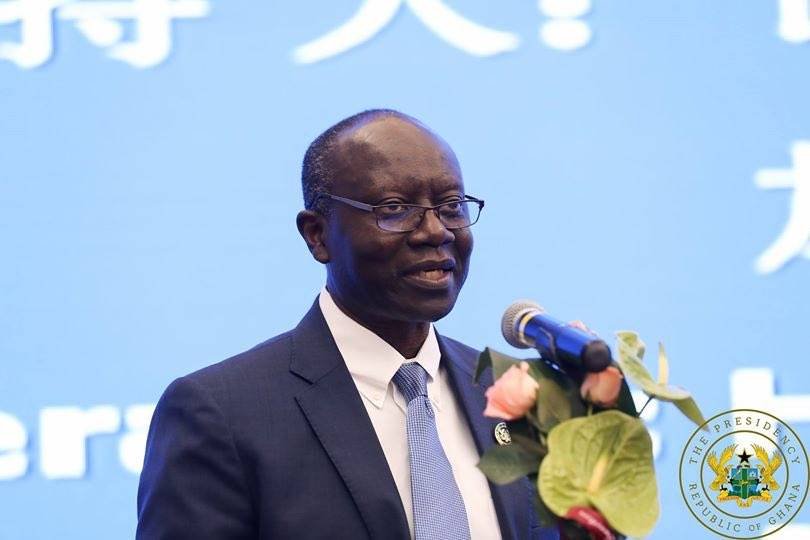
Finance Minister Ken Ofori-Atta has stated that Ghana is open to any new cut-off date proposed by external creditors for the restructuring of Ghana’s external debt.
China is suggesting a December 2020 cut-off date instead of the previously agreed-upon date of December 2022.
This delay has affected Ghana’s meeting with the IMF Board for the next tranche of $600 million.
Speaking to journalists in Accra, Ken Ofori-Atta reiterated that Ghana is open to considering any date.
“For us, we can manage, so the issue is for the membership of the OCC [Official Creditor Committee ] to get comfortable, and so we hope that by the end of next week, we will have what we need so that the Fund Board can sit. Everybody is looking at the comparability of treatment in there and China and France certainly are co-chairs, so they have a good impact on what will happen, but we should be okay.”
This comes on the back of claims by the Minority Leader, Dr. Ato Forson, that the negotiation has suffered a setback and the next $600 million package is in limbo.
According to Mr. Forson, there is a disagreement between the government and the Official Creditors Committee regarding the cut-off point for the external debt to be included in the debt restructuring exercise. He insisted that this disagreement has put the release of the next tranche of $600 million in jeopardy.
Minority Leader, Dr. Cassiel Ato Forson who made the allegation during his concluding remarks on the 2024 budget debate in Parliament on Wednesday, November 29, 2023, said Ghana is currently in a tight spot.
“Mr. Speaker, it will interest you to know that there is a deadlock in the negotiation between Ghana and the International Official Creditors Committee (OCC) made up of China and the Paris Club 50. There is a major disagreement on the cut-off point, regarding the external debt that must be excluded from the restructuring. Mr. Speaker, I do not need to sound the alarm that at this point, Ghana is between a rock and a hard place.”
Source: Citinewsroom.com


The Global Network of Export-Import Banks and Development Finance Institutions (G-NEXID) successfully held its sixth (6th) Exchange Programme, hosted by the Ghana Export – Import Bank (GEXIM) Bank in Accra from March 22 to 23 March.
The event brought together member institutions, partner organisations and Ghanaian public entities to advance dialogue on South-South trade, investment and development finance, while also creating opportunities for knowledge-sharing and institutional cooperation.
Organised as a capacity-building and networking platform, the 2026 edition of the G-NEXID Exchange focused on GEXIM’s experience in developing innovative solutions to promote intra-African and extra-African trade.
It also highlighted trade and investment opportunities in Ghana, particularly in the context of the African Continental Free Trade Area (AfCFTA) and broader national development initiatives.
The Exchange Programme forms part of G-NEXID’s mandate to foster cooperation among export-import banks and development finance institutions in support of South-South trade and investment.
This 6th edition follows earlier successful programmes hosted by India Exim Bank (2016), BNDES (2017), Indonesia Eximbank (2018), Afreximbank (2019) and Saudi EXIM Bank (2025).
On the first day, participants were presented with G-NEXID institutional information and received an update on the Network’s 2026 work programme.
There were a series of substantive presentations, including an overview of the Ghanaian economy by the Ministry of Finance, with particular attention to debt-related challenges; a presentation by the Ghana Investment Promotion Centre (GIPC), on investment opportunities in the country; and institutional presentations by GEXIM and Development Bank Ghana (DBG) on their respective mandates, initiatives, products and services.
Discussions during the sessions underscored strong interest in sector-focused webinars and business dialogues, particularly in agribusiness value chains such as poultry and rice.
Participants also emphasized the importance of continued information exchange and the sharing of best practices, especially in the area of guarantees.
The second day opened with a presentation on the 24-Hour Economy and Accelerated Export Development Programme, a national economic transformation strategy launched by President John Dramani Mahama in July 2025.
The initiative aims to enhance economic productivity through continuous industrial activity, accelerated export development and strategic import substitution.
As the programme is expected to mobilise both private and development capital, it presents concrete opportunities for G-NEXID members in areas such as co-financing, guarantees, trade finance and technical cooperation.
The programme also featured institutional presentations by guest organisations, namely the African Guarantee and Economic Cooperation Fund (FAGACE) and the West African Development Bank (BOAD), which shared their mandates, initiatives, products and services.
Following these exchanges, the G-NEXID Secretariat held bilateral discussions with both institutions as part of the Network’s ongoing membership drive.
Participants further benefited from a presentation by the Eastern and Southern African Trade and Development Bank (TDB), as well as a showcase of GEXIM’s key pipeline projects.
On the margins of the Exchange Programme, G-NEXID members also held their 20th Annual General Assembly Meeting to review progress and discuss strategic priorities.
Following the event, participants joined the GEXIM@10 International Conference, held from March 24-25, 2026 under the theme, “A Decade of Enabling Export Trade and Industrial Transformation: Resetting GEXIM for the Next Frontier.”
The conference provided an important platform for exploring how Ghana can strengthen its transition from a primary commodity exporter to a more competitive player in value-added trade and industrial development.
Source – G-NEXID
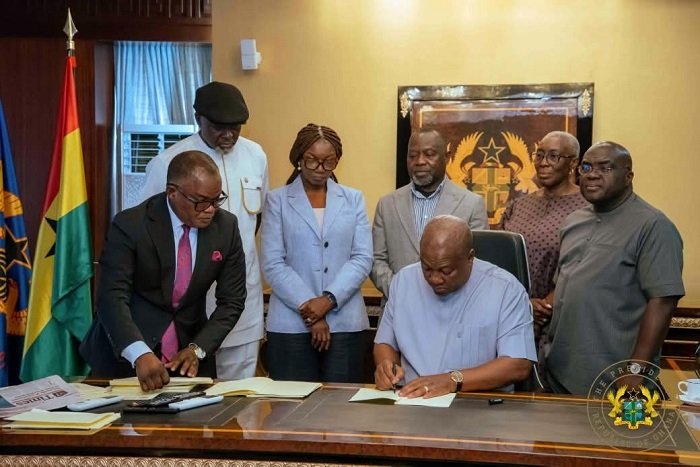
President John Dramani Mahama on Tuesday, March 31, 2026, signed five bills including three amendment bills passed by Parliament into law.
They are: Security and Intelligence Agencies Bill, 2025; University of Engineering and Agricultural Sciences Bill, 2025; Ghana Deposit Protection (Amendment) Bill, 2025; Growth and Sustainability Levy (Amendment) Bill, 2026; and Education Regulatory Bodies (Amendment) Bill, 2026.
In a brief remark after assenting to the bills, President Mahama explained that the Security and Intelligence Agencies Act, 2026, scraps the Office of Minister of National Security and frees the President’s to appoint any Minister to supervise the security agencies.
He said it also reverses the name of the office of National Intelligence Bureau (NIB), to the original name, Bureau of National Intelligence, (BNI).
This the President said, addresses the confusion between that security agency and a well-known Ghanaian financial institution, the National Investment Bank.
President Mahama also noted that the University of Engineering and Agricultural Sciences Act, 2026, establishes another University in the Eastern Region, at Bonsu, with three campuses – the main campus at Bonsu in the Eastern Region, with the second campus to be cited at Ohawu in the Oti Region.
The third, the Presdient assed will be located at Acherensua in the Ahafo Region.
Touching on the Amendment to the Growth and Sustainability Levy Act, the President said, “As you’re aware, the act was amended to increase it from 1% to 3%, and so this act reduces it again. That is the levy on mining companies. It reduces it again to 1%, because of the introduction of the sliding scale of royalties.”
He also spoke to the passage of the Government Education Regulatory Bodies Amendment Act, emphasising that amends Act 1023 to grant greater flexibility to private tertiary institutions and the option to Charter.
The Ghana Deposit Protection Amendment Act, the President concluded, is an amendment to an original act that was supposed to guarantee deposits held in commercial banks or financial institutions.
It basically expands protection to include mobile money wallets and other digital platforms, ensuring a wider scope of digital financial assets are secured.
The signing ceremony, was witnessed by the Clerk of Parliament, Mr. Ebenezer Ahumah Djietror, Secretary to the President, Dr Callistus Mahama, the Minister of Justice and Attorney General, Dr Dominic Akrutinga Ayine, Chief of Staff, Julius Debrah, Joyce Bawa Mogtari, a Senior Presidential Advisor and a Special Aide to the President, Finance Minister, Dr Cassiel Ato Baah Forson, and the Vice President, Professor Jane Naana Opoku Agyemang.
- Sports6 days ago
Former Black Stars player opens up on personal struggles, alleges family betrayal

 News1 day ago
Kwahu Business Forum:My engagement with President Mahama has boosted my business — Lydia Forson
- News1 day ago
“We are working to transform the Kwahu Business Village into an international conference hub”