Features
‘I survived a kidnapping but part of me died that day’


After a surge in the number of abductions in recent years, South Africa has one of the highest rates of kidnapping in the world, as Mpho Lakaje reports from Johannesburg.
Lesego Tau did not panic at first when a stranger opened the back door of her grey Mercedes C-Class and climbed in.
She had parked outside a shopping mall in Johannesburg and was focused on texting a friend before going in to grab a few items for a get-together that evening.
“In my rear view mirror, I was looking and still thinking: ‘This person is going to be so embarrassed when they realise they are in the wrong car’,” she told the BBC, recounting the events of last June.
But this was not an innocent mistake.
“Our gazes locked and I realised what was happening.”
This was a kidnapping.
Six months earlier, businessman Yasin Bhiku was grabbed in the driveway of his home, near Johannesburg, just after returning from the mosque.
CCTV footage that was widely seen on social media shows Mr Bhiku dressed in a blue T-shirt and black trousers calmly chatting to a friend.
Two men can be seen getting out of the car parked opposite. At first they stroll towards him, but then rush at him after Mr Bhiku realises what is going on and tries to flee.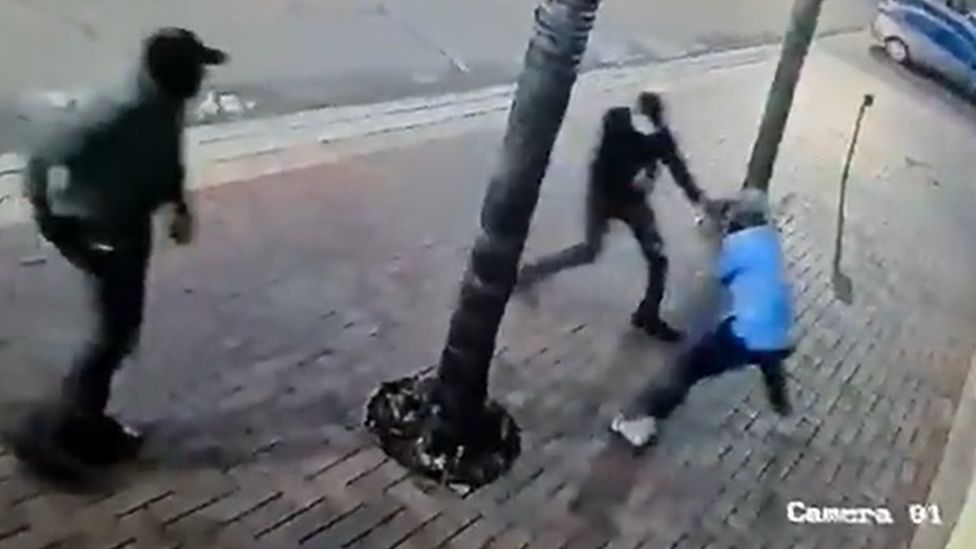
He was overpowered and forced into the vehicle at gunpoint. The businessman was later found unharmed and rescued by the police.
Ms Tau, who runs her own cleaning company in Pretoria, also tried to flee once she had figured out that she was about to be abducted.
She said she tried opening the door of her car, but another man, dressed as a parking attendant in a hi-vis jacket, blocked the door.
The man in the back seat showed that he had a gun and ordered Ms Tau to drive out of the shopping complex.
Along the way, she was told to stop and someone else jumped into her car.
Four-hour ordeal
Once in the countryside, about 15km (nine miles) into the terrifying journey, the kidnappers ordered Ms Tau to stop.
A red car then arrived at the scene and someone got out, took her bank cards and forced her to reveal her security codes.
“The other people from the car… started going through all my different cards. They were withdrawing [money].”
At the same time, her captors were repeatedly hitting her on the head with the gun, ordering her to increase her withdrawal limit.
The ordeal went on for over four hours.
At one point she heard someone on the other end of a phone call say: “Just finish her off. We are done.”
“I made peace that they were going to kill me, but I thought, I need to fight. I have to fight. If they are going to kill me, I might as well fight,” Ms Tau said.
She fought her way out of the car, but the kidnappers grabbed her and started hitting and scratching her. She got away and ran across the road into the oncoming traffic.
This story and that of Mr Bhiku are not isolated.
In February, Police Minister Bheki Cele revealed that 2,605 kidnapping cases had been reported to the authorities in the last three months of 2021.
In the decade from 2010, kidnapping more than doubled in South Africa and there are now 10 kidnappings per 100,000 people, according to the South African think-tank the Institute for Security Studies. This is one of the highest rates in the world.
In 2018, Mr Cele promised to make dealing with kidnapping a priority.
Victims have been kept against their will either for a ransom, to have their bank accounts cleaned out or be sexually assaulted.
Some did not make it out alive, though it is not clear how frequent this outcome is.
In an attempt to deal with these kind of crimes, the police launched a kidnapping task team, combining intelligence gathering with tactical response.
Crime syndicates target South Africa
One thing that has been established is that kidnappers tend to work in teams and the abductions follow a pattern with each gang member having a set role, police spokesperson Col Athlenda Mathe told the BBC.
“The spotters are those that would follow the target. The pickers are those who move in to kidnap the victim.”
The kidnappers often drive high-performance vehicles and are usually heavily armed.
“Then we have the guards that would take over and keep the victim… until a ransom is paid.”
But in the background, there is a mastermind who does thorough research and pulls the strings.
“The kingpin would be someone who lives a high-end life and wouldn’t do the dirty job,” Col Mathe says.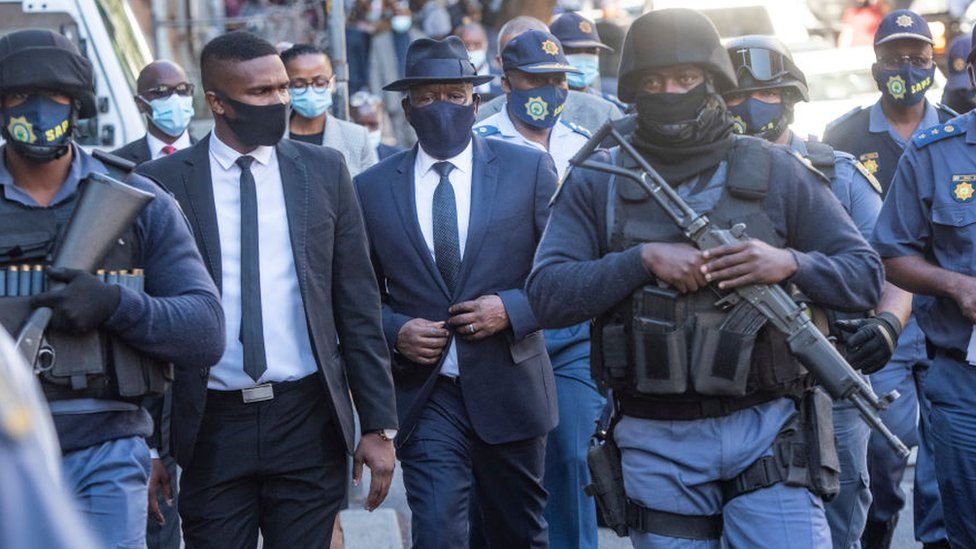
These criminal syndicates have tentacles in countries like neighbouring Mozambique and as far afield as Pakistan.
They tend to mostly target wealthy business people with the means to pay a ransom, but some victims have been from low-income areas and children are not spared.
Private hostage negotiator Gérard Labuschagne says there has been an increase in very high-value cases. Ransoms can be set at up to $3m (£2.3m)
“Organised groups operating in Mozambique and other parts of Africa have now decided, for whatever reason, that South Africa is ripe for this type of crime and they’ve been committing it very successfully,” Mr Labuschagne says.
Some social commentators believe general lawlessness has made South Africa attractive to organised criminals from around the world.
In the face of public anger, the police acknowledge that more work needs to be done but Col Mathe says they have made progress.
“Since the identification of these syndicates, we have arrested 115 suspects, consisting of Pakistanis, Mozambicans as well as South Africans.”
One of the suspects is 43-year-old Faizel Charloos, who was taken into custody in March.
He is believed to be the mastermind behind a spate of recent kidnappings.
During police raids in several Johannesburg properties linked to him, drugs, cash and a high-powered vehicle were recovered.
Mr Charloos recently appeared in court, along with several others, on kidnapping charges. He has made no comment.
It emerged that he has dual citizenship in South Africa and Mozambique.
‘Police don’t rescue victims’
In a separate case in April, police successfully rescued a four-year-old girl who was snatched at a school in Johannesburg, by a woman pretending to be her childminder.
Her kidnappers had earlier demanded thousands of dollars for her safe return.
But four people were arrested when they arrived outside a shopping centre to collect the ransom.
Despite such breakthroughs, Mr Labuschagne is not convinced the police are winning.
“We have had one or two arrests. But in the overwhelming majority of these cases, the police don’t rescue the kidnapped victims from where they’ve been kept. They are released after a payment.”
Ms Tau was lucky that she managed to get away, but her kidnappers took $1,400 (£1,100).
The ordeal has damaged her psychologically and left her family distressed.
“My father is not a man who cries, but he got teary. He kept on feeling like he could have protected me.
“There’s still a part of me that actually died on that day.”
Source: bbc

THE journalist is a hunter. He goes after human rats and grasscutters personified, matters about whom he can salt and spice and present as news. The fatter and juicier the catch, the better, because sensation is essentially our cup of tea.

Our job is to sell news and sell it in grand style.
Because the journalist is a hunter and is created with a special kind of nose for sniffing out news, he is usually not welcome in many places. He is seen as someone who has been born to make people uncomfortable.
The problem is that some people don’t want things written about them even if it is promotional and favourable. When it entails publishing their pictures alongside the story, they are doubly scared.
“Please, don’t use my picture. People will think I’ve got money and come for loan,” someone told me.
Anyhow, journalists are seen as intruders, undesirables, born with plenty of okro in the mouth; maybe some also in the nose. Some of my friends are no longer too close because they fear I’d give them full coverage in the Sikaman Palava column. Ha ha ha! What a funny world!
Well, people like my Uncle, Sir Kofi Jogolo, my former classmate and born-mathematician, Kwame Korkorti, and ex-football star cum human-salamander Kofi Kokotako don’t mind featuring in the hilarious inches of this column. Kofi Owuo alias Death By Poverty is one personality who has to be mentioned in this palaver.
These are people who are going to live long, primarily because they see the world as one big ball of fun. When Kwame Korkorti was told that his dear mother was dead at home, he smiled and asked the bearer of the message whether his mother had cooked the afternoon meal before claiming she was dead. Until her death, Korkorti ate his lunch at his mother’s end.
When my Uncle Kofi Jogolo was picked and lost 1,500 dollars and a good amount of Sikaman currency, he didn’t lament the loss. Instead he was amused. In fact, he was almost glad about it, because he grinned from ear to ear, stroked his delicate moustache and congratulated the thief, adding that “He is smarter than I am.” Yeah, Jogolo is the man who employs a Swedish barber to trim his moustache.
And when Kofi Kokotako was unemployed and was nearly hit by an articulated truck, he called the driver a fool. “The idiot should have killed me,” he said to me. “Didn’t he know I was unemployed and suffering?”
Today, Kokotako is employed as a Reverend and is not doing badly at all. Thanks to the regular silver collection.
And what about Kofi Owuo, the celebrated poor man. His wife left him not because he was poor, but because he swore in front of her that he would never prosper.
The following dawn the wife packed bag and baggage and went back to her parents and told them all about her husband’s alliance with poverty. Her parents were bewildered and called the alliance unholy. They had no option than to send back Owuo’s drinks to end the marriage.
Kofi Owuo alias Death By Poverty did not contest the issue. He was more engrossed thinking about how to become poorer than to contest what he called a frivolous matter. The wife could go to hell, he said. These are people longevity smiles upon. Nothing worries them.
Getting back to talking about journalists. I’d say that anywhere there is journalism, the issue of press freedom is not too far away. Is the press free? That’s one question foreigners want answer to when they are on visit.
Well, journalists celebrate a yearly WORLD PRESS FREEDOM DAY to drum home the idea of press freedom as a very important thing in the practice of journalism.
This year’s was celebrated almost a fortnight ago but people didn’t see much of us because we are normally not good celebrants. We should have mounted a float to roam the entire capital, dancing asaboni to brass band music just like PTC did recently.
Although journalists are known to be very good dancers because they walk very much, on that day, they were all busy writing. It was the Minister of Information, Mr Kofi Totobi Quakyi who saved the day by addressing a forum organised to mark the day.
He is a man I’ve always admired since his radical university days. He spoke much on press freedom, cautioning the press not to abuse the freedom granted by the Fourth Republican constitution, but to use it for the progress of society.
Well, press freedom has been defined by many journalists as the freedom to ‘write nonsense’. This definition is not quite accurate. I asked one staff reporter to define press freedom. It took him fifteen minutes to put up something.
“Press freedom is the freedom that is enjoyed by the press that enables journalists to publish or broadcast any kind of material so long as it is absolutely true, is not libelous and slanderous, and is not against the national interest.”
I gave him eight out of 10, a straight A. I guess every journalist is old enough to know that certain things he or she writes is for or against the national interest. We certainly must guard against writing against the national interest; that is very important.
There is also the question of criticising government. The government can be criticized, so long as the criticisms are genuine and the President and his ministers are not insulted and called names. Let us criticize, but let us do it decently so that the journalistic profession can be revered, and its nobility acknowledged. We are not war mongers, are we?
One area in which journalists are not spoken well of is the complaint that they misquote people. Journalists sometimes misquote people, but in four out of five complaints it turns out that nobody is misquoted after all.
When we interview people they say things unreservedly and we publish unreservedly. When the publication is out and their friends or superiors read it and accuse them of having said too much to the press, then they start claiming they were misquoted.
We have encountered these ‘misquotation palaver’ every now and then and reporters are usually accused of this transgression. However, when they bring out their note-books or recorders, it is realised that they wrote nothing out of the way. “Book no lie”.
My advice to people who deal with the press is that if they do not want anything written, they shouldn’t say it. What they want to say is OFF-RECORD, then of course, there is no reason to say it. When you say it, you’re taking a risk. In that instance, you can’t also claim to have been misquoted or words put into your mouth.
And it isn’t every journalist who would be circumspect in matters that are supposed to be off-record, because journalists often want to be as sensational as possible to make their stories saleable. So say just what you want to see published and you won’t later regret it and claim you were misquoted.
Well, I’m not holding brief for journalists, because a few of us are notorious for colouring our reports sometimes sand-papering the words so much that they look very bright in front of readers.
As I once said, when the police tells one such notorious pressman that the thief stole a brown goat, the pressman would want to know whether the goat was bearded. Of course, the police would say ‘Yes’.
However, in the press report, it appears, “A gang of notorious goat-thieves were apprehended in the early hours of yesterday. In the car in which they were riding was a brownish-red goat having a long beard. Upon further examination, it was realised that the goat also had a greyish moustache.”
When the story appears, the police are naturally disturbed. A single thief turns out to be a gang of thieves. The goat also becomes a chameleon and changes colour to brownish-red. And a moustacheless goat overnight wears a greyish moustache whether you like it or not. Luckily the journalist does not add that the moustache was trimmed by a Swedish barber.
Yes, we have a few of such mischief-creating, chronically notorious journalists. But they are one in a hundred. In any case, we make the world. And we shall always do our best to make it a happy place to live in.
This article was first publish on Saturday, May, 20, 1995
When I hear of people who are of the opinion that they cannot make it in life unless they travel abroad, l become sad.
Whenever I see on TV, news of people, that is migrants who have drowned in the Mediterranean Sea, while attempting to cross to Europe, l become filled with sadness and then anger.
The underlying factor is desperation born out of loss of hope, in life. When an individual tends to believe that his only hope of making it in life is to travel abroad, the risk of dying at sea, does not deter him or her.
The role of some pastors on shaping the mindset of people, especially the youth, leaves much to be desired. You hear them declaring on various media platforms how they can pray for you to get a visa to travel abroad, instead of encouraging them to find something to do to improve their lives as the Bible teaches that God will bless the work of their hands.
The GREATER WORKS CONFERENCE is geared towards renewing the minds of people with a specific focus on people of African descent to rid themselves of the negative perception of lack of capacity to excel in life.
Pastor Mensa Otabil believes that every human being, no matter the skin colour, was created in the exact image of God and therefore has the capacity to do exploits.
The whiteman was not created in the image of God while the Blackman was created in the image of something other than God. The Black person therefore can achieve whatever the whiteman can achieve.
The development in terms of industrialisation that is lacking which has generated unemployment for the youth, is due to lack of effective leadership. The lack of moral integrity in society, is what is causing the lack of job opportunities, which is as a result of corrupt acts which drive away private investment.
A culture of inferiority complex exists which needs to be dealt with, so the African can develop the self worth necessary for personal development which can then result in capacity deployment to avhieve personal goals.
Success in life begins with the individual’s recognition that he or she is capable of achieving the dreams he or she has conceived in his or her mind. The Bible teaches that the fear of the Lord is the beginning of wisdom, and the knowledge of the holy is understanding according to Proverbs 9:10.
Christianity was the driving force behind the development of Europe because no society can sustain development without high moral values. GREATER WORKS therefore is a deliberate project to shape the minds of people, especially the youth, who will become the leaders of our future, to prioritise morality in their daily lives.
This is the only way to see a massive transformation in every aspect of our lives as Ghanaians and Africans in Ghana and the rest of the continent.
Since the inception of the GREATOR WORKS CONFERENCE, it has made a lot of impact in the lives of many people from the youth up to the senior citizens level. I recall the testimony of a church member who was motivated and pursued higher education and became one of the youngest Chartered Accountants in this country. Year after year, the impact of the conference has been enormous and lives in Ghana and across the continent, are being transformed.
Black people have started regaining their self confidence and the youth have started getting into areas that previously were considered out of bounds. At a personal level, certain ideas that some years ago, l would have not dreamt about suddenly has become realistic dreams.
The Christian lifestyle has impacted on my children and those close to me. Mindset change starts with one individual, then another and then gradually it spreads like a viral infection until a critical mass is attained and them a massive impact. There is hope for the future.
By Laud Kissi-Mensah

 News1 week ago
“We are working to transform the Kwahu Business Village into an international conference hub”
- News1 week ago
Kwahu Business Forum:My engagement with President Mahama has boosted my business — Lydia Forson
- News1 week ago
DeniiNoi Foundation Supports Taifa Polyclinic with Medical Equipment