News
30 years of dedicated service …Adanfo the Fanmilk vendor tells his story


The old African adage that says “the mouth does not eat if the feet do not walk and the hands work” perfectly fits the case of Adanfo; the popular yoghurt seller in Accra.
Anybody who schooled in the early 90s till now or lived around the Lartebiokorshie vicinity and don’t know “Adanfo the yogurt seller,” his picture could help you recollect him.
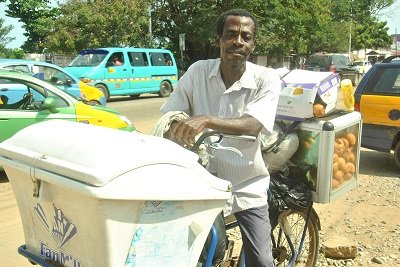
been in business over 30 years
Growing up, Mr Samuel Kojo Boateng popularly known as “Adanfo” wanted to be a merchant but due to financial constraint his dreams did not materialise.
Few years on, not knowing which path to take, a friend introduced him to selling Fanmilk products to schools within the Korle-Bu and Laterbiokorshie areas.
Known as ‘a friend of children’ (Adanfo), he was not the only yoghurt seller in the schools or within the areas but due to his love for children and the jokes he cracked with them, they preferred to buy from him.
One of his popular things was that when a child bought ice cream from him, he would offer to cut the tip for the child. When asked why he always did that, he explained “the child’s teeth are not strong so I don’t want them to lose their teeth in the process of tearing the ice cream rubber.”
This style of Adanfo made him popular among the children as he ‘saved’ children who had lost some portions of their teeth and were contemplating how to tear an ice cream rubber after they had bought it.
When asked whether he still cut the tip of ice cream for children, he said he had stopped doing that due to COVID-19 restrictions.
This reporter having known Adanfo since her Kindergarten days was curious to know the story behind his passion for selling FanMilk products.
If it were in the formal sector, the 54 year-old would be getting ready to have access to an appreciable retirement package from his employers and the Social Security and National Insurance Trust (SSNIT) for his long service.
When The Spectator visited him during his working hours last week, he said, “I started selling yoghurt some years before I had my first son who is 28 years old now so it means I have been selling and dealing with FanMilk over 30 years now.”
When asked why he has spent 30 years selling yoghurt, he disclosed that, at some point within the 30 years he wished to stop and engage in another trade but could not because he realised that he had gained experience in the trade.
Indeed, one would marvel at his dedication and loyalty but he said that he could not ride the bicycle as he used to because of old age and wished that FanMilk would appreciate his loyalty and dedicated service to the company.
Family
Mr Boateng hails from Kwahu Peduase in the Eastern Region and married to Madam Margaret Agyapong who is a second hand clothes dealer at Kantamanto in Accra.
They have 3 boys namely Samuel Kwabena Boateng, who graduated from University of Cape Coast with Bsc in Economics and Geography, Solomon Kwabena who is currently pursuing Bsc in Computer Science at Kwame Nkrumah University of Science and Technology, Kumasi and Bright Kwabena who is also pursuing Doctor of Pharmacy at Central University, Accra.
He said that he was focused on educating his children to acquire higher education since he dropped out of school because of financial difficulties and this explained why he spent his earnings in his children’s education with the help of his supportive wife and some benevolent individuals.
He said: “it is not easy, doing this job and having children in universities is not easy but I am doing my best.”
“I want Fannilk to set up a shop for me to retail their products, I know all the rudiments of the trade and I can make more profits for them. Unfortunately, I cannot ride the bicycle any longer and my children as of now cannot support me financially too.
“Having dedicated over 30 years doing business with them, I hope that they would help me with some package because the work has sapped my strength and I would soon park my bicycle.”
By Portia Hutton-Mills



The State through the Attorney General (AG) has filed an appeal at the Supreme Court challenging the suspension of the trial in the case of The Republic v Hanan Aludiba and Faiza Seidu.
On Monday, the Court of Appeal suspended the trial in the case. But the prosecution says it has filed an appeal against the suspension order.
According to the update, the law does not allow a criminal trial to be suspended simply because an accused person has complained about some of the charges on the charge sheet, particularly when those complaints were dismissed as meritless.
It argues that if the Court of Appeal’s decision is allowed to stand, no prosecution will ever be possible, since all it would take for a trial to be suspended is an accused person complaining about anything on the charge sheet.
By Edem Mensah-Tsotorme

The Ministry of Health has announced enhanced surveillance and preparedness measures following reports of Ebola cases in the Democratic Republic of the Congo (DRC), Kenya and Nigeria.
In a press release signed by the Minister for Health, Kwabena Mintah Akandoh, the ministry indicated that Ghana had not recorded any Ebola case but was strengthening measures to prevent the virus from entering the country and ensure the early detection and management of suspected cases.
The measures include increased screening at points of entry, particularly the Accra International Airport, simulation exercises to assess emergency readiness, monitoring of travellers from high risk areas and improved laboratory preparedness.
The ministry is also working with relevant agencies and partners to strengthen coordination, sensitise healthcare workers and educate the public on Ebola prevention.
According to the release, Ebola symptoms may develop between two and 21 days after exposure. They include high fever, severe headache, extreme fatigue, sore throat and chills, with unexplained bleeding and confusion possible in later stages.
The ministry explained that the virus spreads through direct contact with the blood or body fluids of an infected person or contaminated materials, and is not airborne.
It urged anyone who develops symptoms after travelling to an affected area or coming into contact with a suspected or confirmed case to seek immediate medical attention and disclose their travel history to health workers.
Travellers from affected areas will have their health monitored for 21 days, while the public has been advised to practise good hand hygiene, avoid contact with people showing unexplained symptoms and rely on official health updates.
The Ministry of Health urged the public to remain calm and cooperate with health authorities as Ghana strengthens its preparedness and response measures.
By: Jacob Aggrey