News
2-day workshop on GEII held in Accra

A two-day training workshop on Gender Equality, Inclusivity, and Intersectionality (GEII) has being held in Accra.
The training aimed to equip stakeholders with tools to break these barriers and create an open, diverse, and equitable research environment.
The workshop focused on training participants to recognise unconscious biases, adopt gender-sensitive research methods, and ensure inclusivity in research teams.
The Director of Research, Statistics, and Information Management at the Ministry of Environment, Science, and Technology (MEST), Mr Cephas Adjei Mensah, emphasised that gender considerations should not be treated as side issues but should be central to research and policy-making.
He noted that Ghana’s progress in science, technology, and innovation (STI) depends on ensuring that diverse perspectives were represented.
Mr Mensah stressed that persistent gender gaps in research and evaluation hinder innovation and equitable development.
He said current Gender Equality and Inclusivity (GEI) Project, running from 2023 to 2025, aims to enhance women’s roles in research, expand inclusivity beyond gender, and integrate GEI principles into research design.
“A key aspect of the training was to build the capacity of evaluators to assess research proposals with a gender and inclusivity lens,” he said.
Dr Wilhemina Quaye, Director of CSIR-STEPRI, highlighted the critical funding challenges in research and development in Ghana.
She noted that while the government was supposed to allocate at least one per cent of GDP to research, the current figure stands at only 0.3 per cent.
“This funding gap affects both research institutions and academic bodies, making external support from initiatives like SGCI crucial,” she said.
She emphasized that research is not just about creating knowledge but about engaging with society to find solutions to real-world problems.
Dr Quaye also stressed the importance of science communication, urging the media to help disseminate research findings.
She pointed out that science must not remain in institutions but should be shared with industry players, civil society, and the public to ensure that research innovations are applied in everyday life.
Dr Quaye emphasized that intergenerational knowledge transfer is essential, as the expertise of experienced researchers must not be lost when they retire.
“The integration of young people, women, and underrepresented groups into research teams was identified as a key step towards sustainable development,” she explained
Participants expressed their commitment to integrating GEI principles into their work and ensuring that scientific research in Ghana benefits all sectors of society.
By Agnes Opoku Sarpong


The Vice Chancellor of the Pentecost University, Apostle Professor Kwabena Agyapong-Kodua, is advocating an intentional conversation about the development and education of the boy child in creating stronger families and societies.
According to him, the boy child must not be ignored in conversations on leadership, education, family stability and national transformation because they are key to national development.
“There is a reason why a boy child must not be denied opportunities like education; he is a future leader. When boys are trained well, society becomes safer and stronger,” he stated.
Apostle Prof. Agyapong-Kodua made the remark at a forum organised by the Church of Pentecost Schools Outreach Ministry in Accra to observe the International Day of the Boy Child observed on May 16.
It was held in collaboration with the Pentecost Men’s Ministry and the Ghana Education Service (GES), and under the theme: ‘Flourish and Thrive: Investing and Unleashing Boys for Strong Families and Communities.’
Leading the discussion, the Pentecost University Vice Chancellor warned that poor mentorship, declining in education, harmful social media influences and emotional neglect have made a lot of young boys vulnerable.
With a lot of the attention switching to the girl child, the boy child, he said was confronted with many challenges including violence, substance abuse, educational decline, emotional neglect and the absence of positive role models.
According to Apostle Prof. Agyapong-Kodua, he noted that boys were turning to social media for direction due to the absence of fathers and mentors to help shape their lives.
“If we are not intentional, social media will mentor our children for us. We are not saying they should not use social media, but they should be guided to access the right information to excel in life,” he stated.
Prof. Agyapong-Kodua urged society to encourage boys to become creators of technology rather than mere consumers.
Contributing, Madam Gifty Asiedu, Director of the Girls’ Education Unit at the GES Headquarters, said the service remained committed to ensuring that no child was left behind, adding that, “supporting the boy child should not come at the expense of progress made in girl-child education.”
“If you focus intentionally on one gender and neglect the other, you create a societal problem,” she underlined.
She said the GES had observed some decline in boys’ retention in school, although the gap between boys and girls was not yet too wide.
“Over the years, attention has been focused on the girl child and we have seen the benefits. However, data now show that the statistics concerning the boy child continue to decline,” she indicated.
She explained that the service was implementing gender-responsive education to ensure that classroom teaching addressed the needs of both boys and girls equally.
Elder Barima Acheampong Sarpong II, Deputy Director of the Pentecost Men’s Ministry and Chief of Asante Asaman in the Ashanti Region, said society needed to critically examine the plight of boys.
“As we celebrate the International Day for the Boy Child, I urge every man to identify one boy child, find out how he is doing and dedicate some time to mentoring him,” he explained.
The programme, attended by educators, church leaders and policymakers, was the second edition following a partnership initiated last year between the Schools Outreach Ministry, the Pentecost Men’s Ministry and the GES.
It sought to improve school enrolment, completion rates and learning outcomes among boys so they could grow into responsible men who would build strong families and communities.
By Esinam Jemima Kuatsinu
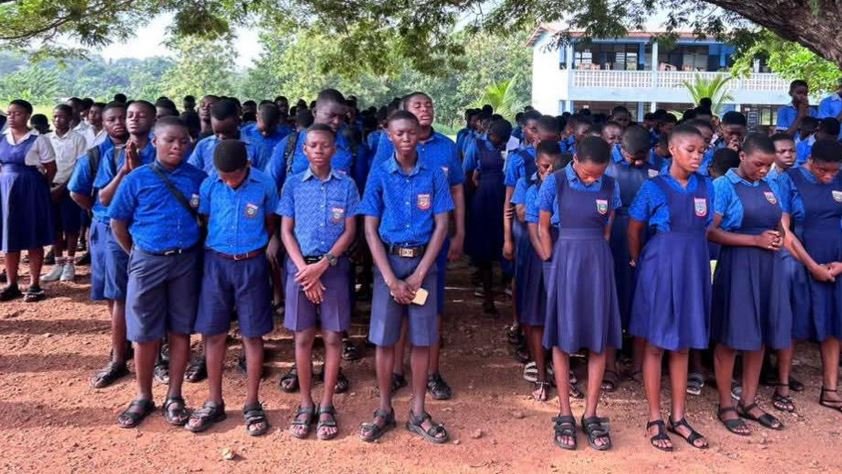
Candidates that wrote the 2026 Basic Education Certificate Examination (BECE) in Ho Municipality are hopeful of obtaining good grades to make everyone especially their parents and the Regional Minister proud.
The candidates said they had so far sat the examination with focus and integrity after a call from Mr James Gunu, Regional Minister to avoid examination malpractice saying, they expected great performance upon release of results.
Mr Gunu, at the start of this year’s BECE delivered the message during a monitoring visit to some centres in the municipality including Ho Kpodzi EP Basic A School, Mawuli School, Mawuko Girls Senior High School (SHS), and Kabore School.
He urged the candidates to rely on hard work and discipline, warning that shortcuts could jeopardise their future.
“Stay focused and give your best in this year’s BECE – your determination and hard work will pay off. Avoid shortcuts and examination malpractice; integrity matters just as much as success,” he said.
The Minister, accompanied by the Ho Municipal Chief Executive, the acting Volta Regional Director of Education, and the Ho Municipal Director of Education, encouraged candidates to view the exam as a foundation for their academic journey and to celebrate responsibly after the final paper, commending parents, guardians, teachers, and officials of the Ghana Education Service for their support in preparing the candidates.
Candidates at some of the centres Ghana News Agency visited, echoed the call for honesty and high standards.
At Kabore School, Ms Francisca Atsu of Sokode Lokoe MA Basic School said, “The Regional Minister was here earlier to speak to us and also to encourage us. We’ve done our best. I assure him that we will make him and our parents proud.”
At Taviefe SHS Centre, Ms Valentina Sakpla of Taviefe R.C Basic School added, “We are expecting good results to make everyone proud and for our own good.”
Mr David Dotse, Supervisor at Kabore School, hosting 11 schools, with a standby ambulance on site to cater for any health emergency, reported smooth proceedings. –GNA