News
Youth urged to venture into agriculture for sustainable income


An agribusiness conference to expose young people to job opportunities that exist in the agricultural sector has been held in Accra under the auspices of the Master Card Foundation.
It was held in partnership with Agri-Impact Limited and the Graduate Students Association of Ghana (GRASAG) on the theme “Empowering Agrofuture Entrepreneurs.”
The conference was simultaneously held at the Universities of Ghana and Professional Studies, Accra and the Ghana Institute of Management and Public Administration (GIMPA) and targeted young people from the age of 15 -35 years.
In an address, Abraham Safo, a Value Chain Enterprise Development Specialist for the programme, said it was important to rope in the young ones at the university, particularly those pursuing Masters programmes to understand the opportunities in the agricultural space.
According to him, this would set their minds right from the onset and disabuse their minds that agriculture was synonymous to the traditional cutlass and hoe farming full of drudgery, stating that job opportunities in crop insurance, banking, credit management, marketing amongst others exist in the agric ecosystem.
With a target of 330,000 jobs along four agricultural value chains in the areas of rice, tomatoes, poultry and soya bean, Mr Safo said the initiative would help elevate the subject of agriculture to the forefront of national discourse and expose young people to the opportunities therein.
He said Agri-Impact extends support to young entrepreneurs in agriculture through capacity building training, adding that support was also extended to young entrepreneurs in the form of starter- packs, access to land, facilitating access to land, among others.
He called on the youth to see agriculture as a business and profitable venture out of which they could make a sustainable living.
On his part, Emmanuel Owusu, GRASAG National President, said the programme was organised to expose members to the opportunities within the agricultural value chain.
Urging the youth to take advantage of the programme, Mr Owusu said with the advent of modern technology, agriculture has taken on a new dimension which does not necessitate being on the farm to till the land.
“We want our members to know that, it was not a case of always doing an office or corporate job but you could venture into agriculture and earn sustainable income,” he said.
A chief farmer, Nana Owusu- Achiaw, said to overcome the challenge of reducing purchasing power, young entrepreneurs should understand where the bulk of money goes in the scheme of things.
He urged participants to apply the FIST principle which deals with using technology for farming purposes, rendering services in the value chain, engaging in farm and food business among others.
By Norman Cooper




ODORGONNO Senior High School (SHS) has won the maiden 2026 Senior High School Plastic Waste Reuse Innovation Awards, organised among five SHSs in Accra to promote plastic waste recycling and reuse.
Odorgonno SHS received a cash prize of GH¢8,000 after securing 97 points. Accra Senior High School placed second with 96 points and received GH¢4,000, while O’Reilly SHS placed third with 90 points and received GH¢2,000.
Forces Senior High Technical School placed fourth with 83 points, while St John’s Grammar SHS came fifth with 72 points. Both schools received GH¢1,000 each as cash prizes.
Outstanding students from the participating school clubs were also recognised with gold medals and certificates. St John’s Grammar SHS received five plastic recovery cages as the school with the highest volume of recovered plastic waste.
The awards formed part of the CSIR-Institute of Industrial Research (CSIR-IIR) Schools Plastics Recovery Project, an initiative aimed at promoting plastic waste recovery, responsible environmental practices and the productive use of recovered materials.
The project included educational campaigns in all five participating schools, the provision of metal cages for plastic source segregation, an educational excursion to a Miniplast recycling factory and a plastics challenge that encouraged innovative reuse of plastic waste.
The Project Lead and Senior Research Scientist at CSIR-IIR, Dr Boniface Yeboah Antwi, said the project demonstrated how young people could become active contributors to solving Ghana’s environmental challenges while providing financial incentives to sustain their efforts.
He said when schools generated income from recovered materials, they could support the maintenance of collection infrastructure, reinforce responsible waste management and instil an entrepreneurial mindset in students.
Dr Antwi explained that within the first month, the participating schools recovered 1.5 tonnes, or 1,500 kilogrammes, of plastic waste—equivalent to the weight of approximately 15,000 one-litre water bottles.
He said the recovery generated GH¢2,000 in revenue for the schools, demonstrating that plastic waste could become a source of value rather than an environmental burden.
The Group Head of General Operations at OmniBSIC Bank, Mr Dominic Donkoh, urged the participating schools to sustain their plastic waste segregation, collection and sales activities.
He said the proceeds could support school environmental clubs and other worthwhile initiatives while providing students with practical lessons in saving, budgeting and responsible financial management.
“We encourage students to apply the financial literacy lessons acquired during this engagement. Learn to manage the proceeds from your recycling activities responsibly, appreciate the importance of saving, and explore innovative ways to create both environmental and financial value,” he added.
–GNA
SKIP THE QUEUE, TAP THE NEWS
You can now read the Ghanaian Times and The Spectator newspapers from the comfort of your device via TimesNewsPlus.
Join our WhatsApp Channel: https://whatsapp.com/channel/0029VbBElzjInlqHhl1aTU27
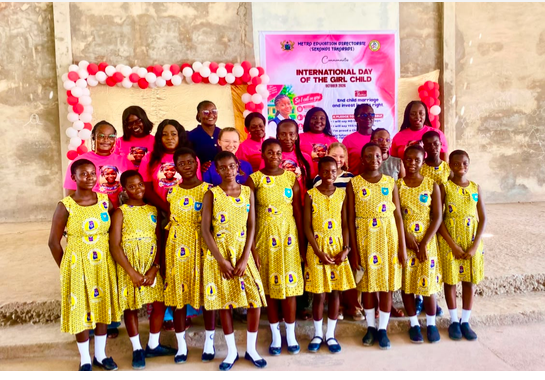
Parents have been urged to prioritise girls’ education over early marriage to protect them from losing their childhood, education and opportunities for a better future.
The Sekondi-Takoradi Metropolitan Girl Child Coordinator, Madam Margaret Blay, said child marriage disrupted girls’ education, threatened their health and well-being, and limited their ability to realise their full potential.
“Keep her in school, not in a man’s house,” she urged parents, stressing the need for families and communities to protect girls’ right to education and personal development.
She made the call in a welcome address at the 2026 celebration of the International Day of the Girl Child in the Sekondi-Takoradi Metropolis, held under the theme: “End Child Marriage and Invest in Girls’ Rights.”
Madam Blay said ending child marriage required collective action from parents, teachers, traditional leaders, government institutions and communities to ensure that girls were protected and given the opportunity to pursue their aspirations.
She noted that child marriage often forced girls out of school before they were physically, emotionally and socially prepared for the responsibilities associated with marriage.
She said investing in girls’ rights was not merely a moral obligation but also an investment in the future of communities and the nation.
According to her, girls who remained in school, had their voices heard and received the necessary support could grow into leaders, professionals, innovators and active contributors to national development.
Madam Blay called on teachers to protect girls’ access to education, create supportive learning environments and empower them to express themselves confidently.
She also appealed to traditional leaders to help address harmful cultural practices and social norms that denied girls opportunities to develop their potential.
The government and relevant institutions, she said, must strengthen the enforcement of child protection laws to ensure that every girl received adequate protection.
She further urged communities to speak out against child marriage, report cases and work together to create safe environments where girls could learn, grow and thrive.
Madam Blay said every girl deserved the freedom to dream, acquire an education and determine her own future.
She expressed the hope that the celebration would strengthen stakeholders’ collective resolve to end child marriage and invest in the rights, education and future of every girl.
Madam Karen Ama Moses, Assembly Member for the Takoradi Railway and Harbour Electoral Area, said keeping girls in school would lead to enlightened mothers, well-informed families, resilient communities and, ultimately, a better Ghana.
She stressed that no child should be forced into marriage, adding that “every child must have the freedom to learn, grow, dream and choose her future.”
Some of the schoolchildren expressed concern that their parents did not always listen to their concerns during difficult times, while others said some children were exposed to abuse and early marriage.
Madam Henrietta Quabu, the Metropolitan School Health Coordinator, urged children experiencing abuse or any situation that threatened their well-being to report to the police, the Department of Social Welfare, the media, their teachers or the Metropolitan Education Directorate for assistance.
— GNA
SKIP THE QUEUE, TAP THE NEWS
You can now read the Ghanaian Times and The Spectator newspapers from the comfort of your device via TimesNewsPlus.
Join our WhatsApp Channel: https://whatsapp.com/channel/0029VbBElzjInlqHhl1aTU27