Hot!
Youth unemployment, terrorism in Sahel can disrupt Ghana’s political stability – Security Report


- /home/u249204778/domains/spectator.com.gh/public_html/wp-content/plugins/mvp-social-buttons/mvp-social-buttons.php on line 27
https://spectator.com.gh/wp-content/uploads/2022/05/52971902.jpg&description=Youth unemployment, terrorism in Sahel can disrupt Ghana’s political stability – Security Report', 'pinterestShare', 'width=750,height=350'); return false;" title="Pin This Post">
- Share
- Tweet /home/u249204778/domains/spectator.com.gh/public_html/wp-content/plugins/mvp-social-buttons/mvp-social-buttons.php on line 72
https://spectator.com.gh/wp-content/uploads/2022/05/52971902.jpg&description=Youth unemployment, terrorism in Sahel can disrupt Ghana’s political stability – Security Report', 'pinterestShare', 'width=750,height=350'); return false;" title="Pin This Post">
The West Africa Center for Counter-Extremism (WACCE), says Ghana’s political stability may be disrupted, in the wake of terrorism in the Sahel and other domestic challenges such as youth unemployment.
In a report by the regional security research organisation, it said even though Ghana has been relatively peaceful over the years, there is the likelihood of an upsurge, due to recent happenings in the sub-region, and neighbouring countries such as Benin, Togo and Ivory Coast.
WACCE maintained that the threats of political instability can, however, be forestalled if measures are put in place to prevent the impending dangers.
“The threat of terrorism is increasingly descending from the Sahel towards the Coastal States. Today more than 53% of all ECOWAS states are experiencing insurgencies. The pervasive spillover phenomenon makes Ghana’s border regions a key area of concern.
“Recent attacks in Benin, Togo and Ivory Coast highlight the determination of the terrorists to expand beyond landlocked Sahelian countries, where the insurgency has devastated thousands of lives and property in the last decade.
“Ghana has a big number of prolonged unresolved chieftaincy and ethnic conflicts and tensions, particularly in the Northern regions.
“The inherently high exploitative capacity of extremists implies that these vulnerabilities put Ghana in danger of terrorist exploitation”, a summary of the report revealed.
The report further stated that “Many analyses project the pervasive youth unemployment rate of about 5%9 as one of the biggest risks. The present government set up the Nation Builders Corps (NABCO) to absorb the high number of unemployed graduates, most of them temporarily.
The growing joblessness has driven many onto cyberspace to live in an illicit economy.
The determination of social activists such as the #FixTheCountry campaigners to exploit the security, economic and governance challenges amplifies the risks associated with youth grievances.
The above highlight the widespread nature of the threat to Ghana and underscores the importance and urgency needed to escalate national commitment to preventing the threat from spilling into Ghana”.
In a related development, an international conflict resolution expert, Col. (Rtd.) Festus Aboagye has charged government to address the socio-economic inequalities to fight terrorism and attacks.
According to him, factors and circumstances that have led to military coups in other West African countries exist in Ghana; hence, government must put stringent measures to deal with the grievances of agitated groups and individuals.
n an earlier interview on Newsfile, the ex-military officer warned that the country is susceptible to similar coups and attacks in other neighbouring countries if the socio-economic needs of the citizens are not fixed.
“All of us need to be worried. I belong to the school of thought that you don’t fight terrorism with only guns and bullets. Indeed, it will be more productive to address some of the socio-economic inequalities.
I don’t need to be a political scientist or an economist to argue that the Northern part of this country [is] bordering countries that are unstable, where there are gross socio-economic inequalities”, he stated.
Touching on how the looming political instability can be averted, WACCE said, “The overall effectiveness of Ghana’s response will be determined by the State’s willingness to recognise that the battle against terrorism and the drivers that underpin it cannot be won on the battlefield alone.
It will be won in the local community in dealing with the drivers of radicalization and building resilience against the threat.
It will be won by effectively addressing grievances, mobilizing local community support and goodwill to build the social and economic infrastructure that is required to build resilience against extremism”.
Source: www.myjoyonline.com



The Tema Regional Police Command has arrested a 32-year-old man for allegedly posing as a soldier and extorting money from unsuspecting members of the public at Ashaiman.
The suspect, identified as Bright Atsu Kudiabor, was arrested by the Ashaiman Police on Wednesday, September 16, 2026, at about 7:00 a.m.
According to the Police, he was arrested at an area known as “I Shall Return”, where he was allegedly parading himself as a soldier and demanding money from people.
The Police said Kudiabor, who is an ex-convict, was initially arrested by personnel of the Ghana National Fire Service in Ashaiman with assistance from other members of the public.
A search conducted on him after he was handed over to the Police reportedly led to the recovery of a set of military camouflage uniform.
The suspect is currently in Police custody and assisting with investigations.
The Tema Regional Police Command said he would be processed for court after investigations are completed.
The Police urged the public to remain vigilant and report anyone who falsely presents themselves as a soldier or a member of another security agency to deceive or extort money from the public.
By: Jacob Aggrey
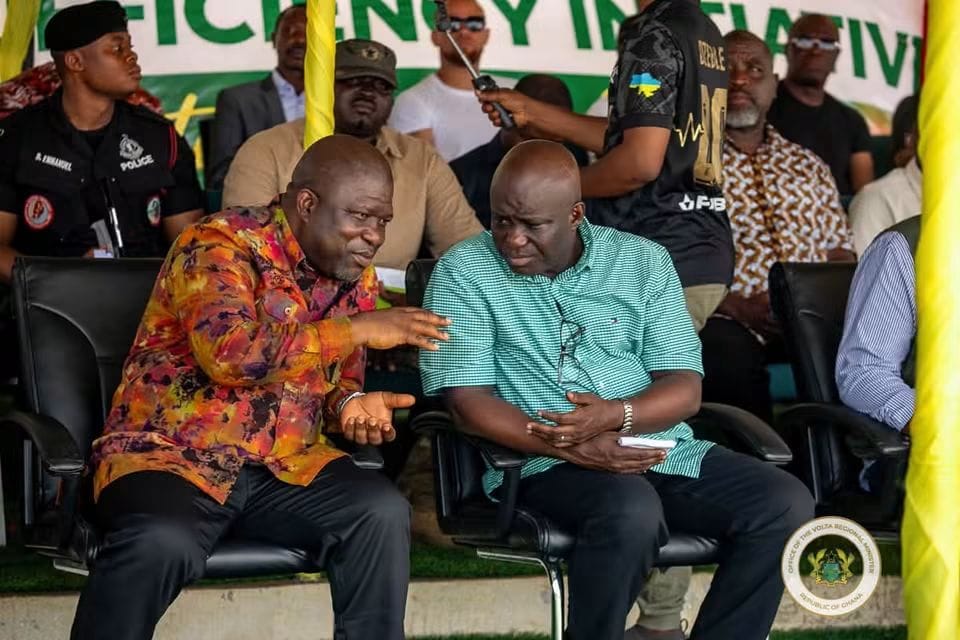
Volta Regional Minister, James Gunu, says the Volta Region holds enormous agricultural potential and efforts must be geared towards connecting farmers to the needed resources to unlock that potential.
He said focus must be on linking farmers to resources, technology, financing and markets to increase production, create jobs and build sustainable livelihoods.
Hon. Gunu made the remarks at the national launch of the Ghana Tomato Self-Sufficiency Initiative (GHATSI) held at Anloga in the Volta Region on Tuesday, September 15.
The initiative, under the theme “Produce at Home. Feed the Nation. Export the Surplus,” seeks to boost local tomato production, processing and marketing while reducing Ghana’s heavy reliance on imported tomatoes.
The launch was attended by the Minister for Food and Agriculture, Eric Opoku, his Deputy, John Setor Dumelo, Feed Ghana Coordinator, Bright Demordzi, Members of Parliament, traditional leaders, MMDCEs, farmers and other stakeholders.
Mr.Gunu expressed appreciation to the Minister for Food and Agriculture for the support announced for the region, including two excavators, 200 cartons of organic fertiliser, and GH¢200,000 for Ms. Kuatudzo Esther Dela, a tomato farmer and processor from Ziope.
He described the initiative as an important step towards making agriculture a stronger driver of food security, job creation and economic growth in the Volta Region.
By Edem Mensah-Tsotorme