News
‘Operating restaurant without Food Hygiene Permit unlawful’

- /home/u249204778/domains/spectator.com.gh/public_html/wp-content/plugins/mvp-social-buttons/mvp-social-buttons.php on line 27
https://spectator.com.gh/wp-content/uploads/2024/05/Bolt-FDA-Pix.jpg&description=‘Operating restaurant without Food Hygiene Permit unlawful’', 'pinterestShare', 'width=750,height=350'); return false;" title="Pin This Post">
- Share
- Tweet /home/u249204778/domains/spectator.com.gh/public_html/wp-content/plugins/mvp-social-buttons/mvp-social-buttons.php on line 72
https://spectator.com.gh/wp-content/uploads/2024/05/Bolt-FDA-Pix.jpg&description=‘Operating restaurant without Food Hygiene Permit unlawful’', 'pinterestShare', 'width=750,height=350'); return false;" title="Pin This Post">
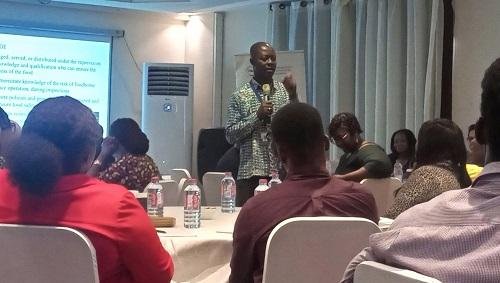
Dr Edward Archer addressing the participants
The Chief Regulatory Officer at FDA,Dr Edward Archer hasurged food establishments across the country to regularise their activities with the authority.
He said securing a Food Hygiene Permit will help keep the industry in check when it comes to compliance and emphasised the need to put the safety of food consumers at the heart of the culinary service industry.
He said this in Accra last week at a workshop organised by Bolt Food in collaboration with the Food and Drugs Authority for some selected Food Service Establishments (FSEs).
The workshop was aimed at educating FSEs, using the bolt food platform on the FDA’s activity in ensuring food safety and also interact with them to know their challenges while helping to address them.
“Anybody who is operating a restaurant or a food business without being issued a food hygiene permit is operating unlawfully, he said
Dr Archer called on food vendors, hotels, restaurants and chop bar operators to secure the necessary documentations before rendering such services to the public, adding that the FDA was ready to collaborate and promote the safety of FSEs in the country.
Speaking to the media in an interview, the Regulatory and Policy Head for Africa, Weyinmi Aghadiuno said the collaboration between Bolt Food and the FDA was in the three parts.
The parts,she said were partnerships, workshops and safe food handling training for couriers, adding that Bolt had identified 20 FSEs that have their business registration permit but do not have FDA permits.
“These top 20 FSEs, bolt will work with FDA to sponsor their license acquisition and the technical support they require. This is our way of giving back to the society,”she added.
Ms Aghadiuno said Bolt will from hence forth ensure that FSEs on their platform have their FDA licenses so as to put hygiene and safety first.
“We want to have that collaborative relationship with FDA and our FSEs; we want to build an ecosystem where we can proudly say that when you are ordering on bolt, you are assured that the FSEs on our platform have the FDA food licensing, safety and hygiene certificate,” Ms Aghadiuno added.
She also stated that Bolt was in discussion with FDA to agree on a time frame so as to ensure that FSEs on their platform get their certificates and food license.
By Jemima Esinam Kuatsinu



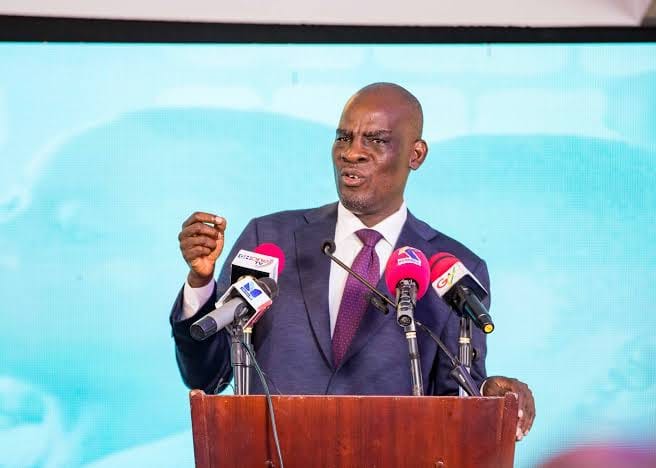
Founder and Chief Executive Officer of VODEC Africa and Convener of the National Emerging Leaders’ Economic Forum (NELEF), Daniel Asomani, has urged young Africans to take greater responsibility for the development of their communities and countries.
He made the call in his keynote address at the 2026 edition of NELEF, held at the University of Professional Studies, Accra (UPSA), on Monday, September 21, 2026, under the theme, “Building Africa’s Future: Emerging Leaders Driving Inclusive Growth and Regional Transformation.”
Mr Asomani said young people should not wait for political appointments, government positions or special opportunities before contributing to national development.
According to him, emerging leaders need courage, discipline, competence, integrity and the willingness to start solving problems within their communities with the resources available to them.
He said Africa had significant natural resources, a young population, growing markets, entrepreneurial talent and cultural creativity, but warned that these opportunities could not translate into development without effective systems.
Mr Asomani cited Africa’s projected economic growth of about 4.2 to 4.3 per cent in 2026, while noting that about 12 million young Africans enter the labour market each year, compared with only about three million formal jobs being created.
He said the gap represented millions of young people struggling to find opportunities and urged leaders to address the systems that prevented young people from turning their skills and ideas into productive ventures.
Mr Asomani traced the origins of the NELEF initiative to a question he posed to university students in 2017 about whether they intended to leave Ghana after graduation.
He said the large number of students who indicated that they planned to leave the country led him to question why young people were looking to escape rather than contribute to national development.
He explained that the experience contributed to the establishment of VODEC Africa, the NELEF platform and the VODEC Africa Idea Challenge, with a focus on connecting young people to capital, mentorship, networks and markets.
He said the inaugural NELEF in 2024 attracted about 2,500 people physically and reached about 4,500 online.
In 2025, he said, physical participation increased to more than 5,000, while about 6,000 people were reached online, bringing total engagement to more than 11,000.
According to him, the 2026 edition had expanded its focus to emerging leaders from across Africa because the continent’s challenges and solutions should not be limited by national borders.
Mr Asomani also called on citizens to complement the work of government by taking responsibility for their own actions and communities.
He said while governments must be held accountable, citizens must also examine what they were doing to contribute to national development.
He challenged participants to ask themselves what problems they were willing to take responsibility for, what value they were creating, whom they were mentoring and what dishonest practices they were prepared to reject.
He further urged young people to practise accountability and integrity in their workplaces, businesses, families, communities, professional associations and online spaces.
According to him, leaders who want to promote accountability in public office must first demonstrate those values in the smaller areas of influence available to them.
Mr Asomani criticised the practice of young people being asked to pay money in exchange for employment opportunities.
He questioned why people should be required to pay to obtain jobs to serve the country and urged emerging leaders to reject such practices.
He shared personal experiences in which he refused to approve the use of money or his name for purposes he considered improper.
In one instance, he recounted how his organisation had collaborated with another organisation on an international conference, where participants paid an administrative fee for assistance with travel-document processing.
He said he insisted that the money should not be used until the promised assistance had been provided and later demanded refunds when that did not happen.
According to him, some members of the organising team instead shared the money among themselves without his approval.
He recounted another occasion when an individual approached him to give verbal approval for money to be collected from people, with the intention of later claiming that the instruction had come “from above.”
Mr Asomani said he rejected the proposal because he believed a person’s name, reputation and integrity were among the most valuable things they possessed.
He therefore urged emerging leaders to protect those three values, stressing that integrity should be treated as a foundation for building strong institutions.
Mr Asomani called for stronger systems to address sanitation and healthcare challenges in Ghana.
He said sanitation in cities should be treated as both a public-health and economic issue rather than a problem addressed only when funding becomes available.
He cited the pollution of waterways such as the Odaw River and Korle Lagoon and called for long-term investment, clear responsibility and effective enforcement.
He called for stronger health systems, saying preventable weaknesses in healthcare could result in deaths that affected families, communities and the country.
Speaking about the VODEC Africa Idea Challenge, Mr Asomani said the initiative was intended to support young people whose ideas could contribute to job creation and economic development.
He said previous participants had developed ideas in areas including food preservation, agribusiness, renewable energy, recycling, assistive technology, urban farming, manufacturing, women-led value chains and environmentally friendly products.
He disclosed that the 2025 cohort included 10 emerging ventures operating in agriculture, agribusiness, technology, manufacturing and social enterprise, with estimated scale-up support of GH¢120,000.
He cited the example of an entrepreneur who developed a Kente-focused enterprise, saying it demonstrated how Ghanaian heritage could be transformed into a business that generates income and creates opportunities.
Mr Asomani urged participants in the 2026 challenge not to allow the outcome of the competition to determine their future.
He encouraged unsuccessful applicants to learn from the process, improve their ideas and continue developing them, while urging finalists and winners to use the funding and mentorship responsibly.
He said success should not end with individual beneficiaries but should create opportunities for other people.
In his closing charge, Mr Asomani asked emerging leaders to make three commitments: take responsibility for one problem, reject one act of corruption or dishonesty, and build one bridge beyond their immediate circle.
He encouraged participants to work with people from different regions, countries, professions, generations and backgrounds, saying Africa’s transformation would require cooperation across borders and disciplines.
He said young Africans should stop viewing themselves merely as future leaders and recognise their role in shaping the continent today.
“The Africa we want will not be delivered to us fully assembled. We must design it. We must finance it. We must govern it. We must defend it. And we must build it together,” he stated.
Mr Asomani urged the participants to leave NELEF 2026 with a problem to solve, a plan, a partner and a deadline.
He concluded by reminding the emerging leaders that their ability to contribute to Ghana and Africa was already within their hands and depended on their choices, character and willingness to act.
By: Jacob Aggrey
The teacher unions have given the government until midday on Thursday, September 24, 2026, to resolve outstanding issues concerning the promotion placement, salaries and arrears of teachers.
The unions, comprising the Ghana National Association of Teachers (GNAT), the National Association of Graduate Teachers (NAGRAT) and the Coalition of Concerned Teachers (CCT), said the 2025 promotion placement and payment of related arrears had not been fully implemented.
In a notice dated Tuesday, September 22, the unions said this was contrary to an agreement reached with the government to automatically place all affected teachers by the end of September 2026.
They described the situation as disturbing and disappointing, saying it had increased tension and anger among teachers across the country.
The unions cited the renewal of the Collective Agreement and the payment of the Deprived Area Allowance as some of the outstanding issues that needed to be addressed.
They warned that if the issues were not resolved by midday on Thursday, September 24, they would no longer be able to restrain teachers from taking further action.
“Whatever happens, the duty bearers should take full responsibility,” the unions stated, adding that the notice was “not a threat but a promise.”
The teacher unions, however, urged teachers to remain calm and follow official directives from their leadership.
They called on their members to participate in any actions announced by the leadership of the respective unions.
By: Jacob Aggrey

 Entertainment1 week ago
Rhythms On Da Runway returns November 28 with 16th edition themed ‘Unbound’
- News1 week ago
48 Engineer Regiment to be major sub-contractor on Accra-Kumasi Expressway, $2bn ready- Prez Mahama
- Entertainment1 week ago
Ohemaa Mercy’s Tehillah Experience outfit was priestly regalia, not costume – Management clarifies