News
NPP questions government’s GH¢2 diesel relief and energy levy policy

The New Patriotic Party (NPP) has questioned the government’s planned GH¢2 per litre reduction in diesel prices, saying the measure is temporary and does not fully offset the increase in fuel prices over the past year and a half.
Addressing a press conference in Accra on Tuesday, Aug. 5, 2026, Chairman of the NPP Policy Co-ordination Committee and Member of Parliament for Ofoase-Ayirebi, Kojo Oppong Nkrumah, said diesel prices remained significantly higher than they were in January 2025 despite the announced reduction.
According to him, petrol sold for about GH¢15.13 per litre and diesel for about GH¢15.49 per litre in January 2025, while current prices remained above those levels even after the proposed relief.
Mr Oppong Nkrumah said the reduction “cushions part of the increase that has already happened” but does not reverse it.
The NPP criticised the Energy Sector Levies (Amendment) Act, saying the government imposed an additional GH¢1 levy on every litre of petroleum products in June 2025.
He noted that the levy took effect on July 16, 2025 and remained in force.
According to him, consumers had continued to pay the additional levy and were now receiving only a temporary reduction on diesel, while petrol prices were not benefiting from the same intervention.
Mr Oppong Nkrumah further argued that the diesel relief carried a fiscal cost because it reduced revenue that could otherwise be used for energy sector debt payments, road maintenance and deficit reduction.
He estimated that the latest intervention could cost about GH¢400 million in foregone revenue for one month.
The party also raised concerns about amendments passed by Parliament on July 31, 2026, which increased the Energy Sector Shortfall and Debt Repayment Levy on fuel oil and extended the Road Fund Levy to fuel oil.
While acknowledging the government’s effort to stop tax evasion, the NPP said the refund system for eligible industrial users had not yet been fully explained.
The party questioned how consumers who eventually bear the cost through higher prices would be compensated if companies later received refunds.
Mr Oppong Nkrumah also referred to a recent World Bank assessment that downgraded Ghana’s Energy Sector Recovery Programme from “Moderately Satisfactory” to “Unsatisfactory”.
He said the downgrade highlighted persistent losses at the Electricity Company of Ghana and the Northern Electricity Distribution Company and pointed to delayed reforms and governance challenges.
The NPP called on the government to publish the full fuel price build-up, disclose the source of financing for the diesel relief, provide details of any budgetary provision for the measure and explain how transport fares and prices of essential goods would be affected.
The party further proposed a transparent and rules-based fuel price intervention system with published fiscal limits, targeted support for public transport, food distribution, agriculture and fishing, and automatic sunset clauses linked to crude oil prices and exchange rates.
Mr Oppong Nkrumah said the NPP would pursue the matter in Parliament by filing urgent questions on the financing of the diesel relief and the continued application of the GH¢1 fuel levy.
He added that the party would monitor fuel levy collections, refunds to industry and movements in pump prices and would engage transport unions, businesses and consumer groups on the impact of current fuel policies.
By: Jacob Aggrey



ODORGONNO Senior High School (SHS) has won the maiden 2026 Senior High School Plastic Waste Reuse Innovation Awards, organised among five SHSs in Accra to promote plastic waste recycling and reuse.
Odorgonno SHS received a cash prize of GH¢8,000 after securing 97 points. Accra Senior High School placed second with 96 points and received GH¢4,000, while O’Reilly SHS placed third with 90 points and received GH¢2,000.
Forces Senior High Technical School placed fourth with 83 points, while St John’s Grammar SHS came fifth with 72 points. Both schools received GH¢1,000 each as cash prizes.
Outstanding students from the participating school clubs were also recognised with gold medals and certificates. St John’s Grammar SHS received five plastic recovery cages as the school with the highest volume of recovered plastic waste.
The awards formed part of the CSIR-Institute of Industrial Research (CSIR-IIR) Schools Plastics Recovery Project, an initiative aimed at promoting plastic waste recovery, responsible environmental practices and the productive use of recovered materials.
The project included educational campaigns in all five participating schools, the provision of metal cages for plastic source segregation, an educational excursion to a Miniplast recycling factory and a plastics challenge that encouraged innovative reuse of plastic waste.
The Project Lead and Senior Research Scientist at CSIR-IIR, Dr Boniface Yeboah Antwi, said the project demonstrated how young people could become active contributors to solving Ghana’s environmental challenges while providing financial incentives to sustain their efforts.
He said when schools generated income from recovered materials, they could support the maintenance of collection infrastructure, reinforce responsible waste management and instil an entrepreneurial mindset in students.
Dr Antwi explained that within the first month, the participating schools recovered 1.5 tonnes, or 1,500 kilogrammes, of plastic waste—equivalent to the weight of approximately 15,000 one-litre water bottles.
He said the recovery generated GH¢2,000 in revenue for the schools, demonstrating that plastic waste could become a source of value rather than an environmental burden.
The Group Head of General Operations at OmniBSIC Bank, Mr Dominic Donkoh, urged the participating schools to sustain their plastic waste segregation, collection and sales activities.
He said the proceeds could support school environmental clubs and other worthwhile initiatives while providing students with practical lessons in saving, budgeting and responsible financial management.
“We encourage students to apply the financial literacy lessons acquired during this engagement. Learn to manage the proceeds from your recycling activities responsibly, appreciate the importance of saving, and explore innovative ways to create both environmental and financial value,” he added.
–GNA
SKIP THE QUEUE, TAP THE NEWS
You can now read the Ghanaian Times and The Spectator newspapers from the comfort of your device via TimesNewsPlus.
Join our WhatsApp Channel: https://whatsapp.com/channel/0029VbBElzjInlqHhl1aTU27
Parents have been urged to prioritise girls’ education over early marriage to protect them from losing their childhood, education and opportunities for a better future.
The Sekondi-Takoradi Metropolitan Girl Child Coordinator, Madam Margaret Blay, said child marriage disrupted girls’ education, threatened their health and well-being, and limited their ability to realise their full potential.
“Keep her in school, not in a man’s house,” she urged parents, stressing the need for families and communities to protect girls’ right to education and personal development.
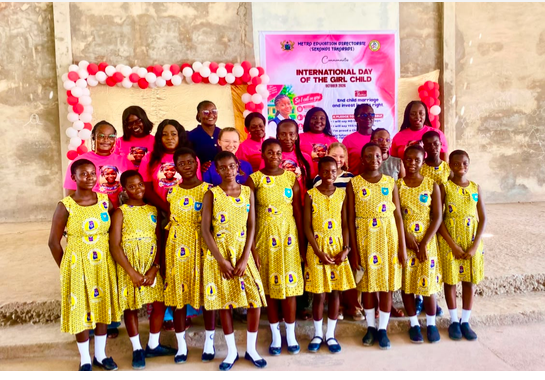
She made the call in a welcome address at the 2026 celebration of the International Day of the Girl Child in the Sekondi-Takoradi Metropolis, held under the theme: “End Child Marriage and Invest in Girls’ Rights.”
Madam Blay said ending child marriage required collective action from parents, teachers, traditional leaders, government institutions and communities to ensure that girls were protected and given the opportunity to pursue their aspirations.
She noted that child marriage often forced girls out of school before they were physically, emotionally and socially prepared for the responsibilities associated with marriage.
She said investing in girls’ rights was not merely a moral obligation but also an investment in the future of communities and the nation.
According to her, girls who remained in school, had their voices heard and received the necessary support could grow into leaders, professionals, innovators and active contributors to national development.
Madam Blay called on teachers to protect girls’ access to education, create supportive learning environments and empower them to express themselves confidently.
She also appealed to traditional leaders to help address harmful cultural practices and social norms that denied girls opportunities to develop their potential.
The government and relevant institutions, she said, must strengthen the enforcement of child protection laws to ensure that every girl received adequate protection.
She further urged communities to speak out against child marriage, report cases and work together to create safe environments where girls could learn, grow and thrive.
Madam Blay said every girl deserved the freedom to dream, acquire an education and determine her own future.
She expressed the hope that the celebration would strengthen stakeholders’ collective resolve to end child marriage and invest in the rights, education and future of every girl.
Madam Karen Ama Moses, Assembly Member for the Takoradi Railway and Harbour Electoral Area, said keeping girls in school would lead to enlightened mothers, well-informed families, resilient communities and, ultimately, a better Ghana.
She stressed that no child should be forced into marriage, adding that “every child must have the freedom to learn, grow, dream and choose her future.”
Some of the schoolchildren expressed concern that their parents did not always listen to their concerns during difficult times, while others said some children were exposed to abuse and early marriage.
Madam Henrietta Quabu, the Metropolitan School Health Coordinator, urged children experiencing abuse or any situation that threatened their well-being to report to the police, the Department of Social Welfare, the media, their teachers or the Metropolitan Education Directorate for assistance.
— GNA
SKIP THE QUEUE, TAP THE NEWS
You can now read the Ghanaian Times and The Spectator newspapers from the comfort of your device via TimesNewsPlus.
Join our WhatsApp Channel: https://whatsapp.com/channel/0029VbBElzjInlqHhl1aTU27