Hot!
More stranded Ghanaians to be evacuated home-Foreign Ministry


- /home/u249204778/domains/spectator.com.gh/public_html/wp-content/plugins/mvp-social-buttons/mvp-social-buttons.php on line 27
https://spectator.com.gh/wp-content/uploads/2020/05/STRANDED...Mr-Charles-Owiredu.jpg&description=More stranded Ghanaians to be evacuated home-Foreign Ministry', 'pinterestShare', 'width=750,height=350'); return false;" title="Pin This Post">
- Share
- Tweet /home/u249204778/domains/spectator.com.gh/public_html/wp-content/plugins/mvp-social-buttons/mvp-social-buttons.php on line 72
https://spectator.com.gh/wp-content/uploads/2020/05/STRANDED...Mr-Charles-Owiredu.jpg&description=More stranded Ghanaians to be evacuated home-Foreign Ministry', 'pinterestShare', 'width=750,height=350'); return false;" title="Pin This Post">
More Ghanaians who have become stranded across the world due to COVID-19 border closures are expected to be evacuated in the coming weeks, the Ministry of Foreign Affairs and Regional Integration has indicated.
The Deputy Sector Minister, Charles Owiredu, who disclosed this at yesterday’s COVID-19 briefing in Accra, said the 230 compatriots who arrived from Kuwait on Saturday were the first cohort of the stranded people.
The others, he said would be evacuated in cohorts because to bring all of them at a go would be overwhelming, adding that the plan was not to bring all Ghanaians living abroad, back home but only those who needed to come.
“The government cannot make a decision saying all of these people should come in at the same time. It is going to be very chaotic if you look at the numbers. So the decision was taken that let’s start with those from Kuwait,” he said.
Mr Owiredu fell short of mentioning the number of people expected home but said the figure was rising because more people were registering with the country’s 63 missions abroad including US, UK, Holland, Germany and Ukraine.
According to him, one cohort of the stranded persons comprised persons who travelled outside the country on their own and were willing to pay for their flight home and the cost of quarantine.
Another category, he said were persons who attended conferences and other national assignments, students who were on government scholarships and completed schools and others who lacked finances to return home.
“We have a fluid situation, the numbers keep rising,” the deputy minister said adding that they would be evacuated in cohorts to reduce the pressure on the government as well as ensure their safety.
On the cost of evacuation, Mr Owiredu, explained that the government was not taking responsibility since majority of people who desired to be brought back home have agreed to finance the trip.
In the case of the first cohort of returnees, he said the government of Kuwait offered to bear the cost of their evacuation while Ghana, provided some food on their arrival as well as the cost of quarantine.
The Kuwait returnees were in quarantine while the COVID-19 medical team had started testing them even though they tested negative in Kuwait.
The deputy minister recounted that the decision to evacuate stranded compatriots followed distress calls following the closure of borders to contain the coronavirus pandemic.
He said President Nana Addo Dankwa Akufo-Addo, after a meeting with the sector ministry and ambassadors, directed that data should be collated on subsequent evacuation.
Ghana’s air, sea and land borders were closed on Sunday, March 22, 2020, following an order by President Akufo-Addo as part of efforts to stop the spread of COVID-19 in the country.
President Nana Addo Dankwa Akufo-Addo extended the closure, which did not apply to goods, to the end of May and is expected to either ease or extend it this weekend.
Within the past few weeks, scores of foreign nationals have been evacuated from the country by their native countries including UK, USA and South Africa as part of their respective COVID-19 measures.
BY JONATHAN DONKOR



The Tema Regional Police Command has arrested a 32-year-old man for allegedly posing as a soldier and extorting money from unsuspecting members of the public at Ashaiman.
The suspect, identified as Bright Atsu Kudiabor, was arrested by the Ashaiman Police on Wednesday, September 16, 2026, at about 7:00 a.m.
According to the Police, he was arrested at an area known as “I Shall Return”, where he was allegedly parading himself as a soldier and demanding money from people.
The Police said Kudiabor, who is an ex-convict, was initially arrested by personnel of the Ghana National Fire Service in Ashaiman with assistance from other members of the public.
A search conducted on him after he was handed over to the Police reportedly led to the recovery of a set of military camouflage uniform.
The suspect is currently in Police custody and assisting with investigations.
The Tema Regional Police Command said he would be processed for court after investigations are completed.
The Police urged the public to remain vigilant and report anyone who falsely presents themselves as a soldier or a member of another security agency to deceive or extort money from the public.
By: Jacob Aggrey
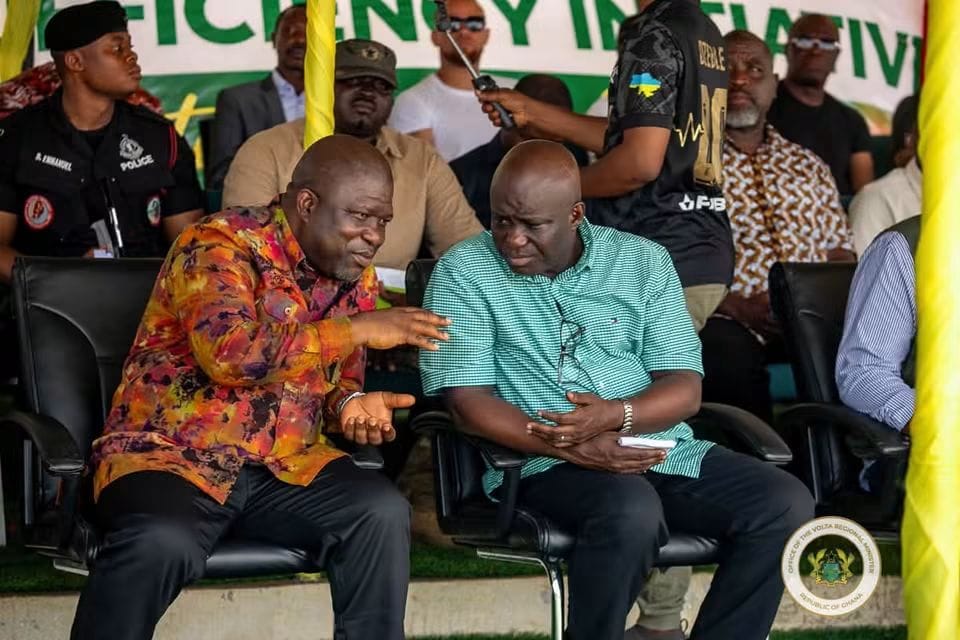
Volta Regional Minister, James Gunu, says the Volta Region holds enormous agricultural potential and efforts must be geared towards connecting farmers to the needed resources to unlock that potential.
He said focus must be on linking farmers to resources, technology, financing and markets to increase production, create jobs and build sustainable livelihoods.
Hon. Gunu made the remarks at the national launch of the Ghana Tomato Self-Sufficiency Initiative (GHATSI) held at Anloga in the Volta Region on Tuesday, September 15.
The initiative, under the theme “Produce at Home. Feed the Nation. Export the Surplus,” seeks to boost local tomato production, processing and marketing while reducing Ghana’s heavy reliance on imported tomatoes.
The launch was attended by the Minister for Food and Agriculture, Eric Opoku, his Deputy, John Setor Dumelo, Feed Ghana Coordinator, Bright Demordzi, Members of Parliament, traditional leaders, MMDCEs, farmers and other stakeholders.
Mr.Gunu expressed appreciation to the Minister for Food and Agriculture for the support announced for the region, including two excavators, 200 cartons of organic fertiliser, and GH¢200,000 for Ms. Kuatudzo Esther Dela, a tomato farmer and processor from Ziope.
He described the initiative as an important step towards making agriculture a stronger driver of food security, job creation and economic growth in the Volta Region.
By Edem Mensah-Tsotorme