News
Lauritz Knudsen expands Ghana operations to boost power reliability

Lauritz Knudsen Electrical and Automation, a unit of Schneider Electric, has deepened its investment in Ghana with a showcase of new low voltage switchgear, industrial and agricultural automation solutions.
The company with over 70 years of engineering experience, brought together partners, distributors and customers at Nova Plus in Accra to unveil its expanded portfolio tailored for the Ghanaian market.
The move comes as Ghana prioritises grid modernisation and industrialisation.
Power outages cost the economy an estimated $2.1 billion annually, about two per cent of Gross Domestic Product affecting real estate, agriculture, manufacturing and other sectors.
The Head of Strategy, Business Development, Pricing and LK MEA International Operations, Dallal Slimani said the company’s technology was built to suit Ghana’s environment.
“Our low voltage switchgear is engineered to keep critical operations running through exactly the kind of instability Ghanaian businesses deal with every day, whether that’s a mining camp running off-grid or a hospital that cannot afford a single second of downtime,” she said, adding that “We’re bringing technology refined through years of working alongside our partners here.”
According to her, Lauritz Knudsen solutions were critical across mining, oil and gas, manufacturing, healthcare, data centers, and real estate in hubs like Tema and Accra.
She said her outfit expected demand to grow as the Energy Commission rolled out regulations for EV charging infrastructure.
“With an existing distribution network in Ghana, Lauritz Knudsen plans to expand further into medium voltage switchgear, smart energy management, and solar,” Ms Slimani stated.
She said the company had supported over 50GW of solar capacity globally.
The Business Development Manager of Lauritz Knudsen in charge of West Africa, Valentine Mbachu, noted that unreliable power directly impacts productivity.
“A $2.1 billion annual loss isn’t an abstract figure, it’s downtime on factory floors, spoiled inventory, and stalled investment decisions. We’ve built strong partnerships in Ghana because this market has the industrial ambition to grow fast,” he said.
BY EDEM TSORTORME

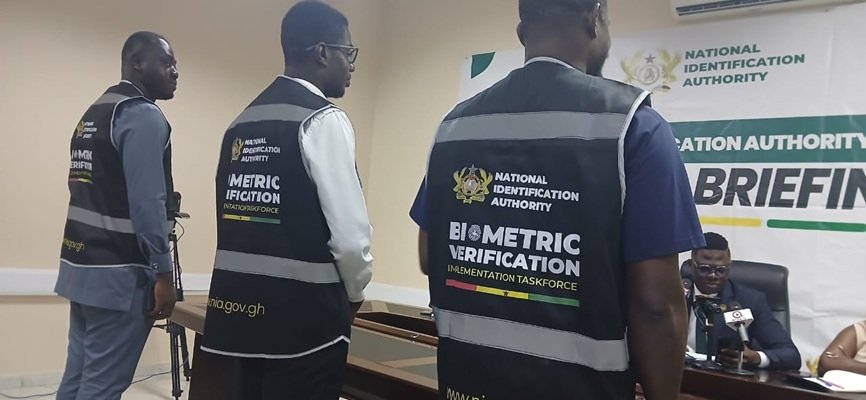
The National Identification Authority (NIA) has announced the commencement of enforcement of the National Identity Register (Amendment) Regulations, 2026 (L.I. 2523), warning institutions that fail to comply with the new requirements of possible fines of up to 2,000 penalty units.
The Authority says it will deploy a Biometric Verification Implementation Task Force to inspect institutions and ensure they comply with the regulations, following the expiration of a three-month grace period granted to businesses and public institutions.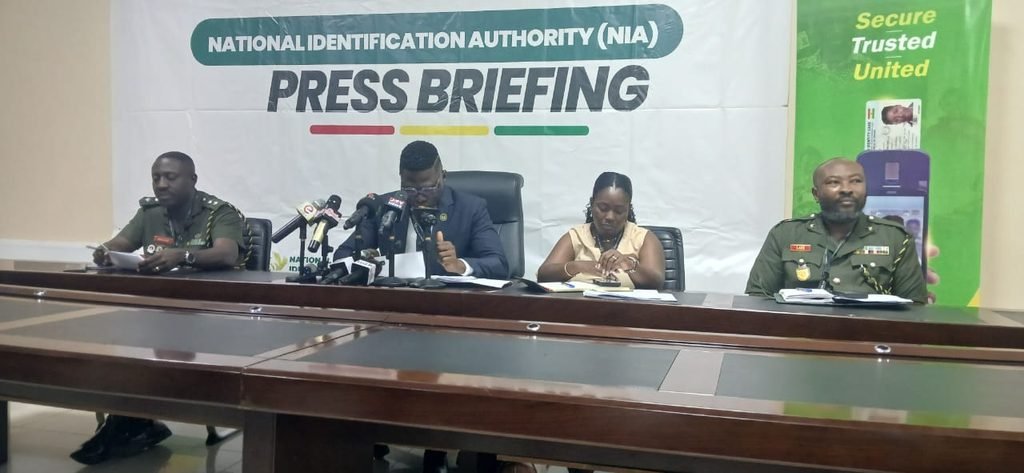
Speaking at a press briefing in Accra on Monday, November 2, 2026, the NIA’s Corporate Affairs representative, William Ampomah Emmanuel Darlas, said the Authority had completed its public education and stakeholder engagement activities and was now moving into the enforcement and compliance monitoring phase.
He explained that the regulations require institutions that verify the identities of customers or applicants as part of their operations to use the NIA’s approved biometric verification platform instead of relying solely on visual inspection of the Ghana Card.
Under the new rules, institutions are prohibited from photocopying, scanning or keeping copies of the Ghana Card for identity verification purposes.
Mr Darlas stressed that simply collecting a customer’s Ghana Card, looking at the photograph and comparing it with the person presenting it would no longer be accepted as a valid method of identity verification.
He, however, clarified that the Ghana Card remains the country’s official national identity document and that citizens are not required to register for a new card or capture their biometrics again under the new regulations.
He said the new system is intended to reduce identity fraud, impersonation and other crimes by ensuring that the person presenting the Ghana Card is the actual owner.
According to him, the biometric verification process will rely on information already captured during Ghana Card registration, including fingerprints, iris details and facial features stored in the card’s chip.
Mr Darlas warned institutions against using third-party companies or individuals to access the NIA’s identity verification platform, insisting that the Authority does not work with intermediaries.
He said institutions seeking access to the National Identity Register must deal directly with the NIA and complete its official onboarding process.
The process requires institutions to prove that they are legally registered companies in Ghana, obtain certification from the Data Protection Commission and work with the NIA’s technical team to establish the necessary connection to its platform.
He further cautioned institutions already connected to the platform against subletting their access to other businesses, particularly small and medium-sized enterprises.
He disclosed that the Authority had received reports of some institutions providing their verification services to other businesses without the NIA’s approval and warned that those involved would face legal action.
Mr Darlas said organisations that fail to comply with L.I. 2523 could face fines ranging from 500 to 2,000 penalty units, depending on the nature of the offence.
He explained that the NIA does not have the authority to impose the fines directly but would take offenders to court for the appropriate punishment.
He indicated that Institutions found guilty could also face additional administrative measures, including being barred from accessing the NIA’s verification platform in the future.
The NIA representative further clarified that the new regulations do not prohibit all institutions from physically using the Ghana Card during transactions.

The Managing Director of the Ghana Publishing Company Limited, Nana Kwesi Boatey, has revealed how he transformed a major overstaffing challenge into a success story through the government’s 24-Hour Economy initiative.
Speaking at the Government Accountability Series on Monday, November 2, Mr. Boatey disclosed that when he assumed office in February 2025, and inherited a bloated workforce of 250 employees doing work that could be efficiently handled by 150 people, a situation that created serious liquidity challenges for the state-owned company.
Instead of resorting to downsizing, he adopted an innovative approach by instituting a 24-hour operational system.
Under the new system, staff were redistributed across three shifts: 7 a.m. – 4:30 p.m., 10 a.m. – 7 p.m., and 10 p.m. – 4:30 a.m.
This not only ensured optimal use of labour but also maximized machine utilization and improved overall output.
According to him, the single move redefined the productivity culture within the company, reinforcing discipline, accountability, and efficiency.
The Ghana Publishing Company’s turnaround is being cited as a practical example of how the 24-Hour Economy policy can drive growth without job losses.
By Edem Mensah-Tsotorme