News
INDIVIDUAL INVOLVEMENT IN POLITICS

- /home/u249204778/domains/spectator.com.gh/public_html/wp-content/plugins/mvp-social-buttons/mvp-social-buttons.php on line 27
https://spectator.com.gh/wp-content/uploads/2020/08/Joyce-Aryee.jpg&description=INDIVIDUAL INVOLVEMENT IN POLITICS', 'pinterestShare', 'width=750,height=350'); return false;" title="Pin This Post">
- Share
- Tweet /home/u249204778/domains/spectator.com.gh/public_html/wp-content/plugins/mvp-social-buttons/mvp-social-buttons.php on line 72
https://spectator.com.gh/wp-content/uploads/2020/08/Joyce-Aryee.jpg&description=INDIVIDUAL INVOLVEMENT IN POLITICS', 'pinterestShare', 'width=750,height=350'); return false;" title="Pin This Post">
I urge, then, first of all, that petitions, prayers, intercession and thanksgiving be made for all people— for kings and all those in authority, that we may live peaceful and quiet lives in all godliness and holiness.— 1 Timothy 2:1-3.
When we talk about a Christian’s political movement, we should realize. that not all involvement is physical. For example, a group of people may meet everyday to pray for the street people. From the world’s perspective they are skirting the real task, withdrawing from the misery on the street. But praying for street ministries is both biblical and a vibrant spiritual involvement. The power of prayer is immeasurable and vital.
Each individual has to seek his or her calling from God. Christ calls people to different ministries. We cannot assume that everyone must have our calling, nor can we prescribe a calling for another individual. Another person’s role within the body of Christ will be different from ours.
Some of us are called to reform politics from within the structure. Others of us are called to be part of a citizen endeavour. Some of us are called to serveon a local school body board or city council. Others may be involved in acitizen group to fight child abuse.
As Christians called to involvement in politics in whatever form, our real mission is to affirm our love and obedience to Christ. Our long-term commitment and our immediate commitment are one and the same – to serve as ambassadors of Jesus Christ; to be the voice, the healing, and the reconciling and liberating force of Jesus. We have Christ in us, the hope of glory (Colossians 1:27). We are witnesses of redemption, of the Good News. As Christians, that mission must undergird our role in politics, just as it is evidenced in our family lives and our role in the marketplace.
Sin manifests itself in evil, in oppression, in injustice, in jealousy, in rivalry, in hate, in poverty. The basic Christian values are the exact opposite – healing, reconciling, encouraging, feeding the poor, visiting the sick and the prisoners. We have the message of the Good News that indeed God has dealt with the forces of injustice and evil. We have the armour of the Word of God and the energizing of the Holy Spirit. We must be involved in both ministry and politics – in the unique way God has called each of us to serve.
THE DYNAMICS OF DIVERSITY
We are responsible to bring the message of Christ into every facet of life. We can join a political party, write to ourparliamentarians, march, hold a vigil or do other things that call attention to what needs to be done for the betterment of peoples’ lives. But while we do these things, we have to be careful that our political agendas do not become a divisive force within the Body of Christ.
There is great danger when someone says, “This is the Christian position on a certain political issue.” That implies that any other viewpoint is not Christian. Political standsdo not determine our salvation; our relationship to the person of Jesus Christ does. I think that relationship alone determines our right to be called a Christian.
What Can We Do When We Disagree with Other Christians Politically?
We can retain our political convictions and still be united with other Christians. To experience that, a basis of love is required. We discuss the issue we disagree on, but we realize that hey are secondary to our love for each other and our love for Christ.
How can Christians Agree to Disagree on Political Issues?
1. Listen to one another. Too often we jump to conclusions about the opposite side of an issue without listening to what the people on it have to say.
2. Make the Bible your anchor. We must hold one another to the biblical context and theological norms. We must remember the church’s tradition of moral reflection.
3. Dig into discussion. We need to present the different options and urge all sides to discuss the issues. That’s how our consciences are formed.
4. Love, don’t leave. There will be times when, after we have discussed all sides of an issue, we will not be able to agree with other Christians. Then we accept them, remembering not what divides us, but what binds us together – Christ’s love.
CONCLUSION
Christians will often disagree on political matters. But we should not disagree on the underlying moral principles, and we most definitely should not interpret moral principles from the vantage point of our own self-interest. When this happens, we discredit ourselves and the wonderful gospel for which we claim to stand.
Source:Adapted from the book “Practical Christianity” – The Down to Earth Guide to Heavenly Living.
Stay Blessed!
For further inquiries please contact us on Tel Nos. 0302-772013 or 0268130615
Email: saltnlightministries@gmail.com
Website: saltandlightgh.org


Residents of Brodi, a farming community in the Tain District of the Bono Region, have been left in shock and mourning following the alleged murder of a 45-year-old woman by her husband, who later died by suicide.
According to information gathered by the Ghana News Agency (GNA), the suspect, popularly known as Kwabena Jack, believed to be in his 50s, allegedly attacked and killed his wife, Abena Donkor, while the couple were working on their farm on Monday, August 11, 2026.
Mr Kingsley Obah, Assembly Member for the Brodi Electoral Area, confirmed the incident to the GNA.
He explained that after news of the woman’s death spread through the community, residents launched a search for the suspect. His lifeless body was later discovered in a nearby bush on Tuesday, August 12, 2026.
Police have since conveyed both bodies to the Tain District Government Hospital, where they have been deposited for preservation and autopsy.
Investigations into the incident are ongoing. -GNA
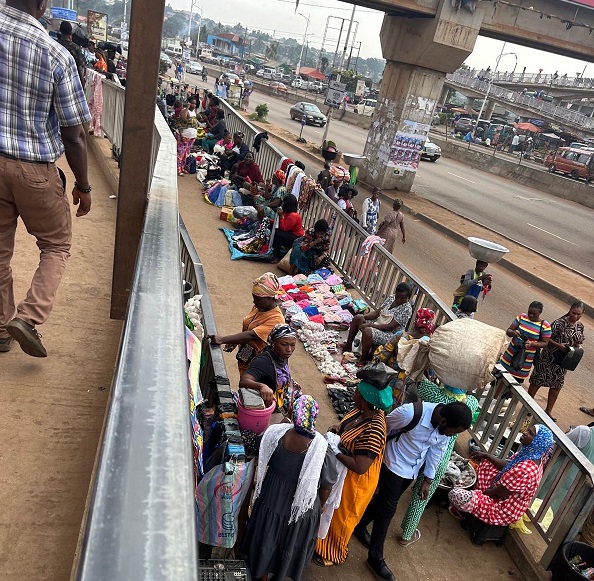
Hawkers and roaming preachers have taken over the five-metre high Madina REDCO footbridge and adjoining streets, making it increasingly difficult for pedestrians to use the facility intended to promote safe road crossing.
The traders have virtually turned sections of the footbridge into a marketplace, displaying their wares on the floor using jute sacks, plastic sheets and metal trays, while others have occupied both sides of the walkway with their merchandise.
Foodstuffs such as okro, garden eggs, pepper, onions, dried fish, smoked fish, grains, spices and other groceries are openly sold on the footbridge and along the roadside, forcing pedestrians to weave through the crowded path.
Clothing and fashion accessories including slippers, brassieres, panties, socks, bags and other household items are also displayed for sale, leaving only limited space for commuters to use.
The situation is worsened by the presence of itinerant preachers who position themselves on the footbridge with public address systems to evangelise, drawing crowds to further obstruct pedestrian movement.
Head porters are also seen crossing the highway through the median while carrying heavy loads instead of using the footbridge, exposing themselves to the danger of being knocked down by speeding vehicles.
Also, portions of the footbridge are showing signs of deterioration. Several metal railings are rusted, bent and loosely secured with pieces of wire, raising concerns about the safety of users, especially children, the elderly and persons with disabilities.
Sections of the concrete surface are worn and chipped, while makeshift wooden supports attached to parts of the structure suggest temporary repairs.
After a visit by The Spectator last week, it emerged that many commuters preferred crossing the busy Madina Highway instead of using the footbridge because of the congestion created by the trading and preaching activities.
For years, successive attempts by the police, the military and the La Nkwantanang Madina Municipal Assembly to address congestion around the REDCO and Zongo Junction enclave have yielded little success, with the area becoming notorious for roadside trading, indiscriminate parking and pedestrians refusing to use the footbridge.
A pedestrian, who gave her name only as Maame Yaa, described the situation as worrying, saying the footbridge, which was constructed to protect lives, had gradually lost its purpose because of the growing encroachment by traders and preachers.
According to her, many pedestrians were discouraged from using the facility because navigating through the crowded walkway had become difficult and uncomfortable.
She appealed to the La Nkwantanang Madina Municipal Assembly and other relevant authorities to intensify enforcement to prevent unauthorised trading and other activities on the footbridge and ensure it served its intended purpose of promoting pedestrian safety.
However, during the visit, personnel of the Ghana National Fire Service (GNFS) were seen carrying out a decongestion exercise to remove hawkers from sections of the roadside around the footbridge as part of efforts to improve public safety and ease the movement of both pedestrians and motorists.
The exercise forms part of a pilot project initiated by the Municipal Fire Commander for Madina, Division Officer II (DO II) Abdul Salia, who assumed command of the Madina Municipal Fire Station three months ago.
Speaking in an interview with The Spectator, DO II Abdulai Salia, who is also a long time resident of the community, said the month long project began on July 1 and ended on July 31, with 30 firefighters deployed daily to regulate traffic, clear hawkers from the streets and footbridge, and create access for emergency vehicles.
Continued on page 12
By Esinam Jemima Kuatsinu