News
Father Campbell receives honourary doctorate for humanitarian support

- /home/u249204778/domains/spectator.com.gh/public_html/wp-content/plugins/mvp-social-buttons/mvp-social-buttons.php on line 27
https://spectator.com.gh/wp-content/uploads/2020/11/Rev-Father-Campbell-receiving-the-citation.jpg&description=Father Campbell receives honourary doctorate for humanitarian support', 'pinterestShare', 'width=750,height=350'); return false;" title="Pin This Post">
- Share
- Tweet /home/u249204778/domains/spectator.com.gh/public_html/wp-content/plugins/mvp-social-buttons/mvp-social-buttons.php on line 72
https://spectator.com.gh/wp-content/uploads/2020/11/Rev-Father-Campbell-receiving-the-citation.jpg&description=Father Campbell receives honourary doctorate for humanitarian support', 'pinterestShare', 'width=750,height=350'); return false;" title="Pin This Post">
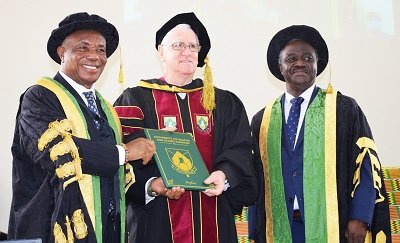
The University of Health and Allied Sciences (UHAS) in the Volta Region last Friday conferred an Honorary Doctor of Science Degree on Reverend Father Andrew Campbell, a Catholic priest, for his unflagging impact on leprosy control, health and development in Ghana.
The ceremony which coincided with the 5th Congregation of the university at the main campus at Sokode-Lokoe, near Ho, was witnessed by the Vice President, Alhaji Dr Mahamadu Bawumia and other dignitaries.
An accompanying citation described Father Campbell as “friend to the poor, brother to the needy and servant of humankind whose persistent humanitarian support for the community of lepers and street children earned him the affectionate title, the leper priest.”
Born in Ireland in 1946 and ordained in 1970, Rev Father Campbell sailed to the Tema port on October 13, 1971, to work as a missionary priest in the Society of the Divine Word in Ghana.
He received his Ghanaian citizenship on July 3, 2013.
“Over the years, you have taken an active interest in the plight of the poor and needy, particularly cured lepers.
“Your public displays of solidarity have been about rehabilitating Ghana’s lepers and breaking down the prejudice that makes outcasts of them,” the citation noted.
It acknowledged Father Campbell’s valiant role in championing the rights of lepers within his parish, often inviting them to church services where they were given the place of honour.
The citation again read in part: Your tireless efforts have been based on your belief that improvements can be made in the lives of the poor and needy not only through state subsidy but also through charitable donations and fund raising.
It lauded Father Campbell for several initiatives, including a mill at the leprosarium in Accra and other places in Ghana; a soap making venture, mat making, poultry farms and dress making for those who still have fingers, aimed at equipping cured lepers with skills that allow them to be self-sufficient.
“As a result of your lobbying, church initiatives and government policies are beginning to handle the plight of lepers in a more compassionate manner,” the citation further said.
Father Campbell who received the degree with great joy thanked UHAS for the great honour and said that “if you want to be happy, make someone happy.”
Father Campbell, the founder of Lepers’ Aid Committee, a group of young people determined to assist in curing lepers by raising funds, is a founding member and co-chairman also of Environmental Protection Association, West Arena, Accra, an NGO with the aim of keeping the surroundings clean.
Pix: Father Campbell flanked by Mr Justice Victor J. M. Dotse (left), Chairman of the Governing Council of UHAS and Professor John O. Gyapong, Vice Chancellor.
From Alberto Mario Noretti, Ho


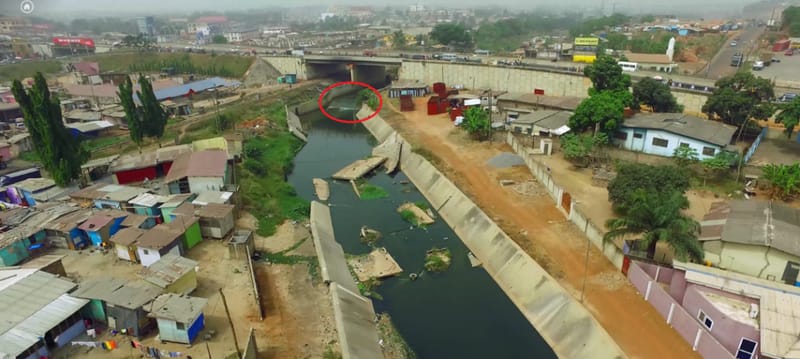
Construction of a major underground stormwater drain along the Dr. Busia Highway within the Kaneshie enclave will commence on September 7, 2026.
The Project Coordinator for the Greater Accra Resilient and Integrated Development (GARID) Project, Dr. Kwadwo Ohene Sarfo, announced this at a special media briefing on Wednesday.
According to him, the works will involve the construction of a double-cell underground rectangular drain measuring approximately 10 metres wide and 1.95 kilometres long, stretching from Pamprom Junction to First Light Junction.
The new drain will replace the existing two 1.2-metre diameter pipes, which are inadequate to carry the volume of stormwater in the area.
Dr. Sarfo said the drain will connect at one end to the recently completed section within the Accra Academy campus and at the other end to the existing drain at Pamprom Junction.
He said the construction is expected to run from September 2026 to October 2027.
The project forms part of government’s broader flood prevention and mitigation programme aimed at addressing perennial flooding in Accra.
By Edem Mensah-Tsotorme
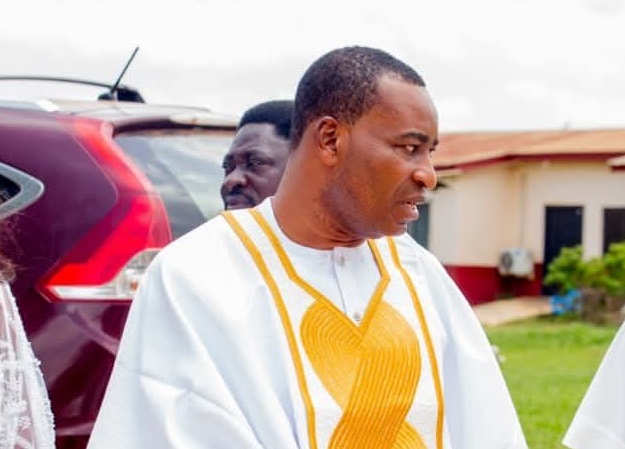
The former Ashanti Regional Chairman of the New Patriotic Party (NPP), Bernard Antwi Boasiako, popularly known as Chairman Wontumi, has withdrawn from the party’s National Chairmanship race.
In a statement issued yesterday, Chairman Wontumi who is currently serving a 20-year jail term said his decision was driven by his love for the party and his unwillingness to let his personal circumstances distract the NPP from its rebuilding efforts.
“There are moments in the life of a man when the heart wants to continue, but duty demands sacrifice. Moments when one must quietly set aside personal ambition, not because the dream has died, but because the family he loves must not be made to carry his burden. Today, I find myself at such a painful moment,” he wrote.
He disclosed that after many nights of prayer, sober reflection and consultations with his family, legal team, party elders, campaign team and trusted supporters, he concluded that his present situation must not become an additional burden on the NPP.
“This is not the decision my heart desired, but sometimes, true love requires us to release what we deeply want in order to protect what we love even more,” he added.
Recounting his years of service, Chairman Wontumi said he had served the party with everything within him, walking through heat and rain, travelling to remote communities and standing with the grassroots in both victory and defeat.
“For many years, I have served the NPP with everything within me… The NPP is not merely a political party to me. It is my family. It is my home. It is a cause to which I have dedicated a significant part of my life,” he stated.
He explained that the party, already carrying the pain of electoral defeat and the huge responsibility of preparing for the future, should not be made to carry his personal weight.
“That is why I cannot allow my present situation or personal ambition to distract the party from the difficult work of rebuilding. I cannot ask the party to carry my weight when it is already carrying the pain of defeat and the enormous responsibility of preparing for the battle ahead. I would rather carry this pain quietly than allow the party I love to suffer because of me,” he said.
He further sympathized with his supporters across the 16 regions, acknowledging that the decision would be painful for many who had sacrificed for his campaign.
“To my teeming supporters across all sixteen regions, I know this message will hurt. I know many of you will read it with tears in your eyes because I understand the sacrifices you have made for this journey,” he said.
By Edem Mensah-Tsotorme