News
Effective implementation of Affirmative Action Law key to gender equality — Convenor

- /home/u249204778/domains/spectator.com.gh/public_html/wp-content/plugins/mvp-social-buttons/mvp-social-buttons.php on line 27
https://spectator.com.gh/wp-content/uploads/2025/09/Participants-at-the-workshop.jpg&description= Effective implementation of Affirmative Action Law key to gender equality — Convenor', 'pinterestShare', 'width=750,height=350'); return false;" title="Pin This Post">
- Share
- Tweet /home/u249204778/domains/spectator.com.gh/public_html/wp-content/plugins/mvp-social-buttons/mvp-social-buttons.php on line 72
https://spectator.com.gh/wp-content/uploads/2025/09/Participants-at-the-workshop.jpg&description= Effective implementation of Affirmative Action Law key to gender equality — Convenor', 'pinterestShare', 'width=750,height=350'); return false;" title="Pin This Post">
Mrs Sheila Minkah-Premo, Convenor of the Affirmative Action Law Coalition, has stressed that the effective implementation of the Affirmative Action (Gender Equity) Act, 2024 (Act 1121), is critical to achieving genuine gender equality in Ghana.
She said while the passage of the law in July 2024 was a landmark achievement after more than a decade of advocacy, its true impact would depend on how well institutions, policymakers, and society commit to its enforcement.
“The law itself will not change the position of women unless we take deliberate steps to ensure that it is fully implemented. By 2026, the law requires that women hold at least 30 per cent of positions in governance and decision-making, and this target must not be taken lightly,” Mrs Minkah-Premo stated.
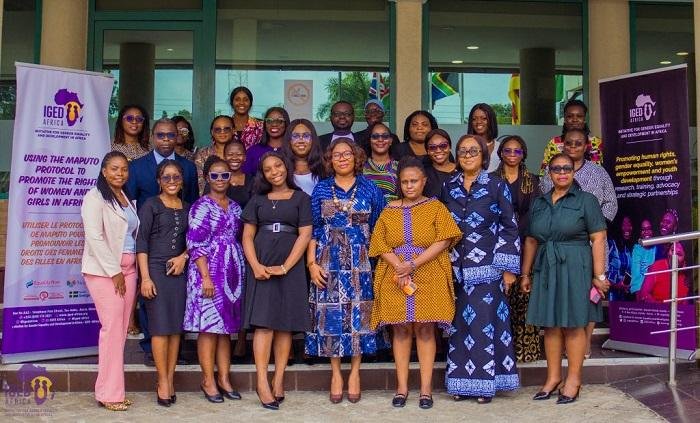
Mrs Minkah-Premo was speaking at the opening of a two-day stakeholder workshop on family law reform in Accra, organised by the Initiative for Gender Equality and Development in Africa (IGED-Africa) in collaboration with the Solidarity of African Women’s Rights (SOAWR) Coalition hosted by Equality Now.
The stakeholder workshop, which runs from September 10 to 11, 2025, has brought together civil society actors, legal experts, and policymakers to deepen advocacy on Ghana’s family law reform agenda.
It seeks to accelerate progress on pending legislations such as the Property Rights of Spouses Bill and the Interstate Succession Bill, which have faced years of delays in Parliament despite their potential to safeguard women’s economic and social rights.
Part of wider efforts to consolidate gender equality gains across Africa, the outcomes of the workshop would contribute to regional strategies aimed at tackling persistent barriers to women’s rights and representation.
Mrs Minkah-Premo, who has been involved in the drafting and advocacy of the Affirmative Action Law, said the Act provided a legal framework to progressively increase women’s participation in governance – 30 percent by 2026, 35 percent by 2028, and 50 percent by 2034.
It also establishes a Gender Equity Committee to oversee compliance and issue certificates to institutions that meet set targets.
However, she warned that implementation challenges were already evident, and that, “We are seeing early signs of non-compliance in presidential appointments, funding gaps for the Gender Equity Committee, and delays in setting up the structures needed to make the law effective. These must be urgently addressed,” she said.
The Convener highlighted that cultural barriers, entrenched stereotypes, and a patriarchal political system continued to undermine women’s representation.
She noted that despite women making up more than 50 per cent of Ghana’s population, their presence in Parliament stood at only 14.8 per cent, with just 41 female MPs out of 276.
She added that the Affirmative Action law was designed not only to meet constitutional requirements but also to align Ghana with its international obligations, including the Convention on the Elimination of All Forms of Discrimination against Women (CEDAW), the Maputo Protocol, and the Beijing Platform for Action.
Mrs Minkah-Premo urged stakeholders to keep pushing for results, and that “The law is only as strong as the people who defend it. It is up to all of us, civil society, policymakers, and citizens, to hold duty bearers accountable so that gender equality moves from paper to practice.”
Participants emphasised that reforming family laws alongside enforcing the Affirmative Action Act would provide stronger protection for women’s rights and create a more inclusive governance system.
They agreed that coalition-building, public education, and consistent monitoring would be critical in sustaining advocacy and ensuring accountability.
—GNA
Join our WhatsApp Channel now!
https://whatsapp.com/channel/0029VbBElzjInlqHhl1aTU27

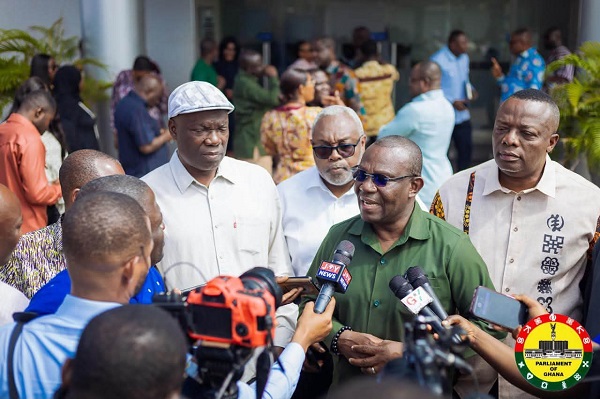
The Parliamentary Select Committee on Energy has appealed to the Ministry of Finance to release GH¢5.6 million to the Petroleum Commission to enable it to establish and operate a world-class data centre.
According to the Committee, access to the funds will strengthen the Commission’s capacity to manage critical upstream petroleum data and improve its operations.
Speaking during the appeal, Chairman of the Committee, Emmanuel Kwasi Bedzrah, said the move was crucial to efforts to revitalise Ghana’s upstream petroleum industry and increase oil production.
He noted that although investment and hydrocarbon production had declined in recent years, Parliament’s approval of an extension of the petroleum agreement to 2030 had attracted additional funding and contributed to an increase in production from about 80,000 to 120,000 barrels per day.
Meanwhile, concerns have been raised over repeated budget allocations for oil exploration in the Voltaian Basin.
Mr. Bedzrah stressed that funds approved for exploration must produce tangible results, adding that the Committee would require clear evidence of progress before supporting future budget allocations for the programme.
The appeal was made during a working visit to the Petroleum Commission as part of the Committee’s oversight activities to assess its operations and management procedures.
During the engagement, the Chief Executive Officer of the Petroleum Commission, Emeafa Hardcastle, took the Committee through the Commission’s working procedures and mandate, which includes regulating, managing and coordinating upstream petroleum activities.
She disclosed that since assuming office in 2025, government had pursued measures to reverse the decline in crude oil production, sustain output and reposition Ghana as an attractive destination for investment in Africa’s increasingly competitive petroleum sector.
In addition, she said government had secured fresh commitments of about US$35 billion to help revitalise the sector.
As part of the oversight exercise, the Committee is expected to conclude its monitoring visit with engagements at the National Petroleum Authority (NPA) and the Ghana Oil Company Limited (GOIL).
By Edem Mensah-Tsotorme
News
“No civilisation deserves to be annihilated” – Mahama calls for dialogue on global conflicts at UNGA 81
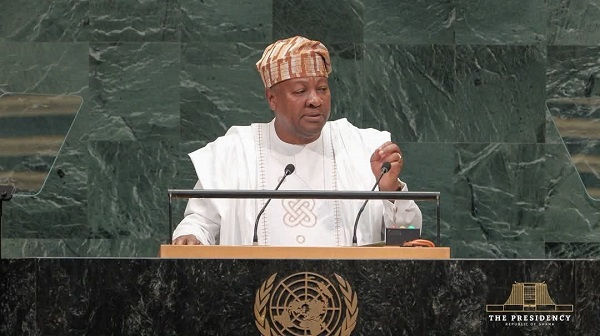
President John Dramani Mahama has called for solidarity and dialogue in resolving global conflicts, insisting that no civilisation deserves to be wiped out.
“No human civilisation deserves to be annihilated, certainly not a member state of the United Nations,” President Mahama stated in his address at the 81st United Nations General Assembly in New York.
He called for solidarity with nations facing terrorism, especially the Alliance of Sahel States (AES), and for a uniform approach to conflicts in Europe, the Middle East and Africa.
On the Middle East, the President called for a return to negotiations, saying “The current Middle East crisis is having a deleterious effect on the world economy.”
“I believe that dialogue can resolve even the most intractable of problems,” he added.
By Edem Mensah-Tsotorme

 Entertainment1 week ago
Rhythms On Da Runway returns November 28 with 16th edition themed ‘Unbound’
- Entertainment1 week ago
Ohemaa Mercy’s Tehillah Experience outfit was priestly regalia, not costume – Management clarifies
 News1 week ago
Janet Asana Nabla criticises Mahama over China curriculum controversy involving Haruna Iddrisu