Hot!
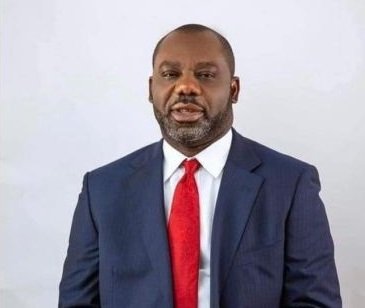
Dr. Matthew Opoku Prempeh leading giant stride at Energy Ministry

- /home/u249204778/domains/spectator.com.gh/public_html/wp-content/plugins/mvp-social-buttons/mvp-social-buttons.php on line 27
https://spectator.com.gh/wp-content/uploads/2023/02/Dr-Mattew-Opoku-Prempeh.jpg&description=Dr. Matthew Opoku Prempeh leading giant stride at Energy Ministry', 'pinterestShare', 'width=750,height=350'); return false;" title="Pin This Post">
- Share
- Tweet /home/u249204778/domains/spectator.com.gh/public_html/wp-content/plugins/mvp-social-buttons/mvp-social-buttons.php on line 72
https://spectator.com.gh/wp-content/uploads/2023/02/Dr-Mattew-Opoku-Prempeh.jpg&description=Dr. Matthew Opoku Prempeh leading giant stride at Energy Ministry', 'pinterestShare', 'width=750,height=350'); return false;" title="Pin This Post">
● Dr Mattew Opoku Prempeh
It is one thing being named a government appointee and another thing making an impact through hardwork and leaving an indelible mark on the minds of the populace.
There are lots of people who have served in various capacities under various governments who have been forgotten totally because of how poor they performed while in office.
History cannot be unkind to Dr. Matthew Opoku Prempeh, Ghana’s Energy Minister, because of the impact he has made as the man in charge of the country’s crucial energy sector, as he has been able to confront most of the teething problems of the sector.
In 2021, when Dr. Prempeh was named by President Nana Addo Dankwa Akufo-Addo to be in charge of the energy ministry, he was fully aware of the sector’s difficult past and had to confront it with alacrity.
The fearsome face of the energy sector made him to devise various strategies with team members of the various agencies under the ministry and set out to work and the results are what Ghanaians are enjoying today.
Dr. Prempeh, who is the Member of Parliament for Manhyia South, in the Ashanti Region, chalked incredible feat in his first year (2021) as the commander-in-charge of the sector and added more feathers in his cap by working extremely hard to achieve the best of results in 2022.

In 2022, the power sector witnessed massive projects that fed into the minister’s agenda of keeping the lights on in every corner of the country.
The power situation from Kumasi in the Ashanti Region to Bolgatanga in the Upper East Region has become best with the commissioning of 330 Kilovolt (KV) transmission line project. Kumasi and the northern part of the country now have stable power.
In June 2022, the Volta-Achimota-Mallam lines were improved and upgraded with the commissioning of 161Kv line that has helped to stabilise the power situation in the southern sector of the country.
In that same month in 2022, the Kasoa substation, which is the second largest Bulk Supply Point (BSP) with a productive capacity of 435 Measuring Apparent Power (MVA) was commissioned, resulting in significant power improvement in the reliability of power supply to Kasoa and its environs in the Central Region.
The Ellen Moran Primary Substation located at Kanda in Accra with productive capacity of 78MVA and the Legon Primary Substation with productive capacity of 52MVA, located at the University of Ghana Medical Centre (UGMC), were completed and commissioned in 2022.
With the development and promotion of solar power very dear to the heart of the minister, the Kaleo/Lawra Solar Project, with productive capacity of 19 Mega Watts (MW), was completed and commissioned in August 2022 to add to government’s policy to increase the share of renewables in the national generation mix.
The power sector also witnessed the execution of Power Purchasing Agreements (PPAs) with some existing Volta River Authority (VRA) customers, including Newmont Ghana Limited.
The Energy Transition Framework was given an impetus in 2022, as it was being developed to provide the path to achieving net zero emission by 2070, while ensuring economic growth and utilisation of Ghana’s natural resources.
The Framework was launched by President Akufo-Addo at the Climate Change Conference-COP27 in Egypt. With Dr. Prempeh’s aggressive and well-tailored programmes, Ghana’s electricity access has increased from 87.03 per cent in 2021 to 88.54 per cent as at the end of 2022.
Improved Cook Stoves Programme saw the distribution of some 92, 552 units of Improved Charcoal Cook Stoves in 2022. The programme has led to efficient energy utilisation and reduced dependence on wood fuels.
Downstream petroleum activities were seriously attended to by Dr. Prempeh and his team in 2022 with the minister leading the charge for Cabinet to lift the ban on the construction of Liquefied Petroleum Gas (LPG) refilling plants.
The National LPG Promotion Programme (NLPGPP) was properly handled leading to US$17 million in funding support from the World Bank for the implementation of Phase 1 of the NLPGPP.
In addition to that initial 40,000 pieces of cook stoves and related accessories for distribution under the National LPG Promotion Programme (NLPGPP) were procured.
Stakeholder engagements with the Association of LPG Marketing Companies (LPGMCs), Ghana Alliance for Clean Cooking (GHACCO), Ministries of Health, Education, Transport, among others were part of the energy ministry’s preoccupation in 2022.
Dr. Prempeh focused on the NLPGPP and ensured that an Operation Manual developed for the full implementation of the NLPGPP was developed as well as having the national launch of the programme.
To make the NLPGPP successful, there were reconnaissance activities in 19 Metropolitans, Municipals, and Districts (MMDAs) across Ashanti, Eastern, Western and Northern regions conducted, while 6,000 single burner LPG Cook Stoves and related accessories were distributed at Obuasi, Kodie and Fomena.
LPG Behavioural Change and Public Awareness Strategy developed and Nationwide LPG Sensitisation Campaign was launched in 2022 by the energy ministry with Steering Committee to provide direction and supervision for the implementation of programmes under the LPG4D instituted with Kintampo Health Research Centre as an Independent Verification Agency for the NLPGPP.
Dr. Prempeh saw the exclusivity agreement between Petroleum Hub Development Corporation (PHDC) and Touchstone Capital Partners (TCP)/UIC Energy Ghana Limited (UIC) for the implementation of Phase 1 of the Petroleum Hub project facilitation in 2022 with the overall importance of the hub as his interest.
There was improved sustainability of the Price Stabilisation and Recovery Account with total annual under-recovery payments of GHS153,753,694.94 and GHS240,655,682.57 from the Ministry of Finance for supplied RFO and premix fuel respectively, facilitated.
A subsidy capping level for Residual Fuel Oil was introduced and the subsidy was gradually reduced to zero while financing the automation of premix fuel distribution to mitigate malfeasance facilitated.
The level of subsidy on premix fuel was also capped at 50 per cent to ensure accumulated under-recoveries due suppliers of products can be paid to avert the current supply disruption was also on the agenda of Dr. Prempeh in 2022.
Upstream Petroleum activities were well coordinated under the supervision of Dr. Prempeh, as Eni was granted conditional approval to jointly appraise the Akoma-1X and the Eban-1X discoveries in the Cape Three Points Block 4 contract area.
An additional discovery (Aprokuma-1X) has been made in the same contract area and merits appraisal and if these discoveries are proven to be commercial, the country’s reserves will be increased leading to increased oil and gas production and thus revenues.
Also, jointly appraising and eventually developing the Akoma and Eban discoveries will reduce petroleum costs as the same infrastructure will be used to produce the two discoveries.
In 2022, there was the establishment of the Institution of Welding in the country to train indigenes in welding and fabrication and equip them with international certification for the global oil and gas industry.
This enhances indigenes’ chances of employment in the global oil and gas industry. There is no doubt that the Ministry of Energy in 2022 made giant strides under the competent leadership of Dr, Prempeh, as all sectors were fully attended to.
By Ohenenana Kwaku Djan



The Tema Regional Police Command has arrested a 32-year-old man for allegedly posing as a soldier and extorting money from unsuspecting members of the public at Ashaiman.
The suspect, identified as Bright Atsu Kudiabor, was arrested by the Ashaiman Police on Wednesday, September 16, 2026, at about 7:00 a.m.
According to the Police, he was arrested at an area known as “I Shall Return”, where he was allegedly parading himself as a soldier and demanding money from people.
The Police said Kudiabor, who is an ex-convict, was initially arrested by personnel of the Ghana National Fire Service in Ashaiman with assistance from other members of the public.
A search conducted on him after he was handed over to the Police reportedly led to the recovery of a set of military camouflage uniform.
The suspect is currently in Police custody and assisting with investigations.
The Tema Regional Police Command said he would be processed for court after investigations are completed.
The Police urged the public to remain vigilant and report anyone who falsely presents themselves as a soldier or a member of another security agency to deceive or extort money from the public.
By: Jacob Aggrey
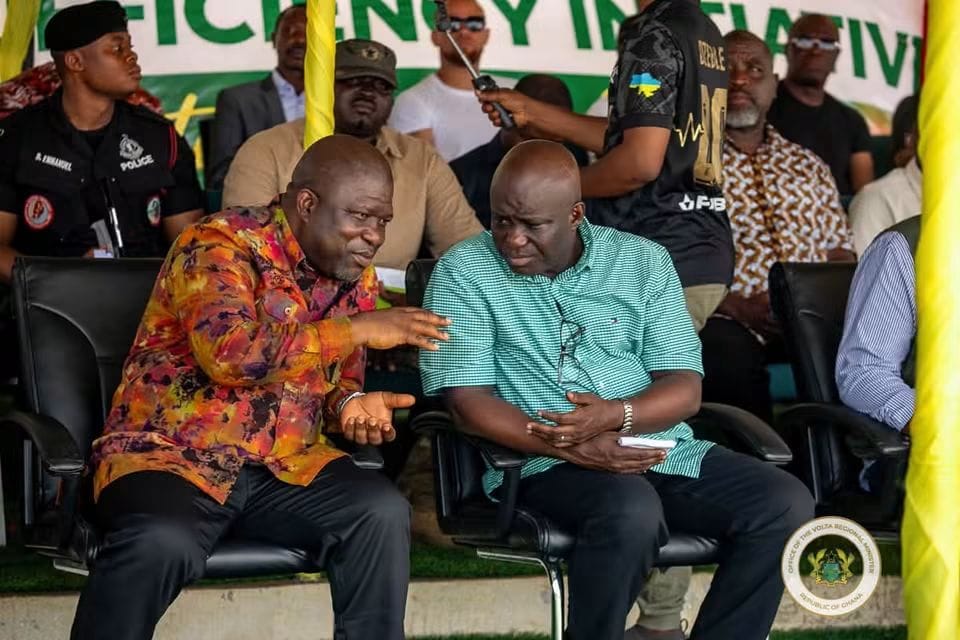
Volta Regional Minister, James Gunu, says the Volta Region holds enormous agricultural potential and efforts must be geared towards connecting farmers to the needed resources to unlock that potential.
He said focus must be on linking farmers to resources, technology, financing and markets to increase production, create jobs and build sustainable livelihoods.
Hon. Gunu made the remarks at the national launch of the Ghana Tomato Self-Sufficiency Initiative (GHATSI) held at Anloga in the Volta Region on Tuesday, September 15.
The initiative, under the theme “Produce at Home. Feed the Nation. Export the Surplus,” seeks to boost local tomato production, processing and marketing while reducing Ghana’s heavy reliance on imported tomatoes.
The launch was attended by the Minister for Food and Agriculture, Eric Opoku, his Deputy, John Setor Dumelo, Feed Ghana Coordinator, Bright Demordzi, Members of Parliament, traditional leaders, MMDCEs, farmers and other stakeholders.
Mr.Gunu expressed appreciation to the Minister for Food and Agriculture for the support announced for the region, including two excavators, 200 cartons of organic fertiliser, and GH¢200,000 for Ms. Kuatudzo Esther Dela, a tomato farmer and processor from Ziope.
He described the initiative as an important step towards making agriculture a stronger driver of food security, job creation and economic growth in the Volta Region.
By Edem Mensah-Tsotorme