News
‘Africa Must Not Surrender Its Humanity to Machines in the Name of Progress’

- /home/u249204778/domains/spectator.com.gh/public_html/wp-content/plugins/mvp-social-buttons/mvp-social-buttons.php on line 27
https://spectator.com.gh/wp-content/uploads/2025/11/Participant-pose-for-the-camera.jpg&description=‘Africa Must Not Surrender Its Humanity to Machines in the Name of Progress’', 'pinterestShare', 'width=750,height=350'); return false;" title="Pin This Post">
- Share
- Tweet /home/u249204778/domains/spectator.com.gh/public_html/wp-content/plugins/mvp-social-buttons/mvp-social-buttons.php on line 72
https://spectator.com.gh/wp-content/uploads/2025/11/Participant-pose-for-the-camera.jpg&description=‘Africa Must Not Surrender Its Humanity to Machines in the Name of Progress’', 'pinterestShare', 'width=750,height=350'); return false;" title="Pin This Post">
A Ghanaian Artificial Intelligence (AI) expert has issued a stark warning as the world rushes to embrace algorithmic governance: “Africa must not surrender its humanity to machines in the name of progress.”
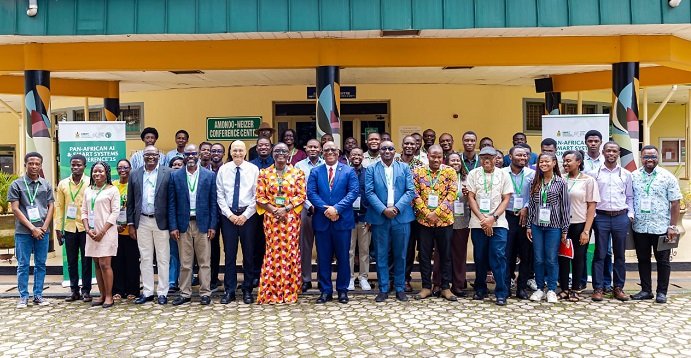
Prof. Jerry John Kponyo, Co-Chair of the fourth Pan-African Artificial Intelligence and Smart Systems (PA-AISS) Conference and Scientific Director of the Responsible Artificial Intelligence Lab (RAIL), delivered the caution on Wednesday at the IDL Conference Centre, KNUST. The event brought together scholars, technologists, and policymakers from across the globe for the continent’s premier AI summit.
His call comes as nations worldwide race to appoint AI systems to cabinet positions and hand over critical governance decisions to algorithms—a trend Prof. Kponyo views with deep concern.
“AI should enable us to be better, not take over from us,” he declared before a packed auditorium, describing the global trend as a dangerous experiment fraught with ethical perils that demand urgent safeguards.
Prof. Kponyo noted that many countries are taking bold steps to integrate AI into public governance and key economic sectors, with some even appointing agentic AI systems as cabinet ministers.
“AI and smart systems offer tremendous potential in transforming the world, but we must ensure there are guardrails in their use so they do not pose an existential threat to humanity,” he cautioned.
“It is my strongest opinion that AI and emerging technologies should always enable humans to be better at what we do and not take over from us. There must always be human oversight in the deployment of emerging technologies, with safeguards to pull the plug should an agentic AI go rogue,” he emphasised.
The three-day conference (October 15-17) comes at a critical juncture, with Africa at a crossroads: to become a pioneer of responsible, home-grown AI solutions or remain perpetual consumers of foreign technologies designed without African realities in mind.
Prof. Kponyo highlighted KNUST’s leadership under Vice-Chancellor Prof. (Mrs) Rita Akosua Dickson, noting that the university has become a continental hub for responsible AI—championing ethical innovation rooted in community impact and aligned with Sustainable Development Goal 17 on global partnerships.
Drawing on insights from the recent AI for Africa Conference in Cape Town, he spotlighted the continent’s greatest asset: “Africa’s median age of 19 makes it the world’s youngest and most dynamic population—a demographic dividend that positions the continent for technological leadership.”
But that advantage, he warned, could be squandered without urgent investment in capacity building across AI, Quantum Computing, Internet of Things (IoT), and Blockchain technologies.
In a passionate appeal, Prof. Kponyo urged African intellectuals abroad to return home and help build the continent’s technological capacity.
“With the current geopolitics and hostile environment for academics abroad, it is time to come home so we build together,” he said, assuring diaspora scholars that KNUST remains a welcoming hub for innovation and growth.
Vice-Chancellor Prof. Rita Akosua Dickson affirmed the university’s commitment to AI transformation, declaring that KNUST is ready to leverage AI across teaching, learning, research, and innovation.
“AI has come to stay,” Prof. Dickson stated, emphasising that students are being prepared to harness the technology responsibly as the institution positions itself at the forefront of Africa’s technological future.
The conference, organised by the RAIL team led by Dr Justice Owusu Agyemang, brought together experts to explore frameworks ensuring AI serves humanity rather than replacing it.
From Kingsley E. Hope, Kumasi
Join our WhatsApp Channel now!
https://whatsapp.com/channel/0029VbBElzjInlqHhl1aTU27







The Office of the Special Prosecutor (OSP) has taken note of public allegations of extortion and related conduct made against the Minority Leader of Parliament, Alexander Afenyo-Markin.
The allegations were made by the Chief Executive of the Ghana Gold Board (GoldBod), Sammy Gyamfi.
In a brief statement, the OSP said it has also received a joint petition submitted by two persons, as well as two separate petitions from other persons, in relation to the same allegations.
“Given the nature of the allegations, the OSP will assess the case and determine whether it falls within its statutory mandate and whether further investigative action is warranted,” the statement said.
The development comes amid a heated public feud between the Minority in Parliament and the leadership of GoldBod over the operations of the Domestic Gold Purchase Programme.
The Minority, led by Afenyo-Markin, has accused GoldBod and the Bank of Ghana of causing a loss of over $1.7 billion, citing the International Monetary Fund’s August 2026 report. The Minority has vowed to pursue the matter as Parliament has reconvened for an emergency sitting.
GoldBod, on the other hand, has rejected claims by some NPP MPs, including Tano South MP Dr Gideon Boako, that it owes the Bank of Ghana GH¢1 billion in overdrafts, describing the claim as “false and malicious.”
In the latest twist, GoldBod CEO Sammy Gyamfi has accused the Minority Leader of extortion and related conduct, an allegation that has triggered petitions to the OSP.
The OSP is mandated under Act 959 to investigate and prosecute specific cases of alleged or suspected corruption and corruption-related offences involving public officers and politically exposed persons.
By Edem Mensah-Tsotorme

General Secretary of the New Patriotic Party (NPP), Justin Kodua Frimpong, has filed his nomination to contest the position of General Secretary again as the party begins its rebuilding efforts ahead of the 2028 general elections.
He was accompanied by party stalwarts and supporters who were in high spirits, expressing confidence that he is the right person to hold the position.
Speaking after filing his nomination, Mr Kodua Frimpong assured the rank and file of the party that he would not disappoint them.
“I can assure you that the faith the rank and file of the party have had in me, I will never disappoint them,” he said.
He also pledged to run a clean campaign devoid of personal attacks.
“I can assure you that our internal campaign will be devoid of personal attacks,” he told his fellow contestants and the rank and file of the party as he seeks to retain his position.
His tenure has seen the party through the 2024 general elections, where the NPP lost power to the National Democratic Congress (NDC) after eight years in government.
The party is currently in a rebuilding phase, with internal elections scheduled to elect new national executives to lead its reorganization towards the 2028 polls.
The General Secretary position is considered one of the most influential in the party’s administrative structure, responsible for the day-to-day running of the party secretariat and implementation of party decisions.
By Edem Mensah-Tsotorme