Features
Environmental stewardship is an act of worship: The Islamic response to climate change, environmental degradation (Part 5)

- /home/u249204778/domains/spectator.com.gh/public_html/wp-content/plugins/mvp-social-buttons/mvp-social-buttons.php on line 27
Warning: Trying to access array offset on false in /home/u249204778/domains/spectator.com.gh/public_html/wp-content/plugins/mvp-social-buttons/mvp-social-buttons.php on line 27
&description=Environmental stewardship is an act of worship: The Islamic response to climate change, environmental degradation (Part 5)', 'pinterestShare', 'width=750,height=350'); return false;" title="Pin This Post">
- Share
- Tweet /home/u249204778/domains/spectator.com.gh/public_html/wp-content/plugins/mvp-social-buttons/mvp-social-buttons.php on line 72
Warning: Trying to access array offset on false in /home/u249204778/domains/spectator.com.gh/public_html/wp-content/plugins/mvp-social-buttons/mvp-social-buttons.php on line 72
&description=Environmental stewardship is an act of worship: The Islamic response to climate change, environmental degradation (Part 5)', 'pinterestShare', 'width=750,height=350'); return false;" title="Pin This Post">
Waste management and public cleanliness
Closely connected to water conservation is the Islamic emphasis on cleanliness. The Prophet Muhammad (peace be upon him) taught that “Purity is half of faith” (Sahih Muslim, Hadith 223). Although this Hadith primarily refers to personal and spiritual cleanliness, its broader implications extend to the cleanliness of homes, neighbourhoods, markets, roads, and public spaces. A clean environment reflects both personal discipline and collective responsibility.
Unfortunately, indiscriminate disposal of refuse remains a significant challenge in many communities. Plastic waste clogs drainage systems, contributes to flooding during the rainy season, pollutes rivers and beaches, and threatens marine ecosystems. Open burning of waste further degrades air quality and poses serious health risks, particularly for children and the elderly (UNEP, 2024).
Islam calls believers to eliminate harm wherever it exists. The Prophet Muhammad (peace be upon him) said, “Removing harmful things from the road is an act of charity” (Sahih al-Bukhari, Hadith 2989; Sahih Muslim, Hadith 1009). This teaching encourages Muslims to view environmental cleanliness as an act of service to society. Proper waste disposal, recycling, community clean-up campaigns, and responsible sanitation practices are therefore practical expressions of Islamic charity and civic responsibility. Mosques can play an exemplary role by maintaining clean premises, minimising plastic waste during religious programmes, promoting reusable materials where practical, and educating congregants on environmental sanitation. Such initiatives demonstrate that environmental ethics are inseparable from Islamic values.
Sustainable development and the ethics of moderation
The modern concept of sustainable development seeks to meet present needs without compromising the ability of future generations to meet their own needs (World Commission on Environment and Development, 1987). Although this terminology is contemporary, its underlying principles have long been embedded in Islamic teachings.
The Qur’an consistently promotes moderation and warns against excess. Allah commands, “Eat and drink, but be not excessive. Indeed, He likes not those who commit excess” (Qur’an 7:31, Sahih International). Extravagance, wastefulness, and irresponsible consumption contribute significantly to environmental degradation by accelerating resource depletion, increasing pollution, and generating unnecessary waste. Islam, therefore, encourages a lifestyle characterised
by moderation (wasatiyyah), gratitude, and responsible consumption.
Similarly, the Qur’an describes the universe as having been created in perfect balance and instructs humanity not to disturb that balance (Qur’an 55:7–9). Sustainable development, viewed through an Islamic lens, is not solely about economic growth; it is about ensuring that economic progress, social wellbeing, and environmental protection advance together in harmony. Development that
enriches one generation while impoverishing the next contradicts the ethical principles of justice and stewardship emphasised throughout the Qur’an.
For Ghana, sustainable development requires integrating environmental protection into national planning, mining, agriculture, infrastructure development, and industrialisation. It also demands greater investment in renewable energy, climate-resilient agriculture, responsible land management, afforestation, and environmental education. These initiatives are consistent not only with international commitments such as the United Nations Sustainable Development Goals (particularly Goals 6, 12, 13, and 15) but also with the Islamic principles of stewardship, justice, moderation, and public welfare.
Ultimately, water conservation, responsible waste management, and sustainable development are not separate environmental agendas; they are practical manifestations of humanity’s role as Khalifah. Every drop of water conserved, every piece of waste properly managed, every tree planted, and every effort to promote sustainable living reflects obedience to Allah and contributes to the preservation of His creation. In this way, ordinary environmental actions become
extraordinary acts of worship, demonstrating that faith is expressed not only through ritual devotion but also through responsible care for the world that Allah has entrusted to humankind.
Aligning Islamic environmental ethics with the sustainable development goals
The environmental values espoused by Islam closely align with the United Nations Sustainable Development Goals (SDGs), demonstrating that Islamic principles continue to provide practical guidance for addressing contemporary global challenges. While the SDGs were adopted in 2015 as an international framework for sustainable development, many of their underlying values have been embedded in Islamic teachings for over 14 centuries.
For example, the Islamic emphasis on protecting water resources directly supports Sustainable Development Goal 6 (Clean Water and Sanitation), which seeks to ensure the availability and sustainable management of water for all. Likewise, the Qur’anic prohibition against wastefulness and extravagance complements SDG 12 (Responsible Consumption and Production) by encouraging moderation, efficient resource use, and environmental responsibility.
Islam’s call to preserve ecological balance and prevent corruption on earth resonates strongly with SDG 13 (Climate Action), which urges coordinated efforts to combat climate change and build resilience against its impacts. Similarly, the obligation to protect forests, wildlife and biodiversity reflects the aspirations of SDG 15 (Life on Land), which promotes the conservation, restoration and sustainable use of terrestrial ecosystems.
This convergence illustrates that environmental stewardship is both a religious obligation and a global development priority. Muslims therefore have an opportunity to contribute meaningfully to national and international sustainability efforts while remaining faithful to the ethical teachings of the Qur’an and the Sunnah. Protecting Allah’s creation simultaneously fulfils the objectives of
Islamic law and advances the broader pursuit of sustainable and inclusive development.
The author is Chief Imam of Katamanso Municipal and Certified Counsellor and Governnace Expert.
SKIP THE QUEUE, TAP THE NEWS
You can now read the Ghanaian Times and The Spectator newspapers from the comfort of your device via TimesNewsPlus.
Join our WhatsApp Channel: https://whatsapp.com/channel/0029VbBElzjInlqHhl1aTU27

The driver stopped the vehicle at the gate of the big fenced property along the Nsawam Highway, and Kakraba stepped out to meet the several workers who had gathered to wait for him. He greeted them and went to straight to the point.
‘Gentlemen, I am glad to see that you have almost completed the clearing of the land. I’m happy to report that we have concluded all arrangements with Nana Serebour, and construction of the palace will start in a few days.
I will need you to go and level the ground, and come back to start this project. Some workers from a construction company will come and join us to start the project. My plan is to build twenty houses in four months, then we will do twenty more until we reach two hundred.
I am relying on you to help me deliver good quality work to satisfy our clients, and as I have already indicated to you, I will reward you for your work’. After an hour’s discussion, he closed the meeting and moved to drive away. Wofa Yaw drew closer.
‘Director, can you please spare me five minutes? I would like to discuss a small issue’. ‘Why Wofa Yaw, your wife has threatened to leave you?’ ‘No, Director’. My wife will never leave me. This concerns a young niece of mine’.
‘I hope it’s something I can help with. Please sit in the car and let me hear you’. ‘Boss, my niece Beesiwa is a polytechnic graduate, very beautiful and with very good character.
Unfortunately, her parents virtually forced her into a relationship with an idiot based in the US, which impacted her badly. She has now recovered from that experience, and boss, I am respectfully asking if you would find a job for her.
I promise you that you will never regret it’. ‘Well, Wofa Yaw, let me meet her and speak with her. I may be able to help, maybe not in the way you will expect, but let me meet her. I will not be back here till after a week, but I will be at the office the whole of next week. You can come with her’.
‘On Monday morning, Wofa Yaw and Beesiwa were seated at the office by nine. Three young ladies welcomed them warmly, offered them soft drinks, and assured them that Kakraba would be there shortly, and got seated behind computers with large screens showing various building designs. Kakraba walked in and greeted them warmly, and after chatting with the three ladies, he ushered Wofa Yaw to his office’. ‘Director, this is my niece, Beesiwa. I mentioned her to you when you came to Nsawam’. ‘Yes indeed. Madam Beesiwa, you are very beautiful, as your uncle said. Wofa Yaw is my colleague.
We have just started a building project that will take about three to four years. He mentioned that you have a very small problem, so I said I would like to meet you, and see how I can help. So Beesiwa, please tell me a little about yourself’.
Beesiwa described her childhood, her school experience, her brief work at the bank, and the nasty episode with Sammy Abrokwa which shattered her peaceful life, and how she had been recovering’.
‘I am really sorry to hear this. Now, here is what we are going to do. We are a small but very busy company. The three ladies over there spend most of the day on site, and come back to report on their work in the morning.
I have three main projects. The big one is an estate project in Nsawam, where your uncle is one of my main colleagues. I need a personal assistant who can take care of my activities, especially when I am not in town.
Now, we will have to start with trust. Based on what I know about Wofa Yaw, and based on what you yourself have told me, I think we can start on a sound basis. So, Wofa Yaw will take you to my home. You can move into one of the four guest rooms. I will give you a good phone and a laptop. I will arrange computer lessons for you’. ‘Sir, I have taken some computer lessons, and I have even done graphics and web design’. ‘Fantastic! Now, Wofa Yaw, take her home. My sister Kuukuwa will meet you and show you round, and you can return to Koforidua. When would you like to start work?’ ‘Sir, I would like to start today, but I would need to go and bring my things’. ‘No problem. Take a taxi to my house, meet my sister, and let me know what you decide’.
Kakraba and the three ladies met with some bank officials to conclude on the sale of the three buildings at Adabraka.
They closed at five-thirty, and after rewarding the ladies for their hard work, he got home just after dark. He was surprised to find Kuukuwa and Beesiwa sitting at table enjoying supper. ‘What’s happening here?’ her said. ‘Beesiwa, I thought you would return to Koforidua?’ ‘She changed her mind’, Kuukuwa said. ‘We went to the Mall and bought a few things for her, and we came back to cook. She has made some nice changes to your bedroom. And she cooked a couple of interesting things. Sit down, we will serve you’.
‘Well, I certainly can’t refuse that. It’s been a busy day. So what’s the plan now? Will Beesiwa go to Koforidua tomorrow, gather her stuff together and come down? ‘No, I will stay here for a while. Kuukuwa bought me things that I need, so I may go back next week. I’m ready to start work. What would you like me to start with?’
‘Well, you can come to the office tomorrow morning, meet the three girls and get a feel of what we do. Since you are living here, at least for now, we can discuss the plans for the next few weeks. Sometimes there are gaps when I travel up north. You can take care of things from now. I think the girls would like having someone like you around’.
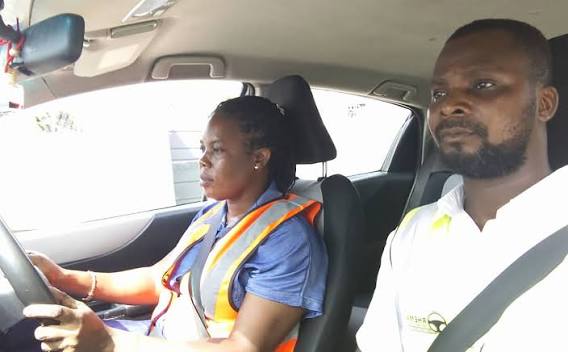
I was always very uncomfortable when I was driving without a driver’s license. Once a policeman stopped me and asked for my license. I gave him my Insurance booklet.
“I say your license.”
I searched frantically for a non-existent license and told the cop the damn license wasn’t showing up in my briefcase. Next time I’d get it for him. He opened the insurance booklet and studied it.
“Are you the writer?”
“Yes sir,” I saluted.
“Carry on.”
The Inspector would have gotten me gaoled if he hadn’t recognised me as the Sikaman Palava man. But I realised that the cop-master wouldn’t spare me a second time so I decided to go for a license.
The Vehicle Examination and Licensing Division (VELD) in Accra is a perpetual beehive of activity. You’d see trainee drivers meekly trailing their instructors, enroute to a tiny office downstairs to meet the man who looks and works like a very efficient Colonel. Mr Joseph Amamoo is the name.
You’d also be privileged to meet ‘connection men’ right at the gate. They’d stop you and politely enquire whether you want a licence. They could get you one in exactly 15 minutes whether you believe it or not.
“Or are you coming to do ownership? That one would take 10 minutes.”
“No I am only coming to see the director here.”
I drove in and was ushered in to see the Acting Director of VELD, the living legend in the person of Mr. J.M.Y. Amegashie. He is the VELD Field Marshall,
“What can I do for you?”
“I want a license.”
“Know the road signs?”
“Yes.”
“Go downstairs and see Mr Amamoo and go for the various tests.”
“Oh, I can drive,” I reminded the director.
“So go and prove it.”
Mr Amamoo was busy taking a trainee-driver through the road signs. The guy was shivering and I wondered whether he was suffering from malaria.
Apparently, he didn’t know half the signs…
“Go back and study the signs well and come back next week,” he was told. It was my turn. The guy left extremely disappointed.
“There are four things you have to do when you want to overtake a vehicle. State them!” Mr Amamoo ordered me. I also went through the drill of identifying all the road signs, and now…
“Did you bring a car?”
“Yes sir.”
Let’s go for the test.”
It was now my turn to shiver. I die finish. I should be careful I do not mistake the accelerator brake.
“You are going to drive through some parts of the capital.”
“Yes sir.” I got in and while reversing I hung my elbow stylishly on the car door.
“Get your arm off the door,” Mr Amamoo growled at me. “You must know that you are at a driving test. You are not in your sitting room.”
“No problem sir,” I said and took off the arm. I drove and got to a junction and stopped although could have gone ahead.
“It is alright for you to stop, but because of the volume of traffic these days, It is always advisable to watch before you get near a junction so that you can enter without stopping if it is clear. You don’t necessarily have to stop at every junction, so watch approach.”
We went round and round through intersections, double lanes, U-turns, whatever. Then we got to a steep slope, I was instructed to stop and then ordered to climb the slope without coming back in the least. I prided myself to being a master driver and executed the task almost effortlessly.
I then forgot and put my arm again on the “You don’t like taking instructions-eh. Take off your arm,” he barked this time.
“Sorry-o.”
When we returned, I was made to go through a process of signing my name here and there, filling one form after another. A whole lot of elaborate procedure that made me impressed with the thoroughness the system applies to the issuance of licences.
CONNECTION MEN
“Mr Amamoo, why do you allow these connection men at the gate,” I asked.
“They are the people who issue fake drivers’ licences to people,” he said. “When a driver is in possession of a driving license without going through the process you have undergone, you can be sure that the license is fake. If you go through the process, you’d have every necessary record at VELD so that in case your license is lost, we’d only have to refer to the records and issue you with a new one. The connection men hang around here and you can’t drive them away because you can’t identify them.”
“But we hear people come here to VELD officials and are given licences without taking the tests,” I said.
“Then those licences are not genuine. Look, whenever the police mount operations to check licences, they seize 15 to 20 fake licences every single day. Those licences were not issued by VELD but by the connection men. If you come to VELD for a licence, you’d certainly go through the process. If a VELD official gives you a licence without a test, it is wrong and against the law.”
Mr Amamoo showed me many fake licences, more than a thousand of them. The ‘connection men’ really must be in big business. I would have done some personal investigation on these connection men, I said to myself.
When I was issued with my licence, I saluted Mr Amamoo, got into my car and drove away, my arm on the car door.
This article was first published on October 31, 1998