News
Minority urges Parliament to pause Chief Justice vetting until court cases end

- /home/u249204778/domains/spectator.com.gh/public_html/wp-content/plugins/mvp-social-buttons/mvp-social-buttons.php on line 27
https://spectator.com.gh/wp-content/uploads/2025/11/IMG-20251112-WA0004.jpg&description=Minority urges Parliament to pause Chief Justice vetting until court cases end', 'pinterestShare', 'width=750,height=350'); return false;" title="Pin This Post">
- Share
- Tweet /home/u249204778/domains/spectator.com.gh/public_html/wp-content/plugins/mvp-social-buttons/mvp-social-buttons.php on line 72
https://spectator.com.gh/wp-content/uploads/2025/11/IMG-20251112-WA0004.jpg&description=Minority urges Parliament to pause Chief Justice vetting until court cases end', 'pinterestShare', 'width=750,height=350'); return false;" title="Pin This Post">
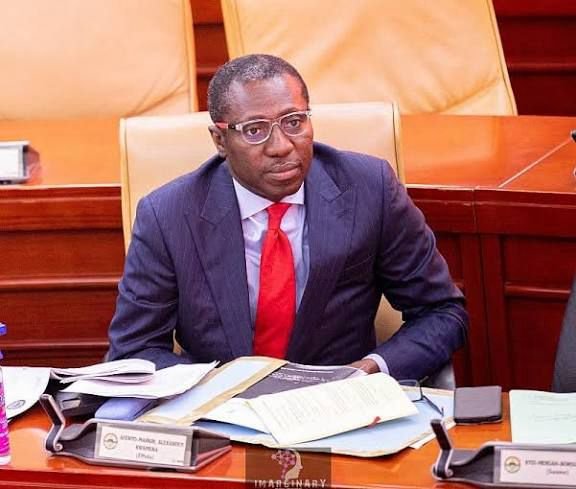
The Minority in Parliament has called on the House to suspend the vetting of Justice Paul Baffoe-Bonnie as Chief Justice until all court cases challenging the removal of Justice Gertrude Torkornoo are concluded.
Minority Leader Alexander Afenyo-Markin urged Parliament to use its discretion under Order 5 of the Standing Orders to pause the vetting process, stressing that doing so would protect the integrity of the Constitution and prevent a possible crisis.
He explained that the Supreme Court, High Court, and ECOWAS Court were already handling several cases concerning the legality of Justice Torkornoo’s removal and that the courts could fast-track these cases if the State cooperated instead of delaying proceedings.
According to him, the Judiciary is not without leadership since Justice Baffoe-Bonnie continues to act as Chief Justice under Article 144(6) of the Constitution.
He argued that there would be no crisis if Parliament waited for the courts to finish their work, but a real crisis could occur if a new Chief Justice is confirmed and the courts later overturn the removal, leading to two people claiming the same office.
Mr. Afenyo-Markin said the President’s power to nominate a Chief Justice under Article 144(1) was not in question.
However, he stressed that Parliament’s power to approve nominees must be exercised with respect for the separation of powers, judicial independence, and the sub judice rule, which prevents actions that may influence ongoing court cases.
He warned against misinterpreting the recent Supreme Court ruling in Vincent Assafuah v Attorney-General as permission for Parliament to proceed.
He explained that the Court only refused to issue a temporary injunction on procedural grounds and did not rule that the removal of Justice Torkornoo was lawful.
The Minority Leader said the Assafuah ruling applied the Moffat principle, which discourages courts from stopping government work because of frivolous suits.
However, he noted that the decision was not meant to encourage constitutional bodies to act without caution while serious cases were still pending.
He stated that the Supreme Court’s reasoning balanced the need to maintain judicial integrity with ensuring that constitutional duties continue smoothly.
The ruling, he added, was never meant as a go-ahead for Parliament to act hastily.
Mr. Afenyo-Markin explained that the Court’s decision not to compel Parliament to stop its work was out of respect for the separation of powers, not because it believed Parliament should disregard the courts.
He clarified that the Minority’s appeal was not for the Judiciary to control Parliament but for Parliament to exercise its own constitutional conscience by choosing to wait until the courts deliver their judgments.
He added that the Supreme Court assumed that constitutional bodies like Parliament would act wisely and in good faith, not mechanically, when performing their duties.
Mr. Afenyo-Markin also referred to Article 64(2) of the Constitution, which allows certain presidential acts to stand even after a court invalidates an election to prevent chaos.
He cautioned, however, that this provision was never meant to encourage recklessness or to create irreversible constitutional problems.
He warned that if Parliament confirms Justice Baffoe-Bonnie while the courts are still handling challenges to Justice Torkornoo’s removal, Ghana could face a constitutional crisis involving two claimants to the office of Chief Justice.
He argued that such a development would damage the reputation of Parliament and undermine public confidence in the country’s democratic institutions.
The Minority Leader maintained that waiting for the courts to conclude the cases would demonstrate Parliament’s maturity, fairness, and commitment to constitutional principles.
He said taking a short pause would protect the rule of law and show that Parliament values legality over haste and principle over politics.
“The prudent path, the constitutional path, is to wait,” he emphasized.
By: Jacob Aggrey







The Office of the Special Prosecutor (OSP) has taken note of public allegations of extortion and related conduct made against the Minority Leader of Parliament, Alexander Afenyo-Markin.
The allegations were made by the Chief Executive of the Ghana Gold Board (GoldBod), Sammy Gyamfi.
In a brief statement, the OSP said it has also received a joint petition submitted by two persons, as well as two separate petitions from other persons, in relation to the same allegations.
“Given the nature of the allegations, the OSP will assess the case and determine whether it falls within its statutory mandate and whether further investigative action is warranted,” the statement said.
The development comes amid a heated public feud between the Minority in Parliament and the leadership of GoldBod over the operations of the Domestic Gold Purchase Programme.
The Minority, led by Afenyo-Markin, has accused GoldBod and the Bank of Ghana of causing a loss of over $1.7 billion, citing the International Monetary Fund’s August 2026 report. The Minority has vowed to pursue the matter as Parliament has reconvened for an emergency sitting.
GoldBod, on the other hand, has rejected claims by some NPP MPs, including Tano South MP Dr Gideon Boako, that it owes the Bank of Ghana GH¢1 billion in overdrafts, describing the claim as “false and malicious.”
In the latest twist, GoldBod CEO Sammy Gyamfi has accused the Minority Leader of extortion and related conduct, an allegation that has triggered petitions to the OSP.
The OSP is mandated under Act 959 to investigate and prosecute specific cases of alleged or suspected corruption and corruption-related offences involving public officers and politically exposed persons.
By Edem Mensah-Tsotorme

General Secretary of the New Patriotic Party (NPP), Justin Kodua Frimpong, has filed his nomination to contest the position of General Secretary again as the party begins its rebuilding efforts ahead of the 2028 general elections.
He was accompanied by party stalwarts and supporters who were in high spirits, expressing confidence that he is the right person to hold the position.
Speaking after filing his nomination, Mr Kodua Frimpong assured the rank and file of the party that he would not disappoint them.
“I can assure you that the faith the rank and file of the party have had in me, I will never disappoint them,” he said.
He also pledged to run a clean campaign devoid of personal attacks.
“I can assure you that our internal campaign will be devoid of personal attacks,” he told his fellow contestants and the rank and file of the party as he seeks to retain his position.
His tenure has seen the party through the 2024 general elections, where the NPP lost power to the National Democratic Congress (NDC) after eight years in government.
The party is currently in a rebuilding phase, with internal elections scheduled to elect new national executives to lead its reorganization towards the 2028 polls.
The General Secretary position is considered one of the most influential in the party’s administrative structure, responsible for the day-to-day running of the party secretariat and implementation of party decisions.
By Edem Mensah-Tsotorme