News
To thine own self be true- Let the law work

On the evening of Tuesday, March 25, 2025, social media reports indicated that His Excellency, the President of the Republic of Ghana, had forwarded three petitions for the removal of the Chief Justice to the Council of State. This step is a constitutional requirement under Article 146(6) of the 1992 Constitution, which states:
1.“Where the petition is for the removal of the Chief Justice, the President shall, acting in consultation with the Council of State, appoint a committee consisting of two Justices of the Supreme Court, one of whom shall be appointed Chairman by the President, and three other persons who are not members of the Council of State, nor members of Parliament, nor lawyers.”
2.Two days later, at 9:20 AM on Thursday, March 27, 2025, the Hon. Vincent Ekow Assafuah of Old Tafo, in Kumasi filed an action at the Supreme Court challenging the President’s referral of the petitions to the Council of State.
3.Mr. Assafuah argues that the President is required, under Articles 146(1), (2), (4), (6) and (7), 23, 57(3), and 296 of the Constitution, to:
“…notify the Chief Justice about a petition for her removal and obtain her comments and responses before referring the petition to the Council of State or commencing consultation with the Council of State.”
4.This claim raises a number of intriguing questions:
i. How did Mr. Assafuah, within just one day, ascertain that the Chief Justice was not consulted before the petitions were referred to the Council of State?
ii. Did the Chief Justice personally inform him that she was not consulted?
iii. Was there any media report confirming that the Chief Justice had been bypassed in the process?
5.And Godfred Dame as his lawyer? As the musician Joseph of Culture says, “this is neither a jigsaw nor a puzzle.” Things are falling into place. We either survive together or perish together.
6. That aside, only Article 146(6) is relevant in determining whether the President was required to seek the Chief Justice’s comments before consulting the Council of State.
7.Article 146(6), in clear and unambiguous terms, states that when a petition concerns the removal of the Chief Justice, the President must act in consultation with the Council of State.
8.In Agyei Twum v. Attorney General & Akwetey, Justice Date-Bah, speaking for the Supreme Court, held that just like other Justices of the Superior Courts, a prima facie case must first be established against the Chief Justice before a committee is empaneled to investigate the petition.
9. However, the Agyei Twum case did not specify how the prima facie determination should be made. What is certain, however, is that the President must act in consultation with the Council of State. The President’s decision to refer the petitions to the Council of State is, therefore, in strict compliance with the Constitution.
10. The following questions expose the suit for what it is—Much Ado About Nothing:
i. If the Constitution explicitly states that “where the petition is for the removal of the Chief Justice, the President shall act in consultation with the Council of State”, is it unconstitutional for the President to refer the petitions to the Council of State?
ii. Isn’t the referral the first logical step in discussing the prima facie determination and the procedure for it?
iii. Should the President unilaterally decide on the petitions without engaging the Council of State, as mandated?
iv. Does referring the petitions to the Council of State amount to a prima facie determination without giving the Chief Justice a hearing?
v. Does this referral prevent the Chief Justice from later providing her comments on the petitions?
11. In the first petition, the former President’s response suggested that the Council of State had been consulted before the determination that no prima facie case had been made against the Chief Justice.
12. Yet, the President’s letter to Prof. Azar does not indicate that the Chief Justice was asked for her comments before that determination was made.
13. The Chief Justice believes in the law. There is no need for presumptive protection. Every Ghanaian believes in the law.
14. The law requires that the President act in consultation with the Council of State. That consultation is currently ongoing. Let the process unfold. The Council of State has its own esteemed legal minds—trust them as much as you have always asked us to trust you.
15. To Proxy Assafuah, let me offer a lesson from the Acts of the Apostles. In Acts 5, Peter and his fellow apostles faced intimidation aimed at silencing their mission. Yet, despite the threats, they persisted in preaching the gospel without seeking legal recourse.
16. When they were eventually arrested and brought before the High Priest, Gamaliel, a respected Pharisee, offered wise counsel:
17. He reminded his colleagues of Theudas and Judas, two men who falsely claimed divine backing but ultimately perished. Gamaliel then gave this timeless advice in Acts 5:38-39:
“…Refrain from these men, and let them alone: for if this counsel or this work be of men, it will come to nought: But if it be of God, ye cannot overthrow it; lest haply ye be found even to fight against God.”
18. So be it, Hon. Mr. Proxy! leave the petitioners alone for if their counsel or work be of men, their petitions will come to nought, but if it be of God, and their cause is just, no court action can overthrow it.
By Thaddeus Sory








Ahyiresu and Abofrem, two quiet communities in the Atwima Mponua District, have been shaken to the core by a chilling midnight drama that reads like a nightmare.
A pastor and a young mother stand accused of attempting to bury a five‑month‑old baby girl alive, a crime that has ignited outrage and disbelief across the township.
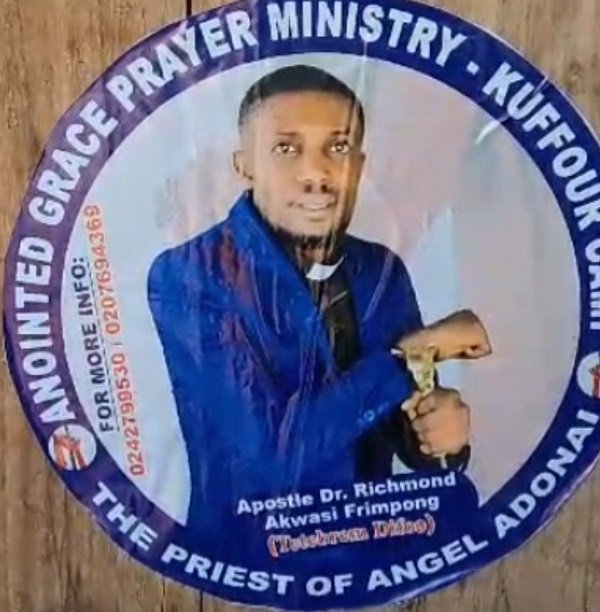
According to police, Apostle Richmond Akwasi Frimpong, 36, Head Pastor of the Anointed Grace Prayer Ministry at Kuffour Camp, conspired with his uncle Emmanuel Appiah, 53, and the child’s mother, 23‑year‑old Beatrice Agyapomaa, to dispose of the infant, Anaya Achiaa, under the cover of darkness.
A fourth suspect, Emmanuel Donkor, remains on the run.
The suspects were caught near a refuse dump around 10 pm on April 9, 2026, after a vigilant resident, Akwasi Twezor, noticed their suspicious movements.
When confronted, they claimed the child was already dead and had palace approval for burial. But Twezor’s instincts proved right—the baby was still alive, gasping faintly for breath.
Chief Linguist, Nana Yaw Badu, later confirmed that Frimpong had misled him earlier in the evening, securing permission for burial by falsely declaring the child dead.
The infant was rushed to the Abofrem Clinic, where she is now responding well to treatment. Police described her as “very beautiful.”
Assistant Superintendent of Police (ASP) Evelyn Yitamkey, Commander of DOVVSU in Bibiani, confirmed that the suspects have been provisionally charged.
Frimpong faces attempted murder and conspiracy charges, while Agyapomaa and Appiah are charged with conspiracy and abetment.
They were remanded by the Bibiani Circuit Court, presided over by Judge Frank Asiedu Nimako, to assist investigations.
The docket has been forwarded to the Attorney General’s Department for advice, ASP Yitamkey indicated.
The attempted crime has provoked fury among residents, many suspecting ritual motives aimed at bolstering the pastor’s influence.
Crowds attempted to attack the suspects outside court, but police intervention prevented mob justice.
The Assembly Member for Ahyiresu, Yusuf Suleiman, has assured residents that justice will be pursued swiftly.
From Kingsley E. Hope, Kumasi

The forecourt of the African University of Communications and Business (AUCB) in Accra came alive on Friday with colour, creativity and innovation, as Level 300 students transformed the space into a lively exhibition of ideas.
Under the theme “Building meaningful brands beyond the logo,” the students invited patrons into a world where ordinary products were reimagined through storytelling, design and purpose.




From scented candles to innovative food concepts, each stand told a unique story, one that went beyond aesthetics to capture identity, value and human connection.



For many of the students, the event was more than just an academic exercise; it was a moment to dream out loud.
Guided by their lecturer, Peter Wonders, they explored what it truly means to build a brand in today’s competitive world where trust, consistency and experience matter just as much as logos and slogans.
Chairman of the occasion, Nana Kum Gyata VI, in his remarks said a brand is what people say about you when you are not present.
At the end of the presentations, awards were presented to deserving groups with Vida Nyaneba emerging as the overall best branding student.
By Esinam Jemima Kuatsinu
Follow our WhatsApp Channel now! https://whatsapp.com/channel/0029VbAjG7g3gvWajUAEX12Q