Hot!
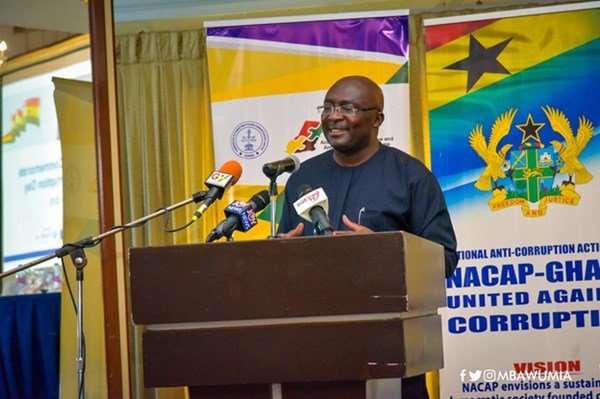
Bawumia: We’ve digitalised corruption fight

- /home/u249204778/domains/spectator.com.gh/public_html/wp-content/plugins/mvp-social-buttons/mvp-social-buttons.php on line 27
https://spectator.com.gh/wp-content/uploads/2022/12/bawumia-corrupt.jpg&description=Bawumia: We’ve digitalised corruption fight', 'pinterestShare', 'width=750,height=350'); return false;" title="Pin This Post">
- Share
- Tweet /home/u249204778/domains/spectator.com.gh/public_html/wp-content/plugins/mvp-social-buttons/mvp-social-buttons.php on line 72
https://spectator.com.gh/wp-content/uploads/2022/12/bawumia-corrupt.jpg&description=Bawumia: We’ve digitalised corruption fight', 'pinterestShare', 'width=750,height=350'); return false;" title="Pin This Post">
The Akufo-Addo government remains very committed to the fight against corruption and will continue to provide the necessary support and logistics to the crime prevention, detection and prosecution agencies,
The Akufo-Addo government remains very committed to the fight against corruption and will continue to provide the necessary support and logistics to the crime prevention, detection and prosecution agencies, Vice President Bawumia has assured.
Speaking at the 2nd Annual District Auditors’ Conference on Monday, 12 December 2022, Dr Bawumia said since assuming office in 2017, the Akufo-Addo government has made a sustained and aggressive push in the fight against corruption by enacting laws, tightening existing ones, and introducing greater digitalisation in governance and the use of public funds while increasing resources allocated to the fight.
“On assuming office, corruption was prevalent in many areas such as the DVLA, where one had to pay a bribe to ‘goro boys’ in order to get a driver’s licence; same thing at the Passport Office; Customs and other officers were having a field day at the ports; it was difficult renewing ones NHIS, and for some reason, dockets kept getting ‘missing’ at the courts”.
“There was inadequate funding for anti-corruption agencies; the Right to Information Law had not been passed; there was no legal backing for a beneficial assets register and no law on Witness Protection”.
“But since 2017, we have taken a number of far-reaching steps in the fight against corruption, including the implementation of a digitisation agenda to disrupt corruption in the public sector”.
“We have also passed a number of key laws, including the Witness Protection Act, 2018 (Act 959), the Office of the Special Prosecutor Act, 2018 (Act 959), the Right to Information (RTI) Act, 2019 (Act 989), and the Companies Act, 2019, (Act 992). Which provides a framework for enacting a beneficial ownership register,” Dr Bawumia explained.
“To further boost the fight against corruption, deficits in logistics and personnel of law enforcement agencies, especially the Ghana Police Service, and other accountability institutions, are being addressed,” he emphasised.
“For instance, since 2017, Government has increased budgetary allocations to all the accountability institutions of State, including the Parliament of Ghana, the Judiciary, CHRAJ, EOCO, the Office of the Attorney-General and Ministry of Justice, the Auditor General, the Office of the Special Prosecutor and the Ghana Police Service,” Dr Bawumia stated in Accra.
While commending the Auditor General, Mr Johnson Akuamoah Asiedu, the Board of the Audit Service and staff of the Service for the “very good work being done”, Vice President Bawumia reminded the District Auditors and their colleagues across the country that when corrupt activities such as financial improprieties such as misappropriation of funds, payroll fraud, and contract and procurement irregularities take place, the expectation of the taxpayers is that the public officials who commit these financial crimes would be sanctioned according to law.
“One of the functions of the Auditor-General which can combat these financial malpractices is disallowance of any item of expenditure which is contrary to law and surcharge the amount of any expenditure disallowed.
“The public, and, in particular the civil society organisations, have expressed dissatisfaction that the Auditor-General has not performed this critical function effectively. I am informed that the District Auditors will use the greater part of this conference to discuss this very important topical issue of disallowance and surcharge. I expect these discussions to produce outcomes to inform the processes for disallowances and surcharges.
“Nevertheless, let me assure the Auditor-General and Members of the Audit Service Board that in the same spirit of cooperation, The government of Nana Addo Dankwa Akufo-Addo will continue to provide the necessary support to the Audit Service to ensure that it operates independently as the Constitution of the Republic of Ghana mandates.”
Source: www.classfmonline.com


General Secretary of the New Patriotic Party (NPP), Justin Kodua Frimpong, has filed his nomination to contest the position of General Secretary again as the party begins its rebuilding efforts ahead of the 2028 general elections.
He was accompanied by party stalwarts and supporters who were in high spirits, expressing confidence that he is the right person to hold the position.
Speaking after filing his nomination, Mr Kodua Frimpong assured the rank and file of the party that he would not disappoint them.
“I can assure you that the faith the rank and file of the party have had in me, I will never disappoint them,” he said.
He also pledged to run a clean campaign devoid of personal attacks.
“I can assure you that our internal campaign will be devoid of personal attacks,” he told his fellow contestants and the rank and file of the party as he seeks to retain his position.
His tenure has seen the party through the 2024 general elections, where the NPP lost power to the National Democratic Congress (NDC) after eight years in government.
The party is currently in a rebuilding phase, with internal elections scheduled to elect new national executives to lead its reorganization towards the 2028 polls.
The General Secretary position is considered one of the most influential in the party’s administrative structure, responsible for the day-to-day running of the party secretariat and implementation of party decisions.
By Edem Mensah-Tsotorme

The University of Ghana Medical Centre (UGMC) has disputed claims made on social media by comedian Michael Blackson concerning the treatment given to his late mother, saying a review found that the allegations did not accurately reflect what happened during her stay at the hospital.
In a statement issued in Accra on August 5, 2026, the management of UGMC expressed condolences to Mr. Blackson and his family over the death of his 83-year-old mother, who died at the facility on July 16, 2026.
The hospital said it had taken the concerns raised by Mr. Blackson seriously and conducted a thorough review in line with its clinical and administrative procedures.
According to the statement, the facts presented by Mr. Blackson on social media contained “numerous inaccuracies” and did not accurately reflect the medical care provided to his mother.
UGMC explained that she was referred to the facility from another hospital and received treatment there from May 27 to July 16, 2026, a period of about eight weeks.
The hospital stated that it would not release details of her diagnosis, treatment, medical records or other aspects of her care because it had a duty to protect patient confidentiality, even after death.
It said the decision was intended to respect the dignity of the deceased and the privacy of her family.
UGMC further stated that all clinical decisions at the facility are made by qualified healthcare professionals based on medical judgment, established standards of care and the best interests of the patient.
The statement added that such decisions are made in consultation with authorised family representatives where necessary and that billing and financial procedures are governed by institutional policies and are separate from clinical decision-making.
The hospital noted that it values feedback from patients and their families and considers both positive and negative comments important for improving the quality of care.
Mr. Blackson had earlier used social media to criticise the care his mother received at UGMC, prompting the hospital’s response.
By: Jacob Aggrey