Editorial
Increase in food prices: We need more sustainable measures

- /home/u249204778/domains/spectator.com.gh/public_html/wp-content/plugins/mvp-social-buttons/mvp-social-buttons.php on line 27
https://spectator.com.gh/wp-content/uploads/2022/11/Some-workers-at-the-Ministry-buying-food-stuffs-1.jpg&description=Increase in food prices: We need more sustainable measures', 'pinterestShare', 'width=750,height=350'); return false;" title="Pin This Post">
- Share
- Tweet /home/u249204778/domains/spectator.com.gh/public_html/wp-content/plugins/mvp-social-buttons/mvp-social-buttons.php on line 72
https://spectator.com.gh/wp-content/uploads/2022/11/Some-workers-at-the-Ministry-buying-food-stuffs-1.jpg&description=Increase in food prices: We need more sustainable measures', 'pinterestShare', 'width=750,height=350'); return false;" title="Pin This Post">
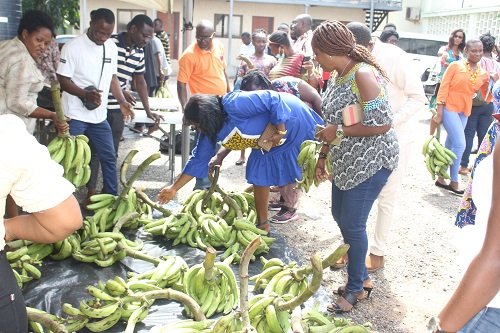
Some workers at the Ministry buying food stuffs
Dear Editor,
Permit me to express my thoughts on the Planting for Food and Jobs (PFJ) ‘market’ set up in Accra recently by the Ministry of Food and Agriculture. The ministry since last week had been selling foodstuff at prices patrons say were relatively cheaper than those on the open market.
This week, I heard other produce would be available at the Efua Sutherland Children’s Park. While some people have lauded the initiative others say food distribution or supply cannot be within the mandate of the agriculture ministry.
Others suggest that the Ministry’s direct sale of foodstuffs would create the impression that traders on the open market are responsible for the escalating food prices in the country.
Whatever be the argument, tough times call for drastic measures hence the decision by the ministry to go to the hinterlands to cart and supply goods to the general public.
While at it, I am yet to see any clear measures the ministry is putting in place to address the numerous challenges traders face in transporting food to their final destination, the capital Accra and elsewhere. Transportation cost, according to traders, had been a major determinant in the prices of goods.
Unlike the ministry, that has enough logistics to cart goods from the hinterlands, traders sometimes have to convey goods in transit for many days before arriving at their final destinations.
Many have said the Ministry’s approach to addressing the high cost of food prices in the country is not sustainable and I cannot agree less. Although this may bring some temporary relief, consumers wonder what will happen in the months and years ahead when this pilot arrangement is over.
Selling foodstuff at the Ministry without tackling the root causes of the general high cost of food prices in the country only amounts to window-dressing the issues. We cannot continue this way, citizens deserve better!
Franklin Kwabena Okyere,
Dodowa


Following the decision to reintroduce the Regional Diary, it has become necessary to provide clear editorial direction on the modalities and content focus for each edition.
To make the Regional Diary more compelling, engaging and reflective of developments in the regions, the Editorial Conference has agreed that the first edition for each region should feature an exclusive interview with the political head of the region—the Regional Minister.
To this end it is expected that the interview will be anchored on the broader government agenda of “Resetting,” with particular emphasis on the administration’s performance nearly two years into its tenure.
The interview should provide an opportunity to assess the government’s interventions in the region, while allowing the Regional Minister to articulate the administration’s successes, challenges and priorities for the years ahead.
Among other things, the interview should explore:
- Key achievements and major interventions since the administration assumed office;
- The impact of government policies and programmes on the people of the region;
- Major challenges confronting the region and how the Regional Coordinating Council is addressing them;
- The status of major development projects and initiatives; Job creation, investment and economic opportunities within the region;
- The Minister’s priorities for the remainder of the administration’s tenure; and Other pressing issues of interest to the people of the region.
Each correspondent is encouraged to approach the interviews with depth and journalistic excellence, asking direct and substantive questions that elicit specific responses and go beyond political rhetoric.
This initiative presents an important opportunity for us to strengthen the Ghanaian Times’ presence and relevance in the regions, reclaim our position as a leading national daily and deepen our relationship with regional authorities and other key stakeholders.
I am confident that, with our collective commitment and professionalism, the Regional Diary can become a distinctive and influential component of the Ghanaian Times’ coverage.
I remain available for further discussions and welcome ideas and suggestions that will help improve the initiative.
Counting on your cooperation.
Thank you.
ACTING NEWS EDITOR
SKIP THE QUEUE, TAP THE NEWS

You can now read the Ghanaian Times and The Spectator newspapers from the comfort of your device via TimesNewsPlus.
Join our WhatsApp Channel: https://whatsapp.com/channel/0029VbBElzjInlqHhl1aTU27
Dear Editor,
Going viral can make someone famous overnight, but fame alone cannot build a sustainable entertainment industry.
Ghana is blessed with talented musicians, actors, comedians, content creators and other creative professionals. Social media has also created opportunities for young people to showcase their talents to audiences beyond Ghana.
However, we must ask whether we are building lasting careers or simply celebrating the next person to trend online.
Today, a song, skit or video can become popular within hours and disappear from public attention just as quickly. This culture of virality can create the impression that numbers, followers and online attention are the only measures of success.
Our creative industry needs to go beyond that. Young creative need proper management, business knowledge, financial literacy, education and opportunities to develop their skills. They also need structures that can help them turn talent into sustainable careers.
Ghana has the talent to become a major force in Africa’s creative economy. But talent without investment, structure and professional development can easily be wasted
Let us therefore stop asking only, “Who is trending?”, and begin asking, “Who is building a lasting career?” Our creative deserves more than temporary applause, they deserve an industry capable of turning Ghanaian talent into sustainable success.
From Elijah Arkoh
Kaneshie.
SKIP THE QUEUE, TAP THE NEWS
You can now read the Ghanaian Times and The Spectator newspapers from the comfort of your device via TimesNewsPlus.
Join our WhatsApp Channel: https://whatsapp.com/channel/0029VbBElzjInlqHhl1aTU27