Hot!
Former President Kufuor explains why he took Ghana to HIPC


- /home/u249204778/domains/spectator.com.gh/public_html/wp-content/plugins/mvp-social-buttons/mvp-social-buttons.php on line 27
https://spectator.com.gh/wp-content/uploads/2022/07/Former-President-John-Agyekum-Kufuor.jpg&description=Former President Kufuor explains why he took Ghana to HIPC', 'pinterestShare', 'width=750,height=350'); return false;" title="Pin This Post">
- Share
- Tweet /home/u249204778/domains/spectator.com.gh/public_html/wp-content/plugins/mvp-social-buttons/mvp-social-buttons.php on line 72
https://spectator.com.gh/wp-content/uploads/2022/07/Former-President-John-Agyekum-Kufuor.jpg&description=Former President Kufuor explains why he took Ghana to HIPC', 'pinterestShare', 'width=750,height=350'); return false;" title="Pin This Post">
Ghana in 2001 under the presidency of John Agyekum Kufuor, was declared a Heavily Indebted Poor Country, HIPC, by the World Bank.
According to the President, creditors were not looking at Ghana because of the debt his predecessor had left behind so, there was no benefit and the macro-economy was in “shambles”.
This is because the previous government had preached a very ‘bloomsome’ picture to depict that all was well, so, Ghana was too proud to admit its indebtedness.
President Kufuor told KSM on ‘The KSM’ show that prior to winning the 2000 election, his government had promised to do a lot for Ghana to grow economically but things were different when he was sworn in on January 7, 2001.
“Through the campaign of becoming President, we had promised a lot. We talked about going to usher in the golden age of business, and what we will do to turn around the economy etc; we go in there and found empty coffers; not just empty coffers, piles and piles of loans, indebtedness. The nation was practically insolvent. Even the fuel stations had long queues of vehicles because there was no petrol to sell.
“Nigeria had blacklisted Ghana because Ghana owed them some supplies; so, they cut us off. We had to rush to Nigeria and beg the president of Nigeria, Olusegun Obasanjo. This was a state thing and I had to get my government and economy working.
“I went there to plead. At the presidency, Obasanjo had assembled his entire cabinet and asked me why I am in their country, so, I told him that I am here to plead so that you restore supplies to Ghana. The place was quiet, the President raised his head back and said, ‘well, our policy is not to continue supplying people who do not pay, so that is why we are not supplying Ghana’.
“I told him that mine was a new government and we needed to have a fresh start and I assured them that when they supply, my government will do everything with its power to pay. Then Obasanjo said, I had to give a written undertaken that when they supply Ghana I will pay. Something hit me at that point, I sensed the mood was softening a bit so I said Mr President if that is the only thing you want, then please give me pen and paper to write to you that when you supply us, we will pay. He burst into laughter; he then said he will give Ghana 30,000 barrels of crude a day for 90 days on credit…true to his word, for the entire eight-year period of my government, the suppliers came [constantly],” President Kufuor said.
He recounted an international conference in Bamako, the capital of Mali, where he had attended on an invitation and met so many dignitaries including the Director of IMF, President of the World Bank and the Secretary of State for International Development of the UK, Clair Short.
President Kufuor said, during the break, he was “cornered” by these dignitaries and somehow, they wanted to get his thoughts on so many issues especially, the policies he had come to power with because he was a new “boy” on the bloc.
He noted that it took the lady, Clair Short to tell me that “look, everybody knows the state of Ghana’s economy, if you tell the truth about the economy then you will get the help you want [because] we know that you are HIPC so, if you will avail yourself to an IMF programme, then you may get the reliefs you want.
“So, that registered with me; the IMF Director then said, if I take the step, he will work with us so, that we come out of the indebtedness. The previous regime had got us there but pride could not make us admit that we are indebted and because of that inflation was over 40%…the cedi against the dollar was high…so, it was impossible for us to move with all the plans we came to office with…
“These three people wanted me to consider that the situation was messy, so, I should own up. I came back to Ghana, assembled my team and told them that nobody want to hear HIPC so, we should find an alternative to HIPC but nothing clicked…I tasked the Finance Minister to go and inform Parliament that we have decided to go to HIPC…truly Britain was the first country to give us a relief of 50 million pounds to service our loans; other countries followed,” he stressed.
President Kufuor noted that he felt fulfilled to have attended the Mali conference which became of great help to Ghana.
He said when Ghana’s debt was cancelled, he decided to write on projects that he constructed after the ‘benefit of HIPC’ – something Ghanaians mocked him for.


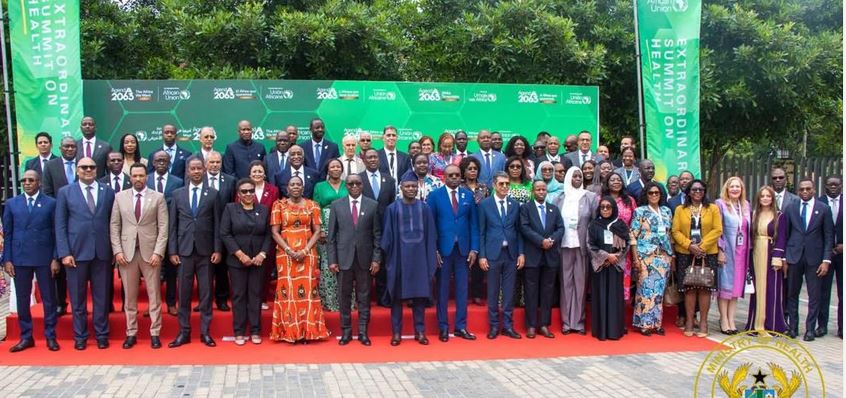
African leaders have been urged to strengthen political commitment and domestic investment to end preventable maternal deaths and AIDS by 2030.
The call comes as African health ministers and policymakers meet in Accra to deliberate on health financing, health security and universal health coverage across the continent.
Mr Edouard Bizimana, Burundi’s Minister of Foreign Affairs, Regional Integration and Development Cooperation, made the call on Tuesday at the opening of the African Union’s (AU) 25th Extraordinary Summit on Health in Accra.
He said Africa needed increased domestic investment to build resilient health systems as it continued to grapple with infectious diseases and the growing burden of non-communicable diseases (NCDs).
Mr Bizimana, who is also Chairperson of the AU Executive Council, said although Africa accounted for nearly 17 per cent of the world’s population, it bore 24 per cent of the global disease burden while having less than three per cent of the global health workforce and only one per cent of global health expenditure.
“Despite maternal mortality declining by nearly 40 per cent since 2000, Africa still accounts for about 70 per cent of maternal deaths globally, while almost two-thirds of people living with HIV reside on the continent,” he said.
Mr Bizimana said the growing burden of NCDs was placing additional pressure on already stretched health systems.
“These figures are not merely statistics. They represent painful human realities, preventable losses and unacceptable inequalities, they remind us that health is not an expense it is a strategic investment and a prerequisite for our sovereignty and development. “he said.
Mr Bizimana said recent global health emergencies had exposed Africa’s vulnerability and underscored the need to expand local production of medicines and vaccines, strengthen the health workforce and improve emergency preparedness.
“Our citizens expect resilient health systems where every mother can give birth safely, every child has access to essential healthcare and every African enjoys quality health services regardless of where they live,” he said.
The two-day summit, being held ahead of the 20th Extraordinary Session of the AU Assembly of Heads of State and Government, has brought together health ministers, policymakers and health stakeholders to identify solutions to Africa’s health financing and security challenges.
Madam Florence Samizi, Tanzania’s Deputy Health Minister, called for stronger collaboration among AU Member States to accelerate progress towards universal health coverage.
The summit is being held on the theme: “Advancing Justice, Equality and Universal Health Coverage: Ending AIDS, Tuberculosis, Improving Maternal Health, Addressing Endemic Non-Communicable and Neglected Tropical Diseases in Africa.”
The meeting is expected to adopt the Accra Declaration, a roadmap to strengthen Africa’s health systems and advance health sovereignty by 2030. -GNA

Senior Lecturer at the University of Ghana’s Department of Political Science, Dr. Joshua Jebuntie Zaato says the imprisonment of the Ashanti Regional Chairman of the New Patriotic Party (NPP), Bernard Antwi Boasiako, popularly known as Chairman Wontumi, will have little meaning unless it leads to a broader crackdown on illegal mining.
In a post on his Facebook page on the July 21, 2026, Dr. Zaato said the judgment should mark the beginning of efforts to completely eradicate galamsey and hold all those involved accountable, regardless of their political affiliation.
He said the country must work towards restoring polluted rivers, protecting forests and ensuring that people implicated in illegal mining activities are prosecuted.
According to him, those the President has publicly acknowledged to be involved in galamsey should face prosecution.
He called for the prosecution of district chief executives (DCEs), members of Parliament (MPs) and senior political party officials who have been accused of engaging in or supporting illegal mining.
Dr. Zaato further urged the government to take decisive action to end the destruction of the country’s forests caused by galamsey.
He maintained that the imprisonment of Chairman Wontumi would only have a lasting impact if it results in a comprehensive and impartial fight against illegal mining across the country.
By: Jacob Aggrey