Hot!
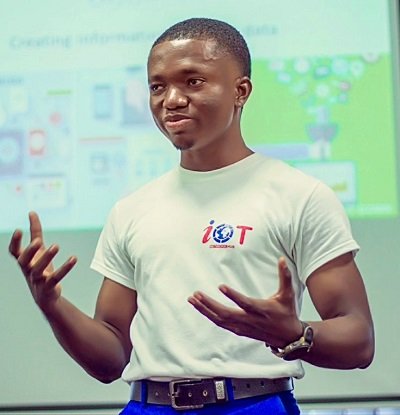
Joshua Opoku Agyemang – inspiring a new generation of tech-savvy youth

- /home/u249204778/domains/spectator.com.gh/public_html/wp-content/plugins/mvp-social-buttons/mvp-social-buttons.php on line 27
https://spectator.com.gh/wp-content/uploads/2022/07/Joshua-Opoku-Agyemang-making-a-presentation.jpg&description=Joshua Opoku Agyemang – inspiring a new generation of tech-savvy youth', 'pinterestShare', 'width=750,height=350'); return false;" title="Pin This Post">
- Share
- Tweet /home/u249204778/domains/spectator.com.gh/public_html/wp-content/plugins/mvp-social-buttons/mvp-social-buttons.php on line 72
https://spectator.com.gh/wp-content/uploads/2022/07/Joshua-Opoku-Agyemang-making-a-presentation.jpg&description=Joshua Opoku Agyemang – inspiring a new generation of tech-savvy youth', 'pinterestShare', 'width=750,height=350'); return false;" title="Pin This Post">
“The fourth industrial revolution would bring a lot of changes where everything would become faster and smarter therefore we need to prepare the younger generation for a future which is yet to be created.”
These are the words of Joshua Opoku Agyemang, a young Ghanaian ‘Techpreneur’ who, together with his team, is helping nurture a new generation of young people to acquire the necessary skills to enable them make valuable contributions in the technology space and beyond.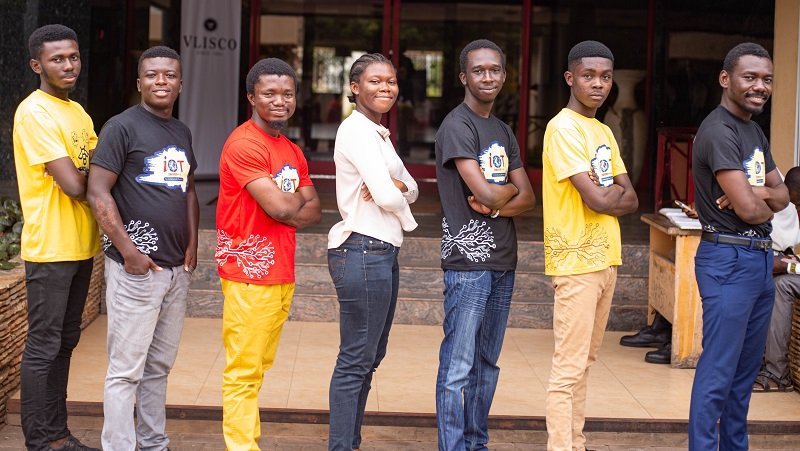
Joshua is the Co-Founder and President of Internet of Things (IoT) Network Hub Africa, a non-governmental organisation with over 20,000 members and chapters in 20 African countries. It comprises innovators, scientists, technologists, engineers, educators, entrepreneurs, college professors, who are helping solve Africa’s “nagging problems” through technology innovations.
The 29-year-old in an interview with The Spectator says the organization, among other things, is focused on making Science, Technology, Engineering and Mathematics (STEM) education “practical and accessible” to every student across the country while helping them tap into opportunities in the fast-expanding sector of emerging technologies.
Emerging technologies relates to subjects such as Robotics, Artificial Intelligence, Virtual Reality, Cryptocurrency, among others. The organisation has for the past six years been developing courses along these areas and continues to impact a number of the youth positively.
Background/Interest
Talking about his personal interest in technology, Joshua, described as a “Tech Progidy or IoT Evangelist,” said he was exposed to computers at a tender age while growing up at Kasapin in the Bono Region.
Born to well-educated parents, he started playing video games and doing other interesting activities with computers before entering Senior High School to study General Science.
“My first experience with computers felt magical so I developed an obsession for computers at the age of seven. My curiosity keep developing and I started doing a lot of things with computers.
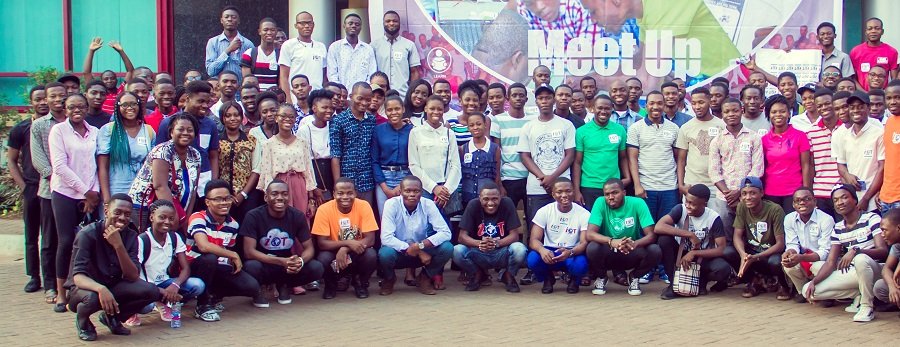
ecosystem in Africa
“I took this same obsession to Mim Senior High School and in my final year, I took a computer to the boarding house and that is how it all started,” he recalled.
He admitted that his passion for computer technology affected his performance in the final examination as he had stopped attending class and rather spent more time with his PC in the dormitory. For this reason, he was unable to make the required grades to enter the university.
Training
In 2012, he relocated to Accra to pursue Diploma in Business Computing (Computer Programming) at the Ghana-Indian Kofi Annan Centre of Excellence in ICT (AITI-KACE) after which he decided to start his own company, Pesonet, to provide solutions and services in software development, computer networking, among others.
Joshua said he was fascinated by the wonderful depiction of science and technology in the movies he watched and wondered if black people could do same. But as time went on, he realised all of that was possible in here in Africa also.
This awareness and the desire to explore the many possibilities of science and technology, he explained, gave birth to the ‘IoT Hub’ so people with similar interests could join.
“After investing in a lot in research and development, we realised IoT was just a tip of the iceberg and we have to delve into how new techonogies that were shaping the world,” he added.
Support
The organisation, since its inception, whips up the interest of the youth in STEM education and continues to gain recognition for its work. In spite of challenges, the Founder said IoT Hub Africa was thriving on a number of partnerships and the voluntary support of members.
“For the past six years, we had to find ways to survive and keep things running. Our human resource has been our greatest asset. One of our biggest partner is STEM AID and Implementers (Ghana) that are helping push STEM education across the country,” he said.
He noted IoT Hub Africa was partnering these organisations which are building sixteen ICT Labs in all regions of the country in addition to training and providing educational content on ICT devices.
“IoT Hub Africa is also in partnership with the Ministry of Communication under the Kofi Annan ICT Centre where we are provided a space to organize our monthly programmes.
“This year we got final support from the Government of Ghana under the U-Start programme to train more young people and create more opportunities for the youth in the technology space,” he added.
Nonetheless, he said the organisation needed more support and resources to deliver on its quest to empower the next generation of tech-savvy young people and help them acquire employable skills.
Achievement
Among other accomplishments, Joshua was named among top 30 entrepreneurs in 2018 at the African Entrepreneurship Award. In 2019 he won the Ghana Open Data Initiative Hackathon.
In 2020, he and his team invented a smart veronica bucket, a 3D printed reusable face mask, an automated ventilator for supplying oxygen to COVID-19 patients.
These works got featured in 50 Innovations from Africa combating COVID-19 by United Nation Development Programme UNPD and in the ‘100 Inventions and ideas’ for COVID-19 in Africa by Forbes Africa in 2021.
Joshua is also the president of the Ghana STEM Network where he is mandated to ensure every student in the country have access to practical ICT education.
Family support
The smart and eloquent fellow said his parents, who had wanted him to become a teacher, now appreciate and understand what he does despite their initial reservations.
He maintains that “the only way to prepare young people for the future is to empower them with 21st century skills so they will be able to survive in any other world,” stressing that “the future is unknown and we need to be ready and prepared for the unknown future.”
By Ernest Nutsugah


General Secretary of the New Patriotic Party (NPP), Justin Kodua Frimpong, has filed his nomination to contest the position of General Secretary again as the party begins its rebuilding efforts ahead of the 2028 general elections.
He was accompanied by party stalwarts and supporters who were in high spirits, expressing confidence that he is the right person to hold the position.
Speaking after filing his nomination, Mr Kodua Frimpong assured the rank and file of the party that he would not disappoint them.
“I can assure you that the faith the rank and file of the party have had in me, I will never disappoint them,” he said.
He also pledged to run a clean campaign devoid of personal attacks.
“I can assure you that our internal campaign will be devoid of personal attacks,” he told his fellow contestants and the rank and file of the party as he seeks to retain his position.
His tenure has seen the party through the 2024 general elections, where the NPP lost power to the National Democratic Congress (NDC) after eight years in government.
The party is currently in a rebuilding phase, with internal elections scheduled to elect new national executives to lead its reorganization towards the 2028 polls.
The General Secretary position is considered one of the most influential in the party’s administrative structure, responsible for the day-to-day running of the party secretariat and implementation of party decisions.
By Edem Mensah-Tsotorme

The University of Ghana Medical Centre (UGMC) has disputed claims made on social media by comedian Michael Blackson concerning the treatment given to his late mother, saying a review found that the allegations did not accurately reflect what happened during her stay at the hospital.
In a statement issued in Accra on August 5, 2026, the management of UGMC expressed condolences to Mr. Blackson and his family over the death of his 83-year-old mother, who died at the facility on July 16, 2026.
The hospital said it had taken the concerns raised by Mr. Blackson seriously and conducted a thorough review in line with its clinical and administrative procedures.
According to the statement, the facts presented by Mr. Blackson on social media contained “numerous inaccuracies” and did not accurately reflect the medical care provided to his mother.
UGMC explained that she was referred to the facility from another hospital and received treatment there from May 27 to July 16, 2026, a period of about eight weeks.
The hospital stated that it would not release details of her diagnosis, treatment, medical records or other aspects of her care because it had a duty to protect patient confidentiality, even after death.
It said the decision was intended to respect the dignity of the deceased and the privacy of her family.
UGMC further stated that all clinical decisions at the facility are made by qualified healthcare professionals based on medical judgment, established standards of care and the best interests of the patient.
The statement added that such decisions are made in consultation with authorised family representatives where necessary and that billing and financial procedures are governed by institutional policies and are separate from clinical decision-making.
The hospital noted that it values feedback from patients and their families and considers both positive and negative comments important for improving the quality of care.
Mr. Blackson had earlier used social media to criticise the care his mother received at UGMC, prompting the hospital’s response.
By: Jacob Aggrey