Hot!
Ayekoo, gallant Black Stars!

- /home/u249204778/domains/spectator.com.gh/public_html/wp-content/plugins/mvp-social-buttons/mvp-social-buttons.php on line 27
https://spectator.com.gh/wp-content/uploads/2022/04/Ayekoo.jpg&description=Ayekoo, gallant Black Stars!', 'pinterestShare', 'width=750,height=350'); return false;" title="Pin This Post">
- Share
- Tweet /home/u249204778/domains/spectator.com.gh/public_html/wp-content/plugins/mvp-social-buttons/mvp-social-buttons.php on line 72
https://spectator.com.gh/wp-content/uploads/2022/04/Ayekoo.jpg&description=Ayekoo, gallant Black Stars!', 'pinterestShare', 'width=750,height=350'); return false;" title="Pin This Post">
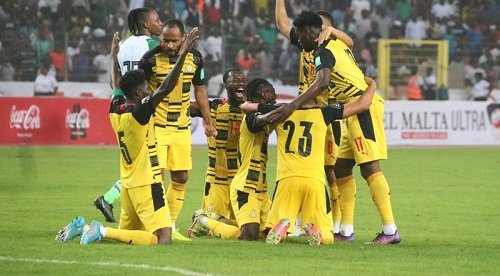
Pockets of Ghanaians across the country were on Tuesday night thrown into delirium when the Black Stars booked their ticket to the Qatar 2022 World Cup tournament.
You know what; the Thomas Partey-led side upstaged no less an opposition than sworn rivals Nigeria’s Super Eagles – who had vowed to flush the Ghanaians out of their way for a seventh World Cup berth.
Indeed, 24 hours ahead of the gut-wrenching tie, the government had announced that public servants in the Nigerian capital of Abuja be given a half-day, whilst free transport arranged from the suburbs to ensure a capacity 60,000 crowd to cheer on the Super Eagles at the Moshood Abiola Stadium.
The directive was obeyed to the letter, and the stadium was filled to the rafters by an intimidating crowd who disrespectfully decided to jeer at Ghana’s national anthem.
Clearly, the Nigerian fans’ behaviour may have infuriated the enterprising new-look young Ghanaians whose stand-in skipper Partey stunned the packed stadium into petrified silence with an 11th-minute right-footed thunderbolt that tore under goalkeeper Francis Uzoho for the opening goal. At that point, even the drop of a pin could be heard by the dumb. Absolute silence!
However, Captain William Troost-Ekong dispatched from the penalty spot after 22 minutes, following a VAR check on Denis Odoi’s challenge on Ademola Lookman. But the Super Eagles failed to score again to keep the game at 1-1 heading into the break.
The second stanza saw a couple of tactical changes by Ghana coach Otto Addo as Jordan Ayew took an early rest. The three changes saw the team switch from 4-3-3 to 3-5-2. This gave them greater midfield control, able to protect their defence and move the ball forward with something approximating to aggression.
As a matter of fact, the team became more stable, resolute, composed, relaxed and impenetrable under pressure from their West African rivals – who had thrown everything at the Stars.
Indeed, Ghana could have killed off the game even before the Tunisian referee’s final signal, had substitute Osman Bukari taken a begging chance from a fierce counter in the dying moments of the eventful half. But never mind, the away goal rule had guaranteed a place for the visitors.
Sadly, the final whistle triggered ugly scenes from the livid home crowd who did not believe what they were seeing. The incident left the image of African football badly bruised.
As a matter of fact, Nigerian security forces had to fire tear gas to disperse the angry fans who stormed the pitch, obviously in reaction to Nigeria’s failure to qualify for Qatar.
The fans plunged into a demolition mission – smashed benches and anything in sight, while others chanted “Pinnick must go! Pinnick must go!!,” referring to the president of the Nigeria Football Federation (NFF), Amaju Pinnick.
Black Stars players and Ghanaian journalists had no choice but to take an Usain Bolt-like sprint into the tunnel and straight into their dressing room for safety, cutting short their celebrations.
Similar scenes happened in 1973 during the West Germany ’74 World Cup qualifier when Ghana beat Nigeria 3-2 in Lagos with Stars’ Kwesi Owusu banging home a hat-trick.
The man who engineered Ghana’s famous qualification, Otto Addo – and his technical team, deserves lots of plaudits for fashioning out a system that caged all Nigerian forwards including the dangerous Victor Osimhen. Addo has been around for barely a month but shown great derring-do in team building. Of course, coaches CK Akunnor and Serbian Milovan Rajevac were all part of the qualification process and cannot be forgotten to carving a return to the World Cup, after missing out on the Russia edition in 2018.
The likes of goalkeeper Jojo Wollacott (put up a magical performance in both Kumasi and Abuja), Issahaku Fatau, Mohammed Kudus, Baba Iddrisu, Denis Odoi, Daniel Amartey, Alexander Kwabena Baidoo Djiku, Jordan and big brother captain Andre Ayew among others, have all contributed massively to the success story.
After that dismal showing at the Cup of Nations in January, with the embarrassing loss to minnows Comoros condemning them to a humiliating first-round exit, Tuesday’s Qatar qualification in Abuja, should give Ghanaians something to cheer home about.
PlainTalk with John Vigah
This present team is showing more desire and passion than what we saw at the Cameroon Nations Cup.
Whilst we congratulate the entire team and the President of the Ghana Football Association (GFA), Kurt Okraku, for a good work done, let us begin to sit and plan for what lies ahead of us in Qatar.
Black Stars, Ayekoo!


General Secretary of the New Patriotic Party (NPP), Justin Kodua Frimpong, has filed his nomination to contest the position of General Secretary again as the party begins its rebuilding efforts ahead of the 2028 general elections.
He was accompanied by party stalwarts and supporters who were in high spirits, expressing confidence that he is the right person to hold the position.
Speaking after filing his nomination, Mr Kodua Frimpong assured the rank and file of the party that he would not disappoint them.
“I can assure you that the faith the rank and file of the party have had in me, I will never disappoint them,” he said.
He also pledged to run a clean campaign devoid of personal attacks.
“I can assure you that our internal campaign will be devoid of personal attacks,” he told his fellow contestants and the rank and file of the party as he seeks to retain his position.
His tenure has seen the party through the 2024 general elections, where the NPP lost power to the National Democratic Congress (NDC) after eight years in government.
The party is currently in a rebuilding phase, with internal elections scheduled to elect new national executives to lead its reorganization towards the 2028 polls.
The General Secretary position is considered one of the most influential in the party’s administrative structure, responsible for the day-to-day running of the party secretariat and implementation of party decisions.
By Edem Mensah-Tsotorme

The University of Ghana Medical Centre (UGMC) has disputed claims made on social media by comedian Michael Blackson concerning the treatment given to his late mother, saying a review found that the allegations did not accurately reflect what happened during her stay at the hospital.
In a statement issued in Accra on August 5, 2026, the management of UGMC expressed condolences to Mr. Blackson and his family over the death of his 83-year-old mother, who died at the facility on July 16, 2026.
The hospital said it had taken the concerns raised by Mr. Blackson seriously and conducted a thorough review in line with its clinical and administrative procedures.
According to the statement, the facts presented by Mr. Blackson on social media contained “numerous inaccuracies” and did not accurately reflect the medical care provided to his mother.
UGMC explained that she was referred to the facility from another hospital and received treatment there from May 27 to July 16, 2026, a period of about eight weeks.
The hospital stated that it would not release details of her diagnosis, treatment, medical records or other aspects of her care because it had a duty to protect patient confidentiality, even after death.
It said the decision was intended to respect the dignity of the deceased and the privacy of her family.
UGMC further stated that all clinical decisions at the facility are made by qualified healthcare professionals based on medical judgment, established standards of care and the best interests of the patient.
The statement added that such decisions are made in consultation with authorised family representatives where necessary and that billing and financial procedures are governed by institutional policies and are separate from clinical decision-making.
The hospital noted that it values feedback from patients and their families and considers both positive and negative comments important for improving the quality of care.
Mr. Blackson had earlier used social media to criticise the care his mother received at UGMC, prompting the hospital’s response.
By: Jacob Aggrey