News
Transatlantic slave trade is the greatest crime against humanity- President Mahama tells UN

- /home/u249204778/domains/spectator.com.gh/public_html/wp-content/plugins/mvp-social-buttons/mvp-social-buttons.php on line 27
https://spectator.com.gh/wp-content/uploads/2025/09/WhatsApp-Image-2025-09-26-at-11.04.38-1000x600.jpeg&description=Transatlantic slave trade is the greatest crime against humanity- President Mahama tells UN', 'pinterestShare', 'width=750,height=350'); return false;" title="Pin This Post">
- Share
- Tweet /home/u249204778/domains/spectator.com.gh/public_html/wp-content/plugins/mvp-social-buttons/mvp-social-buttons.php on line 72
https://spectator.com.gh/wp-content/uploads/2025/09/WhatsApp-Image-2025-09-26-at-11.04.38-1000x600.jpeg&description=Transatlantic slave trade is the greatest crime against humanity- President Mahama tells UN', 'pinterestShare', 'width=750,height=350'); return false;" title="Pin This Post">
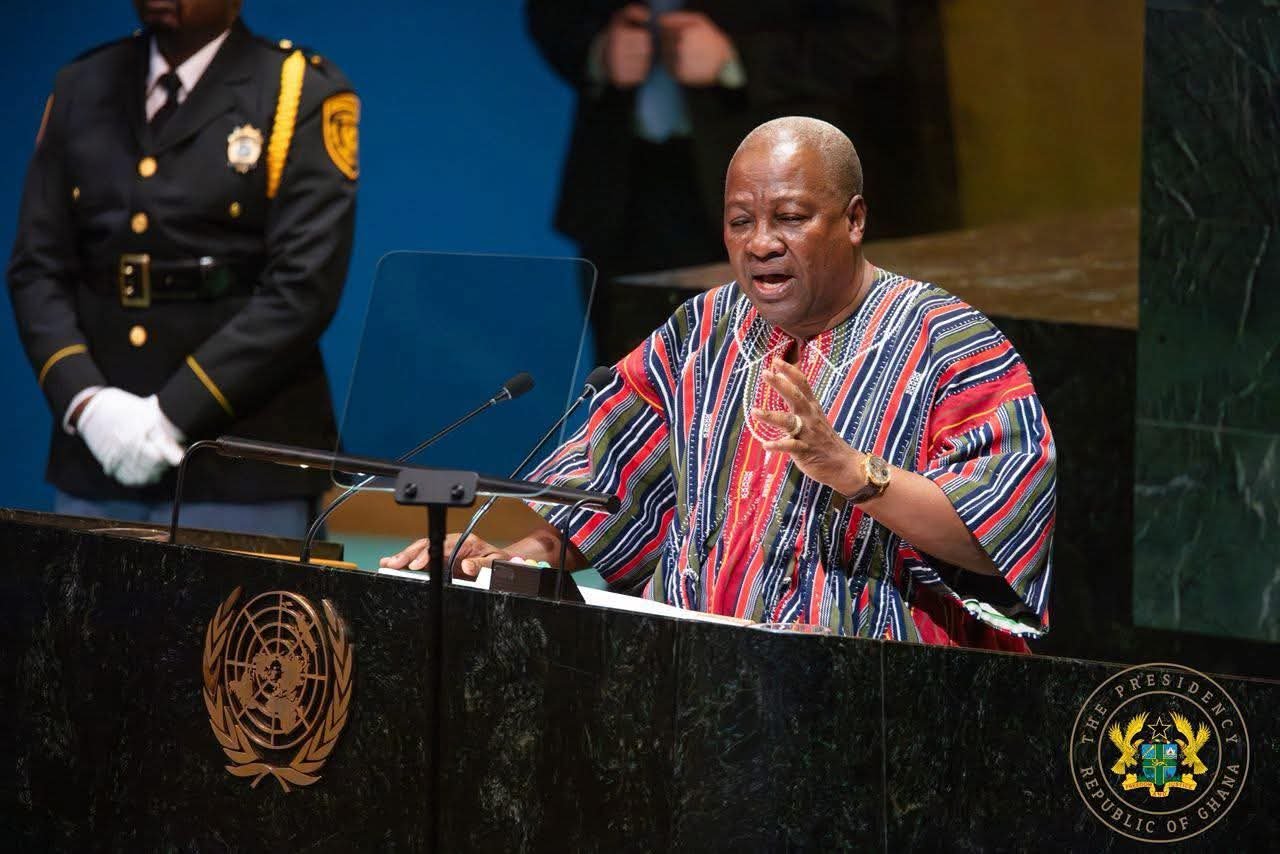
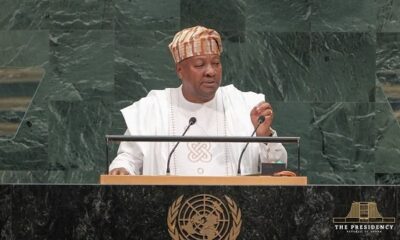
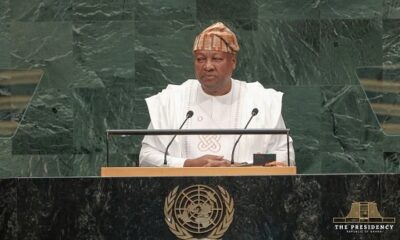
The President of the Republic of Ghana, John Dramani Mahama, has expressed dissatisfaction with the transatlantic slave trade, describing it as the greatest crime against humanity.
Addressing the 80th session of the United Nations General Assembly, the President recalled that millions of Africans were forcibly taken from their homelands to create wealth for powerful nations.
He observed that while former slave owners received compensation for what was described as property, enslaved Africans and their descendants were denied justice for centuries.
He announced that Ghana, in its role as Africa’s champion on reparations, will table a motion before the Assembly to demand reparations for slavery, colonization, the exploitation of natural resources and the looting of cultural heritage.
He stressed the need for the full return of African artifacts taken abroad.
Turning to contemporary conflicts, President Mahama condemned the humanitarian crisis in Gaza, describing the situation as a crime that cannot continue.
He reminded the Assembly that Ghana recognized the State of Palestine in 1988 and has consistently supported a two-state solution.
He explained that such an arrangement is not a reward for Hamas but a relief for innocent Palestinian women, children, and civilians enduring collective punishment.
The President also drew attention to the war in Sudan, which the UN has described as the world’s largest humanitarian crisis.
He noted that 12 million people had been displaced and urged the international community to extend to Sudanese refugees the same level of support offered to those fleeing Ukraine.
President Mahama expressed concern about the decline in global humanitarian aid, estimating a 40 percent drop since July 2024.
He argued that Africa must take control of its natural resources, secure fairer deals with foreign investors and promote value addition on the continent.
He stressed that Africans were tired of being portrayed as poor and marginalized despite the continent’s immense wealth.
On global governance, the President pressed for urgent reform of the United Nations, describing its founding charter as outdated.
He questioned a system that allows a few powerful nations to exercise near total control while the principle of sovereign equality is enshrined in the Charter.
He recommended that veto power should not be absolute and urged that the Assembly be granted authority to challenge it.
Looking to the future, President Mahama underlined Africa’s growing role in global affairs.
He pointed out that by 2050, more than a quarter of the world’s population will be African, with one third of all young people aged 15 to 24 living on the continent.
“The future is African,” he declared to the Assembly.
By: Jacob Aggrey






The Parliamentary Select Committee on Energy has appealed to the Ministry of Finance to release GH¢5.6 million to the Petroleum Commission to enable it to establish and operate a world-class data centre.
According to the Committee, access to the funds will strengthen the Commission’s capacity to manage critical upstream petroleum data and improve its operations.
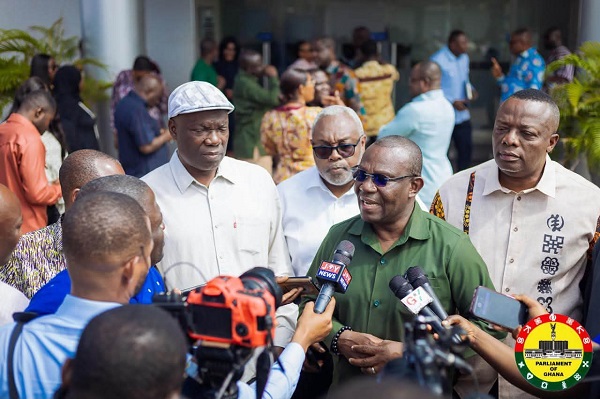
Speaking during the appeal, Chairman of the Committee, Emmanuel Kwasi Bedzrah, said the move was crucial to efforts to revitalise Ghana’s upstream petroleum industry and increase oil production.
He noted that although investment and hydrocarbon production had declined in recent years, Parliament’s approval of an extension of the petroleum agreement to 2030 had attracted additional funding and contributed to an increase in production from about 80,000 to 120,000 barrels per day.
Meanwhile, concerns have been raised over repeated budget allocations for oil exploration in the Voltaian Basin.
Mr. Bedzrah stressed that funds approved for exploration must produce tangible results, adding that the Committee would require clear evidence of progress before supporting future budget allocations for the programme.
The appeal was made during a working visit to the Petroleum Commission as part of the Committee’s oversight activities to assess its operations and management procedures.
During the engagement, the Chief Executive Officer of the Petroleum Commission, Emeafa Hardcastle, took the Committee through the Commission’s working procedures and mandate, which includes regulating, managing and coordinating upstream petroleum activities.
She disclosed that since assuming office in 2025, government had pursued measures to reverse the decline in crude oil production, sustain output and reposition Ghana as an attractive destination for investment in Africa’s increasingly competitive petroleum sector.
In addition, she said government had secured fresh commitments of about US$35 billion to help revitalise the sector.
As part of the oversight exercise, the Committee is expected to conclude its monitoring visit with engagements at the National Petroleum Authority (NPA) and the Ghana Oil Company Limited (GOIL).
By Edem Mensah-Tsotorme
News
“No civilisation deserves to be annihilated” – Mahama calls for dialogue on global conflicts at UNGA 81
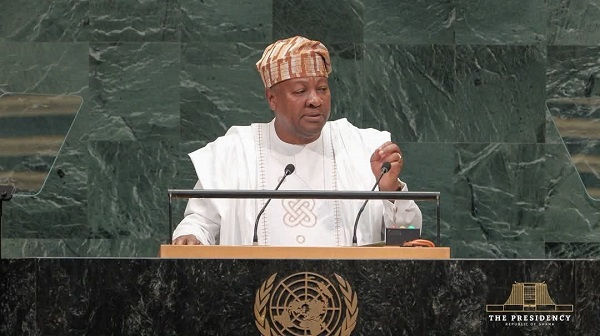
President John Dramani Mahama has called for solidarity and dialogue in resolving global conflicts, insisting that no civilisation deserves to be wiped out.
“No human civilisation deserves to be annihilated, certainly not a member state of the United Nations,” President Mahama stated in his address at the 81st United Nations General Assembly in New York.
He called for solidarity with nations facing terrorism, especially the Alliance of Sahel States (AES), and for a uniform approach to conflicts in Europe, the Middle East and Africa.
On the Middle East, the President called for a return to negotiations, saying “The current Middle East crisis is having a deleterious effect on the world economy.”
“I believe that dialogue can resolve even the most intractable of problems,” he added.
By Edem Mensah-Tsotorme